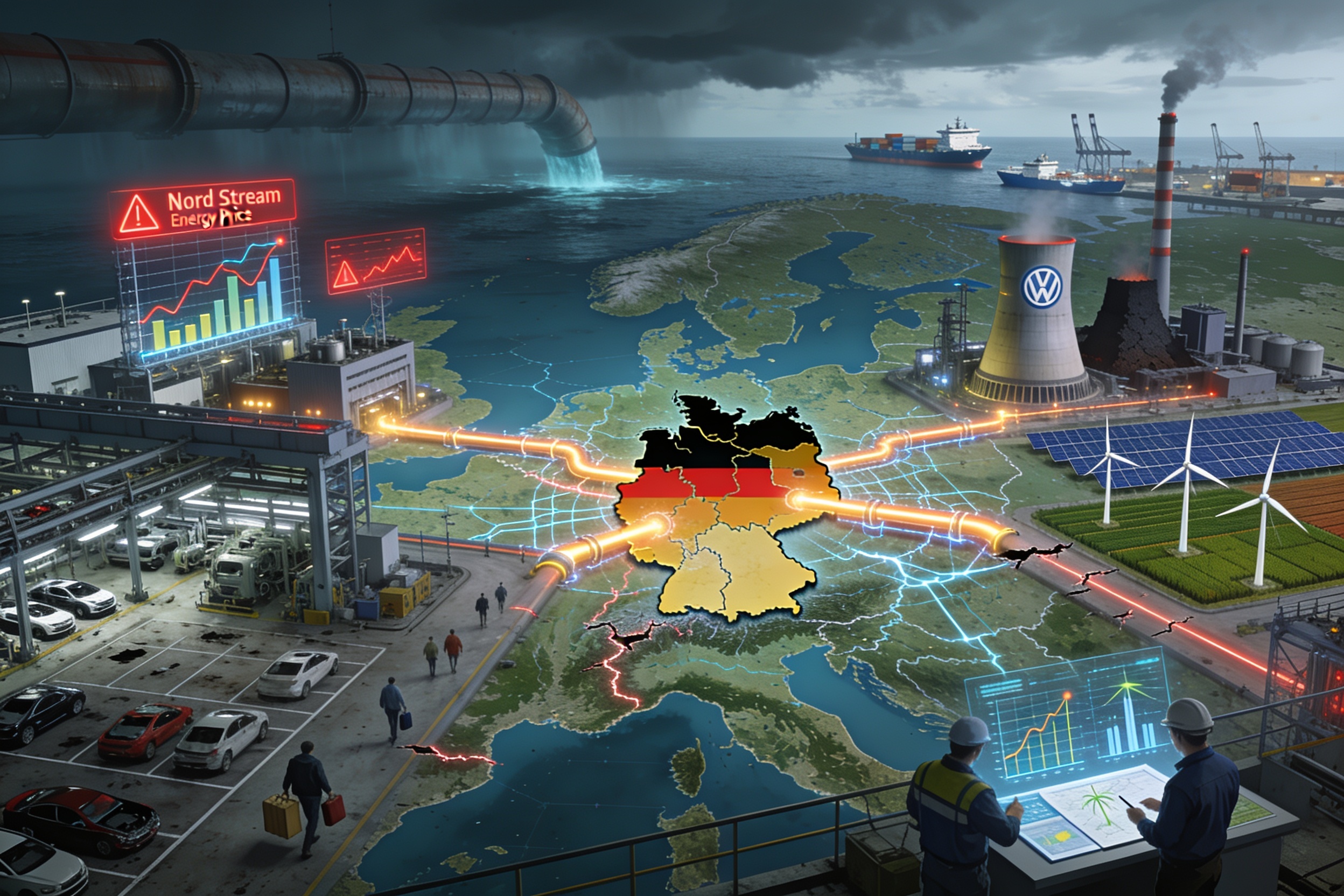
From Energy Sufficiency to Strategic Dependency
Germany’s path to its current industrial crisis begins not in 2022, but in the early 2000s, a period when the country made fateful policy decisions that would ultimately unravel its economic foundations.
In the early 2000s, Germany was a nation with genuine energy options. Nuclear power generated over 30% of the country’s electricity, providing reliable, carbon-free baseload power. Renewable energy deployment was expanding through the innovative Renewable Energy Sources Act (EEG) of 2000, which created a de-risking mechanism for investments in wind and solar, leading to an eight-fold increase in renewables’ share of the power mix over 24 years. The country had the industrial strength to chart an independent energy future.
But two interlocking political decisions would systematically dismantle this energy sovereignty.
Decision One: The Nuclear Phase-Out
In June 2000, Chancellor Gerhard Schröder’s Red-Green coalition signed a nuclear phase-out agreement with German utilities. The political motivation was not climate change it was the anti-nuclear position of the Green Party, the junior coalition partner. The policy was designed to protect domestic lignite coal interests, preserving jobs and reducing energy imports as Germany moved away from nuclear power.
This created a fundamental contradiction: nuclear power, which accounted for approximately 60% of Germany’s baseload capacity, was to be dismantled, while the most carbon-intensive fossil fuels lignite and hard coal received subsidies to maintain employment and energy security.
Decision Two: The Embrace of Russian Gas
Simultaneously, the Schröder government forged a strategic energy partnership with Russia that would become the structural foundation of Germany’s vulnerability. The *Wandel durch Handel* (“change through trade”) doctrine assumed that economic interdependence would create mutual benefits and stable relations, that commerce would transcend geopolitical tensions.
In October 2005, just weeks before leaving office, Schröder signed the agreement to build the Nord Stream pipeline under the Baltic Sea, bypassing Poland and Ukraine, eliminating transit fees for Russia, and securing direct Russian gas deliveries to Germany. The German government guaranteed €1 billion of the project cost should Gazprom default.
The result: by 2021, over 50% of Germany’s total gas consumption came from Russia.
The Nuclear Reversal That Sealed the Trap
The 2011 Fukushima disaster triggered a panicked policy reversal. Chancellor Angela Merkel, fearing political fallout, ordered the immediate decommissioning of all German nuclear plants by 2022while maintaining Germany’s ambitious emissions reduction targets.
With nuclear power eliminated, the aggressive decarbonization goals now had to be achieved through even more rapid renewable energy deployment. But solar and wind are intermittent sources. As the share of renewables grew, Germany became increasingly dependent on backup power, overwhelmingly from fossil fuels. The intermittency problem created a structural need for reliable baseload power that renewables alone could not provide.
Russia’s gas filled that gap. By design, Germany had become captive to Russian energy flows.
The Energy Crisis Materializes
When Russia invaded Ukraine in February 2022, the German political establishment faced a choice. Rather than maintaining the commercial relationship that had underpinned German industry for decades, Berlin chose to join Western sanctions against Moscow, including the progressive halt of Russian gas imports through Nord Stream 1. Nord Stream 2, completed in September 2021, was never allowed to become operational, a unilateral German decision that cut off the very supply lines the country had spent two decades building.
The result was a self-inflicted energy shock. As analysts have noted, Germany’s rapid deindustrialization was “sparked by the boomeranged effects of anti-Russian sanctions, which, instead of collapsing the Russian economy… brought German industry to a standstill as energy prices skyrocketed.” The sanctions did not cripple Russia, which redirected its energy exports to Asia; they crippled Germany, which had no alternative supply infrastructure in place.
Germany’s elite had been warned not about Russian untrustworthiness, but about the structural fragility of their own dependency. As early as 2004, the German Institute for International and Security Affairs published a paper questioning the wisdom of deepening reliance on Russian gas. Central European nations Poland, the Baltic States warned repeatedly that the Nord Stream project bypassed European solidarity and created structural vulnerability. The warnings were not about Russian intentions but about German exposure: a nation that places its industrial lifeline in a single foreign supplier, regardless of that supplier’s character, surrenders its sovereignty to forces beyond its control.
The Industrial Collapse
Volkswagen’s announcement of potential plant closures and the elimination of 35,000 jobs by 2030 represents the deindustrialization tipping point. As VW works council head Daniela Cavallo stated, “De-industrialisation is happening in Germany.”
The numbers tell a devastating story:
- Manufacturing employment has already fallen from 32% of total employment 20 years ago to 27% today.
- In the auto industry, approximately 140,000 jobs are expected to disappear over the next decade.
- Steel giant ThyssenKrupp will lay off up to 40% of its workforce (11,000 employees).
- Auto parts manufacturers ZF Friedrichshafen (14,000 layoffs) and Continental are hemorrhaging jobs.
A Case Study in Lost Sovereignty
The sovereigntist framework explains why this crisis was avoidable. Germany in the early 2000s possessed the industrial strength, nuclear capacity, and economic flexibility to maintain genuine energy sovereignty. The decisions made between 2000 and 2011 systematically dismantled that sovereignty through a combination of:
Ideological policy-making: The nuclear phase-out was driven by Green Party ideology, not energy security or climate science. As one analysis notes, “to simultaneously obliterate Germany’s nuclear sector and to cut off energy ties with Russia wasn’t simply foolish, it was self-sabotage of the highest and most unforgivable order.”
Geopolitical miscalculation: The assumption that Russia would remain a reliable partner regardless of geopolitical shifts proved catastrophically naive. But the decisive failure was Germany’s own choice to sever the relationship a decision made without securing alternative energy sources, without building the necessary LNG infrastructure, and without considering the industrial consequences. As Putin himself observed in 2025, Russia could “hasten its exit from the European market, therefore leaving the Europeans without access to energy when they need it most” not as a threat, but as a description of the commercial reality Germany had created. When Europe imposed sanctions, Russia simply redirected its gas to Asian markets, leaving Germany to bear the full cost of the rupture.
Ceded monetary sovereignty: The Euro limits Germany’s ability to use monetary policy to cushion the industrial shock. A sovereign nation could devalue its currency to maintain export competitiveness or issue debt to finance energy independence. Germany cannot take these steps without EU consensus.
Germany’s Volkswagen crisis is the product of a lost generation of energy policy a series of choices that prioritized ideological commitments and short-term corporate interests over strategic sovereignty. The consequences are now visible: a nation once known for industrial excellence facing deindustrialization, job losses, and geopolitical irrelevance.
The lesson is not that Russia is an untrustworthy partner. The lesson is that dependence itself is the vulnerability. Whether the supplier is Russia, China, the United States, or any other nation, a country that places its industrial lifeline in foreign hands has surrendered its sovereignty. The decision to boycott Russian energy made without alternatives, without infrastructure, without industrial transition plans was not an act of moral courage but an act of strategic suicide.
Germany was energy-sufficient in 2000. It had nuclear power, coal, and the beginning of a renewable transition. Two decades of policy choices the nuclear phase-out, the embrace of Russian gas, the failure to diversify created a house of cards. The sanctions policy merely blew it down.
The lesson for the broader world is unambiguous: countries that delegate control over energy, monetary policy, and trade strategy to external actors will find their industrial base held hostage when geopolitical winds shift. Sovereignty is not a nostalgic luxury; it is the foundation upon which industrial survival depends.