From melting ice to the dispute over supply chains, the Arctic is moving from being a remote frontier to becoming one of the decisive geostrategic spaces of the 21st century
For decades, the Arctic was treated as a geographical periphery: a frozen ocean, hostile and distant from the great centers of power. That perception is disappearing.
Climate change is changing the physical conditions of navigation, but behind the environmental phenomenon there is a much deeper transformation: the Arctic is beginning to become a new strategic infrastructure of the world system.
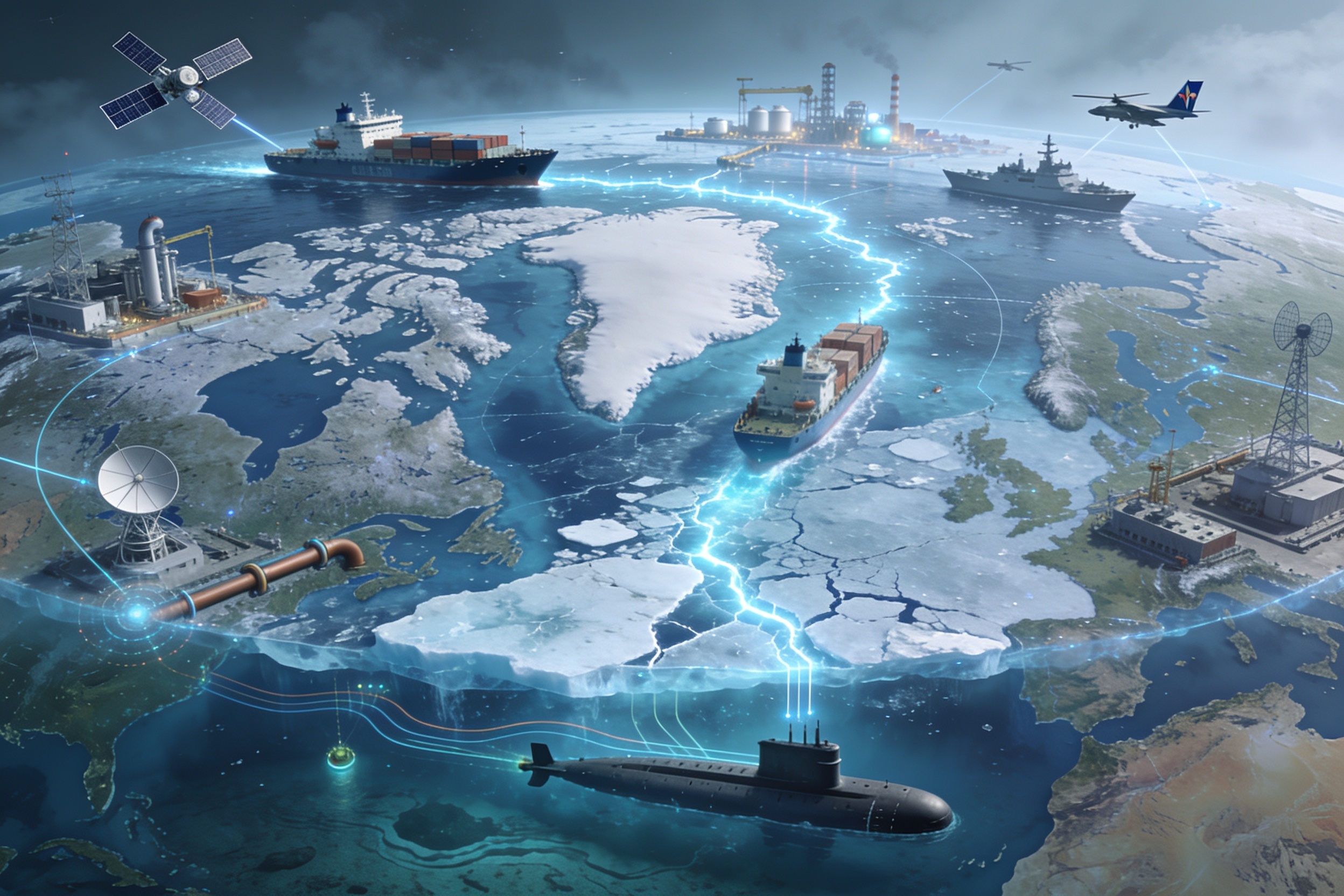
The seasonal opening of new maritime routes, access to natural resources, the expansion of military capabilities and competition for ports, infrastructure, submarine cables and energy corridors are turning the far north into a new arena of competition between great powers.
And there is a central issue: whoever controls the Arctic’s routes, logistics nodes, and critical infrastructure will not control just one sea lane; they will have the ability to influence global supply chains.
A new map for global trade
The so-called Northern Sea Route, which connects the North Atlantic to the Pacific via the Russian Arctic coastline, represents the main transformation project for northern shipping.
Its appeal is evident.
For certain routes between Asia and Europe, the route can significantly reduce the distances compared to the traditional corridors that cross the Suez Canal.
But reducing kilometers does not automatically mean replacing existing routes.
The Arctic presents formidable obstacles: extreme weather, limited infrastructure, the need for icebreakers, seasonal navigation windows, search and rescue difficulties, and high insurance costs.
Therefore, the true strategic value of the Arctic Route should not be measured only in tons transported.
It must be measured in strategic options.
An alternative route can become hugely important even before it becomes the main trade route on the planet.
Moscow sees the Arctic as a strategic highway
For Russia, the Arctic is not a future opportunity.
It is a question of geopolitical survival.
Its huge northern coastline makes the country the dominant territorial power in Arctic space. Moscow has developed port infrastructure, icebreaker capabilities, military installations and energy projects aimed at consolidating its presence.
The aim is to progressively transform the Northern Sea Route into a permanent logistics corridor.
Here a fundamental dimension appears.
Russia does not just intend to transport goods. It intends to turn its geographical position into a strategic power.
The development of the route can generate revenue, facilitate the export of hydrocarbons and minerals and, at the same time, increase Russian autonomy vis-à-vis maritime routes directly or indirectly dominated by the West.
In a context of sanctions, economic fragmentation and competition between blocs, this autonomy acquires extraordinary value.
China does not need to be an Arctic power to be an Arctic power
The entry of China completely modifies the chessboard.
Beijing has defined the Arctic as a space of growing economic and strategic importance and has sought to participate through investments, energy projects, scientific research, infrastructure and cooperation with Russia.
The Chinese logic is particularly interesting. China does not need to territorially control the Northern Sea Route. It is enough for you to have reliable access to it.
This is part of a broader strategy to diversify supply routes.
China is heavily dependent on maritime trade and corridors vulnerable to geopolitical shocks. The Strait of Malacca, the Red Sea, the Gulf of Aden and the Suez Canal are hotspots.
A northern alternative would not replace those routes, but could become an additional piece of the system.
And in geopolitics, having alternatives is equivalent to having room for manoeuvre.
The Arctic as insurance against “Chokepoints”
Over the past few decades, the world economy has built a gigantic dependency on certain maritime choke points.
- Malacca
- Hormuz
- Bab el-Mandeb.
- Suez
- Panama
All of them can be affected by wars, blockades, accidents, regional conflicts, sanctions or tensions between great powers.
The Arctic Route introduces a different possibility. It does not eliminate traditional chokepoints. It multiplies them. And that difference is fundamental.
A global system with five major strategic corridors is more vulnerable than one with ten.
For this reason, the Arctic Route can become an instrument of resilience for Eurasian supply chains.
Supply chains enter the era of redundancy
The globalization of the twentieth century was built on a premise: maximum efficiency.
The system sought to produce where it was cheapest and transport using the most efficient routes.
The geopolitics of the twenty-first century is introducing a new priority: redundancy.
Companies and states are beginning to ask themselves not only how much it costs to transport a product, but also what happens if the route is blocked.
The pandemic, the war in Ukraine, the Red Sea crisis, and trade tensions between the United States and China have shown that over-optimized supply chains can quickly transform into vulnerable chains.
The Arctic then appears as a potential piece of a new architecture:
Asia–Arctic–Europe.
Not necessarily as a substitute for Suez, but as a complementary corridor.
The Anglo-American Reaction: The Arctic Is No Longer a Periphery
Russian expansion and the growing Chinese presence could not remain unanswered.
The United States, Canada, the United Kingdom, and the Nordic countries are placing increasing importance on the Arctic.
The issue is not exclusively commercial. It is military.
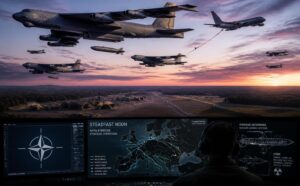
The Arctic connects the North Atlantic with the North Pacific and is a prime space for submarines, strategic aviation, sensors, satellites and early warning systems.
In addition, the thaw modifies the operating conditions for naval forces.
The accession of Finland and Sweden to NATO further altered the regional balance.
Northern Europe has acquired a strategic continuity that goes from the North Atlantic to the Arctic and the far north of Europe.
The Western message is clear: the Arctic will not be considered Russia’s exclusive zone of influence.
The submarine is once again king of the Arctic
There is a less visible dimension to this competition. Under the ice.
The Arctic is of enormous importance for strategic submarine warfare.
Submarines can use certain areas of the Arctic Ocean as hard-to-detect patrol spaces. For Russia, this is particularly important in relation to its strategic nuclear component.
For the United States and its allies, controlling access between the North Atlantic, Greenland, Iceland, the Norwegian Sea and the Arctic is essential.
For this reason, Arctic competition is not limited to ports and merchant ships.
Includes:
- submarines,
- sensors,
- satellites,
- drones,
- long-range aviation,
- electronic warfare and
- seabed surveillance.
The Arctic is thus becoming a gigantic sensor space.
Greenland: the territory that returned to the center of the chessboard
Few territories better illustrate the emerging strategic importance of the Arctic than Greenland.
Its geographical position makes the island a fundamental point for controlling the connections between North America, the North Atlantic and the Arctic. But its importance does not end there.
Greenland possesses potentially strategic mineral resources, while its position may become more important as northern shipping increases.
That’s why the Arctic is beginning to combine three dimensions:
Geography + resources + infrastructure.
A historically explosive combination.
And what will the multipolar world do?
This is probably the most interesting part of the problem.
Arctic competition will not necessarily be exclusively bipolar.
India, China, the Gulf countries, Japan, South Korea and other Asian economies have incentives to participate in the construction of new logistics chains.
China already has a significant advantage in terms of its financial and industrial capacity.
India, for its part, has an interest in diversifying its trade and energy routes.
Developed Asian economies will seek to reduce logistical risks.
And the countries of the Global South face an even deeper question: who will control the new routes of multipolar globalization?
Because the problem is not only about accessing the Arctic.
It consists of preventing the new system from reproducing the same strategic dependencies as the previous one.
The Global South Can’t Look at the Arctic from a Distance
To Latin America, the Arctic may seem geographically remote.
But geoeconomically it is much closer than it seems.
If an increasing share of Eurasian trade starts using northern routes, transport flows, relative prices, marine insurance, port demand and infrastructure investment may change.
And here a paradox appears.
While the great powers compete for the north of the planet, the Global South holds some of the most important strategic positions in the southern hemisphere.
- Panama Canal.
- Strait of Magellan.
- Cape Horn.
- South Atlantic.
- South Pacific.
- Routes to Antarctica.
The emergence of an Arctic route can increase, not necessarily diminish, the strategic value of southern routes.
Chile: the Arctic also changes our map
For Chile, the issue deserves a particularly careful reading.
The country has an extraordinary position in front of the South Pacific and maintains a privileged geographical relationship with Antarctica.
If the global system evolves towards an architecture of multiple strategic corridors, Chile may cease to be just a country located in the extreme west of South America to become a potential node of the logistics system of the southern hemisphere.
But that requires anticipation.
The emergence of alternative corridors in the north may force Chile to rethink the strategic value of its ports, its bioceanic connections, its naval capabilities, its digital infrastructures and its relationship with Antarctica.
Arctic competition may end up reinforcing the geopolitical importance of the extreme south or it may lead to irrelevance with respect to the northern hemisphere and its power struggle.
From the Arctic to the Antarctic: competition is shifting to extremes
There is a trend that deserves attention.
The international system is beginning to pay greater attention simultaneously to both poles.
In the north:
Russia – United States – Canada – NATO – China.
In the south:
Antarctica – Southern Ocean – South Pacific routes – South Atlantic – resources and polar science.
It does not mean that both spaces will experience identical militarization.
But the extremes of the planet are acquiring a strategic relevance that previously seemed unlikely.
The twenty-first century could become, in part, the century of the poles.
The real battle will be over infrastructure
The traditional image of geopolitics shows warships and military bases.
But Arctic competition will be much more sophisticated.
The real power will also be in:
- deep-water ports;
- icebreakers;
- satellites;
- submarine cables;
- navigation systems;
- radars;
- data centers;
- energy infrastructure;
- marine insurance;
- logistical capacity;
- meteorological intelligence;
- resilient communications.
Whoever controls this infrastructure will have the capacity to condition traffic.
The new geopolitical power will be less visible and much more systemic.
A new cold war on ice?
Probably not exactly. The reality will be more complex.
Russia and China may cooperate in certain areas, but they also have interests of their own.
The United States and its allies will seek to contain Russian-Chinese strategic expansion, but they need to keep certain economic channels open.
Asian countries will want access to new routes without getting caught up in the rivalry between Washington and Beijing.
And the Global South will try to take advantage of the competition without becoming the scene of confrontation between great powers again.
That is why, rather than a new Cold War, armed and multipolar geo-economic competition could emerge.
The Arctic as a seismograph of the new world order
The real importance of the Arctic is not only in how much trade it will be able to carry in ten or twenty years’ time.
It is in what it reveals about the transformation of the international system.
The world is moving from a globalization based on efficiency to one based on resilience, redundancy and strategic autonomy:
- Trade routes are no longer just trade routes: they are geopolitical assets.
- Ports are no longer just economic infrastructure: They are strategic nodes.
- Submarine cables are no longer just telecommunications: They are critical infrastructure.
- And the poles are no longer empty spaces: they are borders of power.
Conclusion: the north opens up and the world changes
The Arctic Route will not replace the Suez Canal tomorrow. Nor will it automatically make Russia or China the masters of world trade.
But it would be a strategic mistake to measure its importance solely by the current volume of goods.
Its real value lies in the possibility of creating a new architecture of strategic mobility between Asia and Europe, reducing certain vulnerabilities and opening up additional space for competition between great powers.
For the West, it means defending a space that for decades seemed secondary.
For Russia, it means turning its geography into power.
For China, it means adding a new alternative to its trade architecture.
For Asian powerhouses, it means diversifying risks.
And for the Global South, it raises a question that can no longer be ignored:
Will it be able to participate in the construction of the new world logistics map or will it simply have to adapt to the routes designed by others?
The Arctic is thawing. And so is the status quo. It is the new map of power that begins to emerge on top of him.