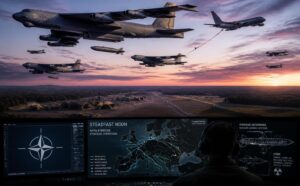
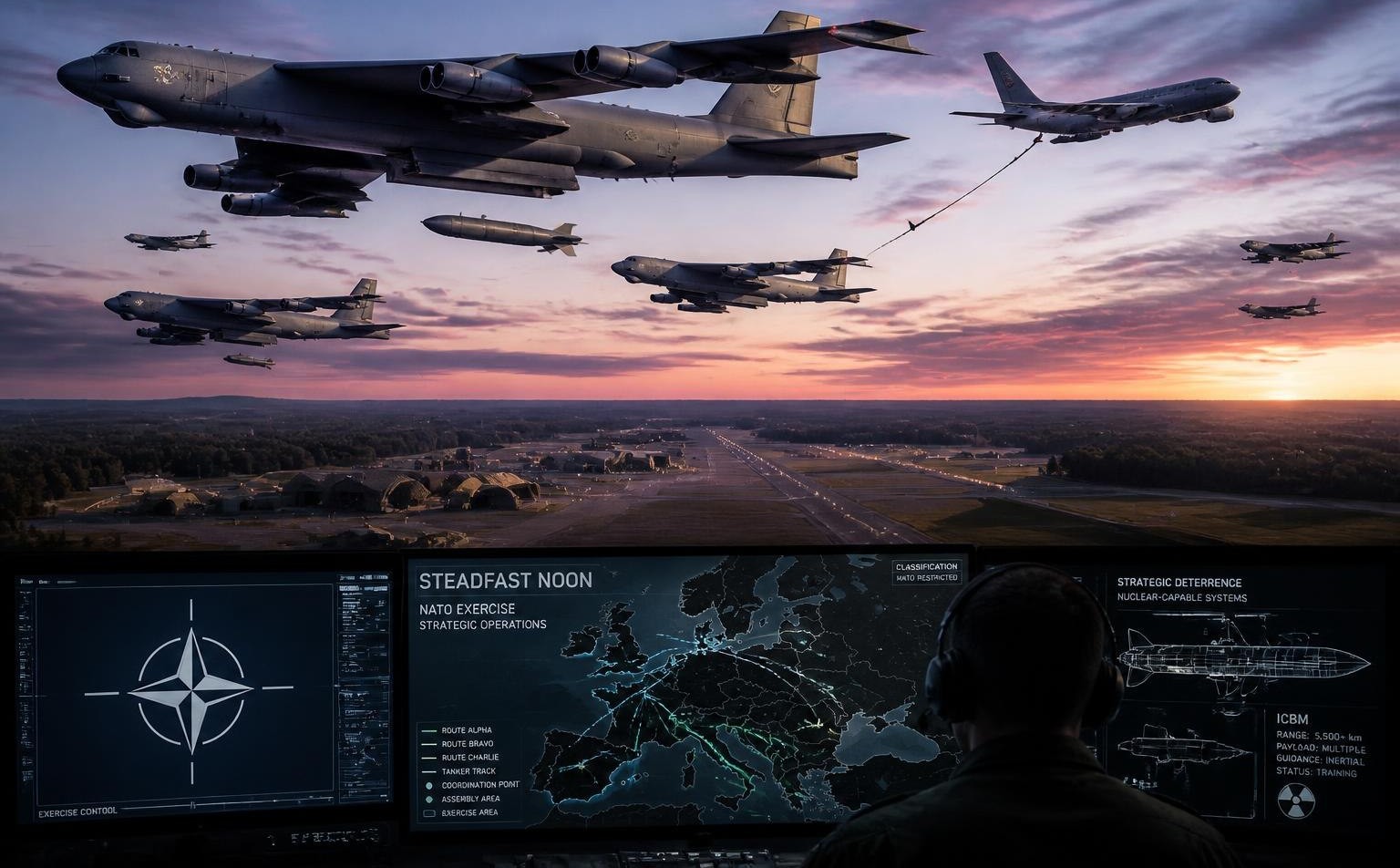
As in previous years, for ten days, starting on October 13, this time with Italy as the host country, NATO carries out its annual Steadfast Noon exercises in which troops from 17 nations participate during which the Alliance’s nuclear capabilities are tested. Although in other years such exercises went unnoticed, this time, due to the certain conjunctural increase in geopolitical tensions and uncertainties, especially in the face of the uncertainty of the immediate evolution of the war in Ukraine due to the change in the attitude of the US in relation to Russia, these exercises have attracted attention in a way, we believe, excessive and unjustified.
1- Two opposing positions
On the one hand, there are the countries of Western Europe that consider these military exercises a reaffirmation of the principle of collective defence and of the so-called US “nuclear umbrella”, while those of Eastern Europe also consider them proof of guaranteeing their security in the face of what they perceive as a direct existential threat following the recent conflicts in the region.
On the other hand, there are those who consider that the presence of strategic bombers and the simulation of nuclear-armed missions in Europe turn the continent into the epicentre of a potential confrontation of catastrophic magnitudes, so that instead of serving as a deterrent and guarantee of peace, they erode diplomatic channels for conflict resolution, increasing the vulnerability of their respective countries.
Likewise, in both positions there are two opposing positions. Those who consider these exercises essential to send a clear message of firmness and unity to rival powers such as Russia or China, warning that any military aggression would have unacceptable costs. And those of the “identity” sectors, on the rise in almost all European countries, who believe that these actions are a demonstration of force by transnational power structures, that is, the so-called “globalist establishment” or “deep state”, for the benefit of the interests of technocratic elites and the global military-industrial complex, but above all the United States, with a view to consolidating that unipolar world order that is cracking in the face of the multipolar one that is consolidating.
In our opinion, both positions are exaggerated. The exercises are routine, they are held annually and have no other purpose than to verify that this part of the Alliance’s structure maintains its levels of operability despite, and this is the important thing, that none of its members really wants or contemplates the possibility of the use of these weapons of mass destruction, aware that if they did they would destroy all of them to levels never known, or even suspected. If the infamous bombs on Nagasaki and Hiroshima have shown anything, it is that, in a war with nuclear weapons, especially with the destructive level they have reached today, no one could claim victory. We can therefore consider these new nuclear exercises as fireworks by NATO.
2- Nuclear race out of control
The suspension of key arms control treaties, such as the Intermediate-Range Nuclear Forces (INF) Treaty and New START, seem to have left the world without the regulatory frameworks that partly avoided a catastrophe during the Cold War, which together with the surprising modernization of arsenals with hypersonic missile technologies and automated systems that drastically reduce reaction times to an alert, increasing the danger of a miscalculation or a fatal technical accident, have been generating, for some time now, not only among the moderately informed population, but also among specialists and technicians, concern about the possibility of a tragic event by drastically reducing the already thin line between prevention and provocation, stoking the fear that we could succumb to the temptation of a new escalation of nuclear weapons and even worse that it could get out of control.
For us, and despite the evident mediocrity shown today by the different world political leaders, especially the European ones –with exceptions such as those of the Russian and Chinese leaders–, we do not believe that either one, that is, escalation, or the other, that if it occurs, it would escape diplomatic control.
On the one hand, because the economic costs of such an escalation would be unbearable for a world that suffers serious recurrent crises that it does not really know how to solve, among other things because the interdependence of the different national economies prevents it because the world is getting smaller every day in this fundamental aspect; on the other hand, because despite the aforementioned mediocrity of world leaders, this does not mean that they do not retain a minimum of common sense about the fact that such an escalation, and even worse if it were to get out of control, would greatly aggravate those same crises with unpredictable results, but in any case also harmful to those same political leaders.