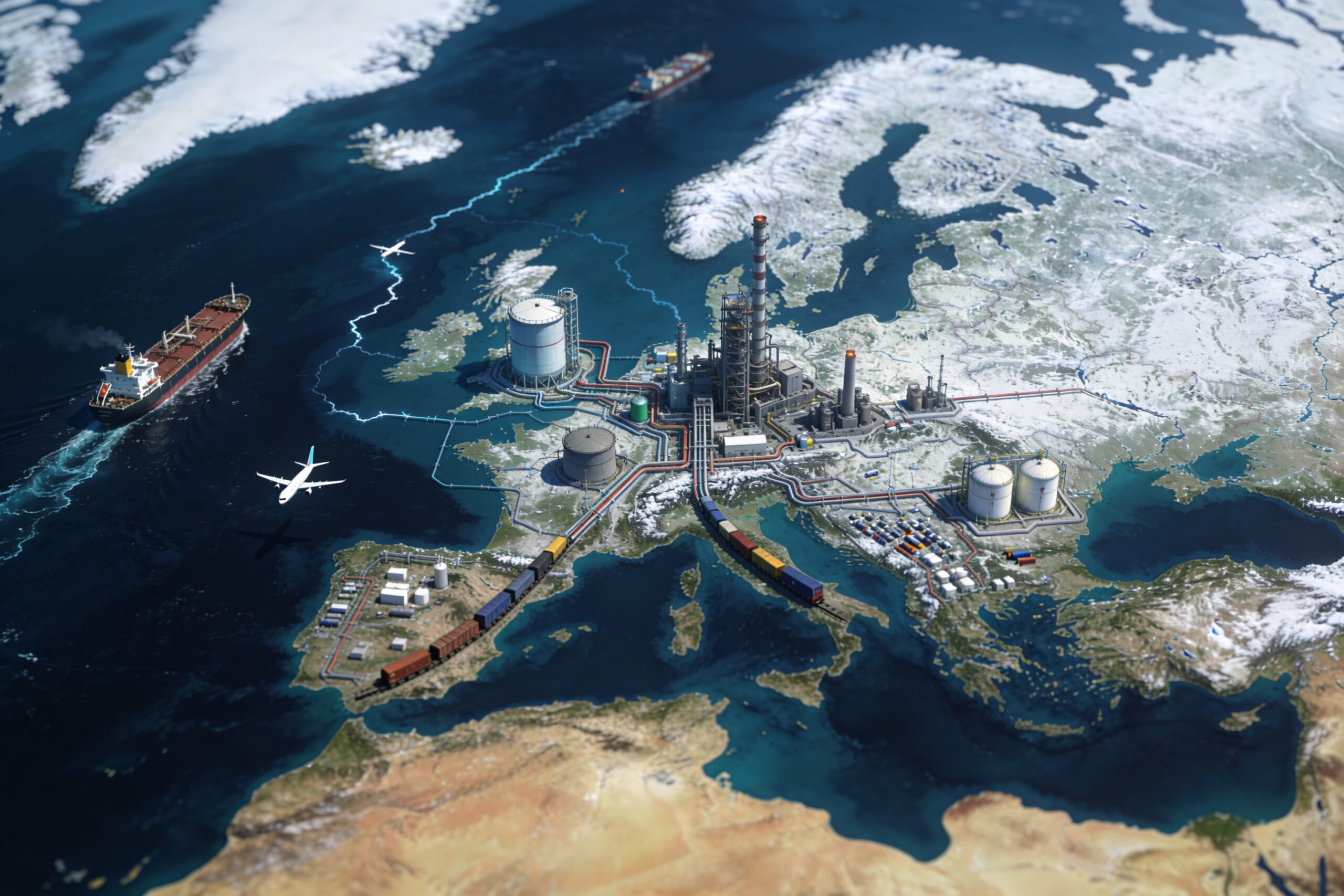
Europe, on the verge of a new winter, is deepening an energy crisis the likes of which it has not suffered for decades, a victim of the prolongation of the closure of the Strait of Hormuz due to the new Gulf crisis caused by the failure of the US and Israel in their obsession to destroy the current Iranian regime. Thus, and as so many other times, it is the European countries that suffer the consequences of their traditional submission to American interests and designs. As long as Europe does not free itself from this dependence, as long as it is not able to “become independent” from the US and take its own course looking only for its interests, it will continue to harm itself, that is, its own citizens whom it claims to defend.
The dual blockade of the Strait of Hormuz since the end of February 2026 – with operational restrictions by Iran and US naval counterblockades – is seriously damaging the eurozone economy; it should be borne in mind that around 20% of the world’s liquefied natural gas (LNG) and 25% of the world’s seaborne oil circulated through Hormuz before the conflict.
On this occasion, it does not seem possible that Brussels will be able to diversify its supply as it managed to do at the beginning of the war in Ukraine by replacing Russian gas with the massive purchase of North American and Qatari LNG, as Europe’s dependence on global fossil fuels remains its Achilles’ heel. With diplomatic negotiations completely blocked and after months of paralysis in the world’s main energy corridor, the temporary truce reached over the summer has not crystallised into lasting solutions, causing the cumulative impact to be felt strongly in European industries and households.
Qatar, one of Europe’s main suppliers of LNG, is unable to maintain its shipments on a regular basis due to the blockade and the damage suffered to its infrastructure by effective Iranian counterattacks. This has also led to a price war with other global producers who are taking the opportunity to increase their production capacity to cover about 75% of the deficit; an increase in prices paid by Europe so that, both on the European continent and in the United Kingdom, the wholesale price of gas has risen by more than 100% compared to the levels of the beginning of the year.
Another fact: the European Commission estimates that the European Union has had to bear an extraordinary expenditure of more than 24,000 million euros to deal with the overprices of fossil fuel energy imports since the conflict in the Gulf broke out.
As concrete examples of the magnitude of the crisis caused in the euro area by the closure and blockade of Hormuz, the following data are worth mentioning:
- Germany: $11.4 billion in indirect losses and trade cost overruns, mainly due to damage to its important manufacturing and heavy industry sector.
- France: 8,200 million dollars, mainly affecting the supply of kerosene for commercial aviation.
- Spain: 7,000 million dollars needed to alleviate the oversize experienced in subsidies, subsidies and emergency tax exemptions to contain prices.
- Italy: 5,800 million dollars for having had to restructure a large part of its gas infrastructures that come to it from North Africa.
In short, the closure of Hormuz has already meant a total extraordinary cost overrun of more than 35,000 million dollars (some claim that it reaches 41,000 million).
The problem is not reduced to the damage suffered by citizens in terms of their quality of life and comfort, that is, in terms of the electricity and heating bill in their homes, but affects and in a very special way other aspects and sectors that, logically, also have an impact on citizens who are the ones who always end up paying everything:
- The German manufacturing industry, as well as others, is facing unsustainable production costs forcing closures and mass layoffs.
- In the electricity sector, and in the face of the scarcity and high cost of gas, European demand for coal has experienced an unexpected rebound of 1.2%.
- Commercial aviation in Europe deserves special attention.
Aviation imports almost 40% of its jet fuel (kerosene) through Hormuz, whose closure has pushed critical bookings to six-week lows, forcing rationing alerts and rising ticket prices. Aviation kerosene accounts for about 40% of any airline’s total operating expenses, so the closure of Hormuz shattered any budget forecast by doubling the price of a barrel on European markets from an average of €68 to peaks of more than €150 per barrel. Although the big companies cushioned the initial blow thanks to previous contracts, the prolongation of the conflict for months ended up exhausting them.
The global market experienced a structural lag of 600,000 barrels per day with respect to demand, which prevented finding cheap alternatives in the short term, therefore, the accumulated losses by this sector in the airspace of West Asia and Europe already exceed 3,000 million dollars due to a combination of factors: a) the increase in mileage due to route diversions (+40% in flight cost); b) airspace restrictions in areas adjacent to the conflict forced the reconfiguration of long-haul routes to Asia, so that avoiding the exclusion zone implies adding between 1.5 and 3 more flight hours on intercontinental routes, which causes higher gross fuel consumption per route, an increase in overtime pay to crews and greater wear and tear and maintenance costs per flight hour.
This has led airlines, faced with the real threat of running out of reserves at airports in northwestern Europe (where critical inventories fell to lows of less than 30 days), to massive scheduling cuts to mitigate consumption with preventive cancellations so that some operators suspended thousands of flights during the peak season (more than 30,000 flights suffered cancellations or serious disruptions in the Eurasian corridors), cost transfer to the consumer and emergency measures, so that the financial imbalance has led to the return of fuel surcharges in the European Union (average airfares in Europe have risen across the board with increases on medium and long-haul routes) and the intervention of the EU Booking Market to avoid the paralysis of the main airports in the high season (the European Commission and the Petroleum Coordination Group monitor the selective release of the EU’s strategic kerosene reserves to inject physical liquidity into airport hydrant systems).
Due to the prolongation of the closure of Hormuz, but even more so because there is no end in sight, the European Union has been forced to modify its outlook for the end of the year and the coming months with the following measures: a) lowering the GDP growth forecasts for the euro area from the 1.4% initially estimated to only 1.1%; b) contemplating an increase in inflation in the euro area of around 3%, forcing the European Central Bank to freeze interest rates to avoid the consequent rise in prices.
But also, and finally, although it does not really seem likely, the European Commission is already analysing the impact that the “double maritime blockade” could have, i.e. that the closure of Hormuz could be joined by the blockade of Suez if geopolitical tensions escalate, which would cause the total collapse of global logistics routes, making maritime transport freight more expensive at levels never seen before.
Conclusion
As stated at the beginning of this analysis, the European Union is paying a very high price for the closure of Hormuz, provoked, let us not forget, by the Israeli effort, seconded by the United States, to overthrow the Iranian regime, without caring either of them about the consequences for Europe, its supposed ally. Once again, the United States looks only for its own interests above all other considerations. The failure of its intentions, in which Iran responded with the closure of Hormuz, as well as with highly effective counterattacks and a Numantine resistance that remains firm and determined for the moment, has surprised the United States, which is merely saving face as best it can, but without being able to hide its failure, while the serious damage that the prolongation of the current situation causes to its “allies” may plunge them into a disastrous energy and economic crisis.
If the situation continues as it is now, Europe may be on the verge of the biggest crisis since the end of the Second World War because its energy alternatives, due to its dependencies, are very scarce; especially since it has disassociated itself from its imports of Russian gas which, without a doubt, the different European governments will now be remembering, although of course they are not going to publicly recognise it, and who knows if they regret, once again, having allowed themselves to be dragged by the US into a conflict, the Ukrainian one, senseless, avoidable and which again only harms Europeans.
If the current situation continues, Europe has two ways out of it. Either it pressures the US to abandon its Iranian adventure or it turns to Russia by abandoning Ukraine.
The former does not seem possible, since its ability to influence the United States is practically nil.
The second would be the logical and the most effective and easy from every point of view, there being only one problem: the arrogance of European leaders who have bet with excessive words and deeds on a Ukraine that is only serving to bleed them in all aspects.
Everything will depend, as so many other times, on the ability of European rulers to assume that their countries depend more than they believed on those against whom they insist on fighting for their stubborn and stubborn submission to the US, even at the cost of seriously harming their own citizens.