An international summit begins to really matter when its decisions come into everyday life: the medicine that a family can buy, the work that allows them to live with dignity, the school that remains open. It is from this perspective that the BRICS meeting in India should be read: for its ability to transform the power relations that condition those lives.
New Delhi hosted the BRICS Business Forum on 11 September and the 18th Summit of its leaders on 12 and 13 September. Under the Indian presidency, the agenda was articulated around resilience, innovation, cooperation and sustainability. Distinguishing the two meetings makes it possible to connect the economic opportunities discussed with the political responsibilities of the states.
Its geopolitical relevance lies in an aspiration that runs through the Global South: to participate in the decisions that organise the world economy. The New Delhi Declaration calls for greater representation of developing countries and reforms of the United Nations and international financial institutions. It also recovers the spirit of Bandung, linked to equality, independence and cooperation between peoples.
Its geopolitical relevance lies in an aspiration that runs through the Global South: to participate in the decisions that organise the world economy. The New Delhi Declaration calls for greater representation of developing countries and reforms of the United Nations and international financial institutions. It also recovers the spirit of Bandung, linked to equality, independence and cooperation between peoples.
In this area, the BRICS open up a possibility: to diversify international relations and expand the negotiating space of historically subordinate countries. But a world with several centers of power — that means multipolarity — also requires asking who decides within each society and who receives the benefits of growth. Emancipation loses content when wealth changes hands without reaching those who produce it.
This question allows us to understand the human scope of the financial debates. The declaration promotes the work on cross-border payments and operations in national currencies, which is why it is a cooperation that is still in development. It is important to mention that the text does not establish a single currency of the BRICS, but without a doubt, it is something that is seen coming in the future.
The issue seems technical, but it can be explained simply. When a country repays a debt in dollars and its currency loses value, it needs to allocate more domestic resources to the same payment. Expanding financing options can help reduce this exposure, although its results depend on credit conditions and responsible management. The decisive criterion is how much space is reclaimed to guarantee health, education, food, and housing.
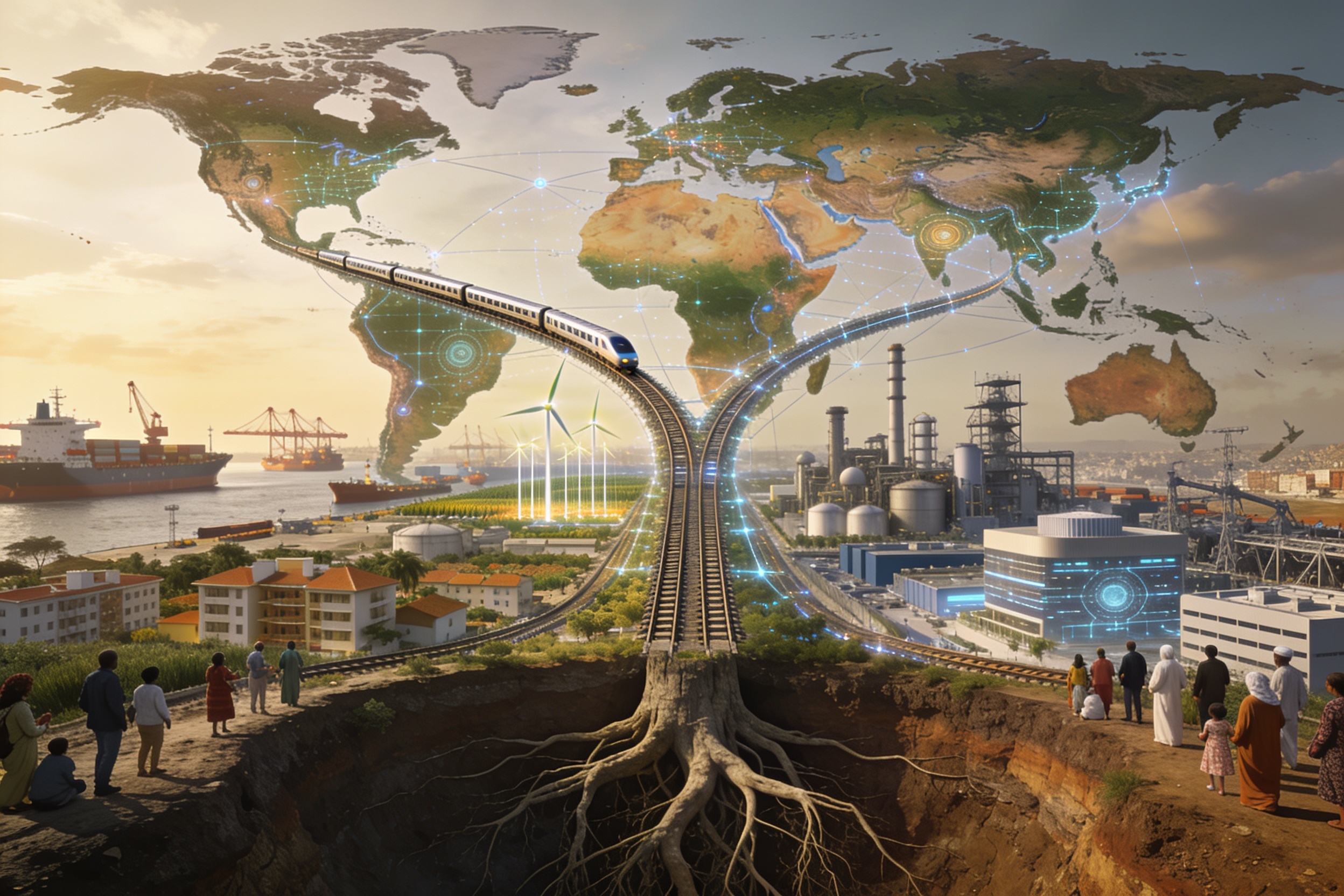
The same demand should guide the Business Forum. Each investment deserves to be evaluated by the decent employment it creates, the knowledge it shares, the taxes it brings and the respect it shows towards communities. An infrastructure can connect territories and sustain public services; it can also be limited to facilitating the extraction of resources. The difference is in public decisions, contractual conditions and the participation of affected populations. South-South cooperation acquires depth when it strengthens its own capacities and distributes its benefits.
This dispute over autonomy today reaches technology. During the summit, Xi Jinping proposed a BRICS open-source artificial intelligence community, digital cooperation and training of scientific and technical talent. These are initiatives announced by China, the implementation of which will have to be followed, and offer a concrete field for sharing capabilities.
For a university with few resources or a public health system, access to knowledge adaptable to its needs can be decisive. Such cooperation must be accompanied by data protection, public control, labour rights and equitable access. Technological sovereignty includes the ability to understand and monitor the tools that influence our lives. Their social value is also measured by who can use them and who is excluded.
Without peace, however, those possibilities are weakened. The declaration condemns unilateral coercive measures contrary to international law and points out their impact on the rights of the affected populations.
This position requires consistency. Articles 2.1, 2.3 and 2.4 of the Charter of the United Nations provide for sovereign equality, the peaceful settlement of disputes and the prohibition of the threat or use of force in the terms provided for in the Charter. Their implementation must protect all peoples. The credibility of any international alternative will depend on its willingness to uphold those principles even when doing so would be politically uncomfortable.
This is where the link with the decolonization of human rights promoted by the International Association for Human Rights and Social Development (IAHRDES) lies: to overcome their selective use and restore them to their full universal dimension. The 1986 Declaration on the Right to Development places the individual at the centre of development and affirms the participation and fair distribution of its benefits. It is a declaration of the General Assembly, not a treaty; it offers a framework for evaluating policies from the perspective of human dignity.
From this framework, it is essential that BRICS cooperation incorporates verifiable commitments: accessible financing for public services; technology transfer with local training; social and environmental guarantees in investments; and participation of trade unions, universities, social organizations and communities. Public monitoring should show what is being executed, who benefits and what inequalities it manages to reduce.
New Delhi thus leaves an opportunity whose historic dimension will depend on what happens next. The strength of the BRICS can expand the autonomy of the South; its legitimacy will grow if that autonomy is converted into shared well-being. The horizon deserves ambition: that no people should mortgage their future to finance their present, and that each advance in sovereignty opens a concrete door to dignity.
For the South to have a voice means that it can decide. For that voice to make history requires that its peoples be able to live better.