More and more European experts and analysts are realizing that one of the cardinal problems of the current historical phase of Europe, especially in the Western area, is the fracture between the objectives and goals of its ruling elites and the aspirations and existential maxims of their respective peoples.
This conceptual and factual disintegration is arriving, although in different proportions and scales, to the extent of an antithetical transformation that, on the one hand, drives unexpected events and, on the other hand, reconfigures the various environments.
Therefore, we are witnessing a converging accumulation of phenomena that will revitalize the holistic historical process that is certainly being structured.
In this regard, the massive eruption of social protests in Germany and Switzerland set the main tone in societies that, until recently, many interpreters of the political conjunctures conceptualized as intimidated and asleep.
The truth is that “The Hour of the Peoples” is also coming to these two countries where numerous social strata are in mobilizing effervescence, not so much for the search for meanings and signifiers, as used to happen in other periods, but, clearly and openly, to express in the multifaceted reality the vital demands of the “popular being”.
Despite the fact that, in the face of an uncomfortable contextual situation that becomes increasingly uncontrollable for the formulators of the manufacture of “social discipline”, the artificial dialectic of supposed operating opposites is activated by those who stubbornly cling to the established order – where the people are adjectives – the fact is that naturally and genuinely the citizens of both countries are already tired of paying the consequences of the incorrect decisions that descend from the pinnacle of power.
Germany
Friedrich Merz, who is visibly the most unpopular chancellor of Germany in the last 35 years, and where some institutional variables of his own party, CDU, are operating to remove him from the political scene to save the “party”, can no longer correct the decadent course of his government, which, by the way, together with his allies in the mainstream of the political elite, also present meager indices of social support.
Specifically, many Germans perceive – and denounce it daily – that Merz and his partners are putting an end to the “welfare state”, that they are putting formal employment and full productivity in an ascending crisis; that they are suffocating the traditional agricultural sector, that they are discouraging independent private initiative and that the security crisis is only increasing.
As if that were not enough, these sectors that are strongly critical of the current federal government wield, Merz and his people want to send German boys to international wars that only benefit a minority that supports Merz’s government.
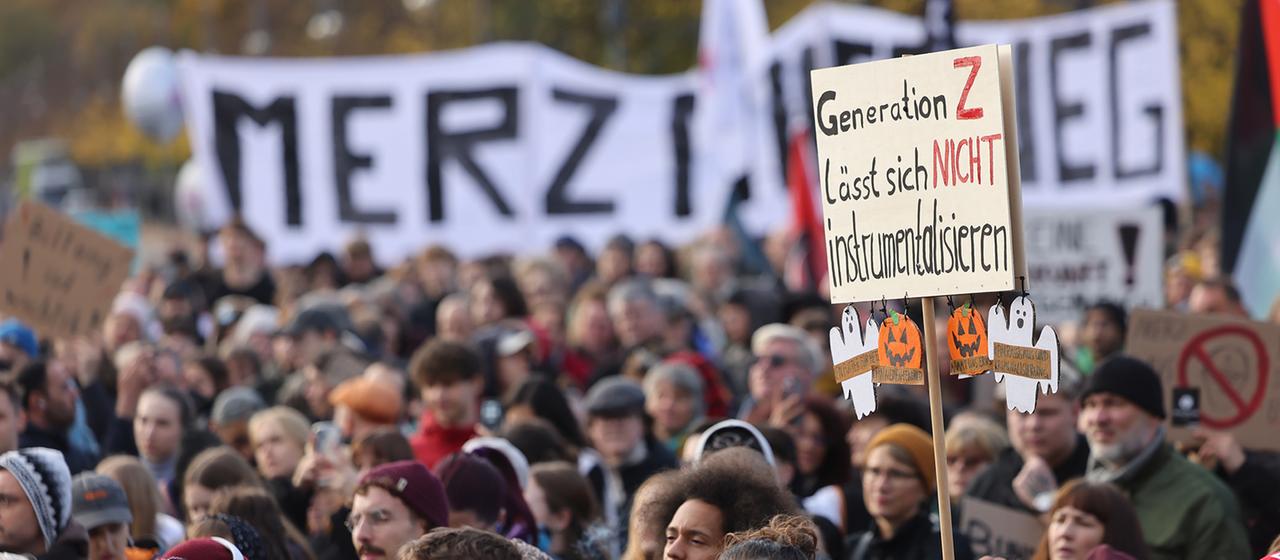
Accurate polling indicators continue to indicate that at least 80% of members of “Generation Z” do not want to enlist in compulsory military service, much less want to die in international wars.
It is that these guys are intelligent and correctly interpret that precise elites want Germany to be an asset for wars that are internationally immoral, unpopular and destabilizing of the global order. But, above all, they understand that their lives are at stake and they do not intend to fall into the traps that are created for them.
In addition, this position of “Generation Z” receives the support of members of other generations, who also oppose that children die for the “Europe of globalist technocrats”.
For this reason, the internationally recognized Dieter Bohlen showed his solidarity with the campaigns of the “Generation Z” demonstrations, declaring: “I am also completely opposed to a new military draft. Why? I have six children, and I would never send them to war. What are these wars good for? Absolutely nothing!”.
According to a survey by the Forsa Institute, 83% of respondents, from all over Germany, declared their support for the youth protests.1
This social accompaniment is devastating for the Merz government and it is for this reason that, from the CDU’s decision-making dimensions, the prohibition of the next protests of “Generation Z” would be favored, arguing preventive scenarios of violence.
Evidently, this claim is seen by the majority of the German people as an excuse to ban and cancel genuine demonstrations of social democracy by “Generation Z.”
So far, the next “Gen Z regelt” protests will take place in the streets of 34 cities and, from organizing circles, they are already warning that dark interests will try to turn the protests into chaos and violence, if they finally take place.
As can be seen, just as the majority disapproval of the figure of Chancellor Merz is transversal (more than 80%), in the same way is the empathy of Germans towards the platforms and demonstrators who civically protest against the general policy of the current federal government.
This speaks clearly that the social movements of students, farmers and others like them will increase their actions, in 2027, to demand social justice and, consequently, politics.
Switzerland
At the same time, it is often mentioned by the Swiss population that the country could enter a “race of decline” if the Swiss do not redouble their actions to protect themselves from external “social and geopolitical tidal waves”.
Other experts predict that the trend that is being tried to impose in Switzerland is one of continuous loss of competitiveness where the labor market is no longer assured of the bonanza or vigor of other times. 2
Moreover, some specialists are warning of the risk of relocation of companies due to energy costs.
According to Allianz Trade’s own projective valuations, record rates of bankruptcy of Swiss companies are expected this year3, while 267,300 people received economic social assistance in 2025, of which around 5% are children and adolescents and forecasts mention that this trend will increase.
Social activists have been talking for several years now that poverty has increased in Switzerland in the last decade and that the central government has a deficiency in the practical application of the approach to poverty, and they question certain official measures to survey poverty levels.
Of course, Switzerland does not have the same situation of economic decline as other European countries, but, as we stressed earlier, the alarm is coming from the Swiss people themselves.
Recently, more citizens of the country could be observed who, through social networks, expressed their opinion that it is necessary for parts of the masses of the people to take to the streets to raise a series of demands, raising the demand, among other considerations, so that the salary of the middle class stops being in the phase of stagnation.
“People also have to take to the streets in Switzerland! Enough is enough!” can be read on social media accounts.
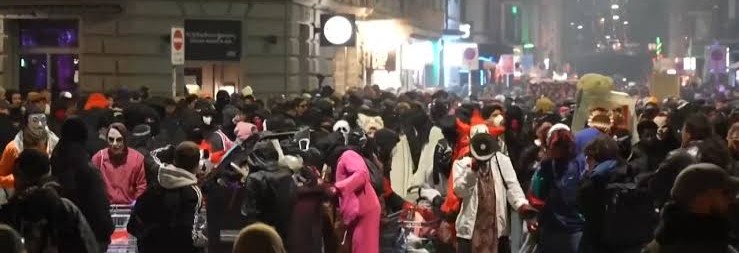
Over the past weekend, hundreds of people took part in demonstrations in Zurich and Basel, after which there were some riots that were commented on internationally and criticised by some sectors in Switzerland and deny that “Swiss social tension” is comparable to that of France.
One current of interpretation accused the left of being behind the acts of violence to win over the “Swiss scene”.
At the same time, other expressions pointed out that genuine demands constitute legitimacy and that they would be part of the wave of youth demonstrations that is occurring in Europe.
Be that as it may, it is also undeniable that there are objective requirements for social, political and economic improvement in important portions of the national population and nothing can guarantee the Swiss ruling elite that the country will not go through the phase of “social effervescence”.
In short, the German and Swiss conjunctures, with their similarities and differences, are part of a more general European picture that numerous social sensibilities effectively want the development of national sovereignties – without limitations or submission to the supranational elite, with a productive, developmental economy and with ladders of social ascents – and that “The Hour of the Peoples” is not a matter of the past.
Sources:
1-https://www.zeit.de/gesellschaft/zeitgeschehen/2026-11/forsa-umfrage-jugendproteste-deutschland-schueler-cdu-afd
2-https://www.swissinfo.ch/ger/aussichten-am-schweizer-arbeitsmarkt-tr%C3%BCben-sich-leicht-ein/92311887
3- https://www.nau.ch/news/wirtschaft/schweizer-firmenpleiten-durften-2026-auf-rekordniveau-steigen-67193757