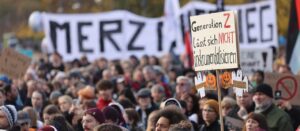

For a few weeks now, France has been experiencing a series of demonstrations that, last Saturday, October 31, took place relatively calmly with more than 290 arrests, as reported by various media. This new day of riots and violence after clashes between police and demonstrators in several cities of the country. The incidents occurred mainly in cities such as Paris, Marseille, Rennes, Lyon, Nantes and Toulouse.
Which leads us to analyse why a country like France is experiencing such a turbulent social climate.
And the first question that arises in the face of these protests born on September 17 is, why is there protesting, and with so much violence, in a developed country, which has a high per capita income?
On the one hand, it is necessary to analyse the economic and socially worrying situation that challenges citizens.
Three days before the outbreak, the government had presented the first draft of the budget for 2027, which aims to cut 43,000 million euros in spending and reduce the public deficit target to 5%. The cuts freeze civil servants’ salaries, increase taxes on the highest pensions and reduce student and housing benefits. A worrying budget, which aims to reduce the current high fiscal deficit of 5.5% but will hardly improve the current growth rate of 0.4% and unemployment of 8.3%.
But in my opinion, the main trigger is the accumulated anger that has a structural character and is transversal, because the evident inequalities and citizen disaffection that becomes a common denominator run through years of progressive discontent.
En efecto, debemos tener presente que, históricamente, la ideología dominante la socialdemocracia en Francia, y en toda Europa, era sinónimo de Estado de bienestar, lo que fue asumido también por conservadores demócratas y por el mundo entero.
The different policies were based on the universalization of social and labor rights, financed with progressive fiscal policies, with an increase in the purchasing power of the population, through an increase in labor income. This has come to an end and what has caused a harsh social awakening.
But I must also add that the traditional political class, with high responsibility for this crisis and especially the social democrats, has not been able to reverse this crisis and restore the levels of well-being prior to the seventies, causing an evident disaffection on the part of the citizens and increasing a series of problems that are seen more clearly after September 17.
All this is explained when one analyzes hard figures that are directly related to the low growth of the French economy, and, therefore, to the weakening of industry and employment. To which is added an ostensible predominance of financial capital.
In addition, a problem that is global that directly has to do with the constant migratory flows and that Europe has experienced strongly in recent decades, and that is directly related to the fact that there has been no capacity to respond to migratory processes, which the extreme right has taken advantage of as a basic rant to accuse liberal positions on the negative impacts of migrants, without social democracy having managed to counteract this discourse.
This is what has allowed far-right populism led by Marine Le Pen to advance, and with a certain possibility of reaching power in 2027. And the essential factor in this advance is the drift of social democracy, which has forced a transition towards neoliberalism of the ideology of social welfare, with the abandonment of the goals of the welfare state, this has resulted in aggressive austerity policies, boosting unemployment and exacerbating inequalities.
But, in addition, social democracy has lost influence and strength not only in the economic sphere, but also in the political and ideological field, and the cultural hegemony it achieved for much of the twentieth century is no longer the same.
The French mobilization has become a benchmark for students and citizen organizations from other countries.

The battle of social networks in this crisis
Meanwhile, intense street battles are raging in France. Socialmedia is at the center of intense debate, with the government considering temporary restrictions due to its use to coordinate riots and looting, although it is not a general internet blackout, but the possible limitation of specific platforms.
This is because in the opinion of the authorities there is coordination of acts of vandalism. President Emmanuel Macron and authorities such as the Minister of the Interior, Laurent Núñez, have pointed out that platforms such as TikTok and Snapchat were used to organize looting, destruction of public furniture and monitor the police in real time during the protests that have taken place since September to date, due to the loss of purchasing power and the deterioration of public services.
The assessment comes after the violent riots that took place on Saturday, October 17, during that mobilization. The looting and subsequent damage affected at least 3,000 businesses.
Apart from the demonstrations themselves, the government is on alert due to calls on social networks, by far-left groups and other radicalised groups, to provoke riots, commit looting and take advantage of celebrations such as Halloween to organise violent gatherings.
Based on the above, the French government has studied the possibility of temporarily suspending certain platforms in specific areas and under very strict legal conditions, a debate also driven by proposals from mayors and political figures who see social networks as a hidden power that contributes to chaos and disorder.
But suspending social media comes up against strong barriers both in terms of personal and legal freedoms in France and with European Union regulations (such as the Digital Services Act, DSA), which creates a complex balance between curbing violence and protecting freedom of expression and the right to demonstrate.
But the government has seen the need to take action and, therefore, presented an amendment to the bill on the reparation of damage caused by the riots of Monday, October 26. The proposal began to be examined in the Senate and establishes specific deadlines for removing content that incites violence.
The text proposes that platforms remove within a maximum of one hour publications that call for attacks, promoting an insurrection or resorting to arms against the State or sectors of the population. In addition, it proposes a period of 24 hours to remove messages that incite murders, aggressions, robberies or destruction of property when they represent a serious threat to public order.
This would lead to the adoption of measures, if companies fail to comply with these provisions, the authorities could order the blocking or de-indexing of their services. The amendment also seeks to expand the powers of Pharos, the French state platform that allows identifying and reporting illegal content on the Internet.
The proposed measures include the use of drones for judicial purposes, the suspension of accounts on online services and the possibility of seizing certain social benefits from those responsible for damages. In addition, maximum prison sentences would increase from one to three years and fines would increase from 15,000 to 45,000 euros.
The text also contemplates extending civil liability to people who remain at the scene of the destruction despite a dispersal order, with the aim of facilitating the repair of the damage.
In Conclusion
We must understand that the crisis that is shaking France does not represent a fortuitous social explosion or a simple episode of street vandalism. It is the manifestation of socio-economic and political tensions accumulated over the years by the degradation of the social protection model and, therefore, the widening of inequalities.
In the short term, the course of events of the social outbreak will depend on the ability of the unions to articulate general strikes, the impact of the school holidays that could put cold cloths on street mobilizations and the government’s willingness to offer structural solutions in the short, medium and long term.
French society is at a crossroads where the discontent manifested in the classrooms and in the streets will indelibly mark the political course of the country and, in a way, the challenges of the next government, and why not say it, predict who can capitalize on this discontent.