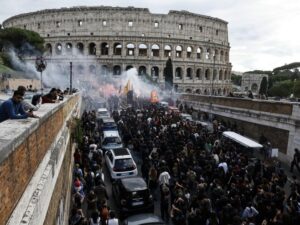
Next year, France will hold presidential elections in October, and this past November, Emmanuel Macron’s government faced a series of protests that escalated into violent riots. Various left-wing groups—the same ones that, paradoxically, had united to secure Macron’s victory in 2022—took to the streets to protest economic tensions and the rising cost of living.
The result was the destruction of historic buildings, looted businesses, a wave of violence in the streets, and a statue of Joan of Arc that was draped in a hijab.
With six months to go before the presidential election, Emmanuel Macron’s government is walking a fine line—a government marked by protests, from the “Yellow Jacket” protests in 2016 to the demonstrations against the Covid-19 lockdowns and now these riots that have swept through the streets.
However, these protests always come to nothing, because once the anger and the moment have passed, it is the business owners—ordinary people—who bear the brunt, while Macron and the politicians responsible for precarious working conditions and low wages sleep soundly.
But on top of all these problems is another that could prove decisive: the Ukrainian factor.
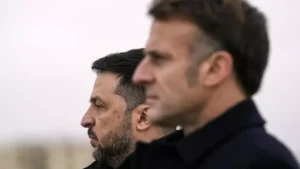
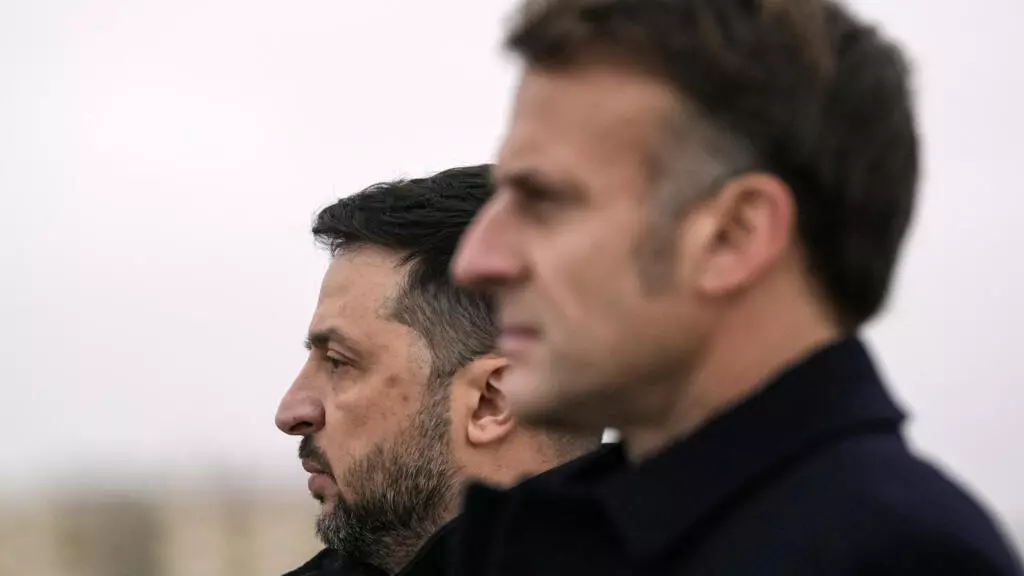
Since the war between Russia and Ukraine began in 2022, Macron’s government has been one of the main allies of the country led by Zelensky, providing both political and financial support—and this is where its Achilles’ heel may lie.
Since the start of the war, France has provided 6,000 million euros annually to Ukraine and has committed to a loan of 90,000 million, which, in a country facing economic strains, a housing crisis, and Zelensky’s declining popularity, could be the factor that ultimately propels far-right candidate Marien to the presidency.
Marine (whom I refuse to call Le Pen because her father revoked her right to use the surname), who is reportedly running for office again, has stated that if she wins the election, she will cut off all financial support to Ukraine—not for ideological reasons, but for economic ones—though she clarifies that she will continue to provide humanitarian aid.
By 2027, Ukraine will face considerable political resistance to providing additional funding; with a 27,000 million deficit in its Ministry of Defense and the refusal of countries such as Slovakia, Hungary, and Bulgaria to contribute, the internal crisis in Kyiv will become even more delicate than it already is.
The Ukrainian factor could become a key issue in these elections, and this situation could be replicated in other European countries that are literally fed up with wasting their money.
For most French people, this cancellation of funding may be seen as a relief given the current climate of economic tension. French citizens—farmers and workers alike—are not interested in a war taking place far away from their country; they want decent housing, good wages, and to meet their basic needs—not a conflict that feels distant to them.
This is the electorate that the promise to cut off all funding to Ukraine will lead to vote for Marine in the upcoming elections; however, it is still too early to say whether this will be a decisive factor—as the elections draw nearer, we will see whether it is or not.
It’s important to keep in mind that Macron’s government, as mentioned, has faced numerous demonstrations and protests. Despite this unpopularity, various groups on the undefined left prefer to support him or any other candidate rather than the far-right candidate. However, the Ukraine issue could take a turn that leads a large portion of French citizens to vote for Marine; It will all depend on how she handles the issue.
The political struggle France will face is to maintain its economic sovereignty rather than follow Brussels’ policies.
That is, at its core, the struggle of European nations; the Ukrainian factor is playing out in different countries, and Zelensky’s situation is becoming more unstable.
All that remains is to wait and see what will happen in 2027.
Sources:
1- SWI swissinfo.ch
2- SWI swissinfo.ch
3-Politico