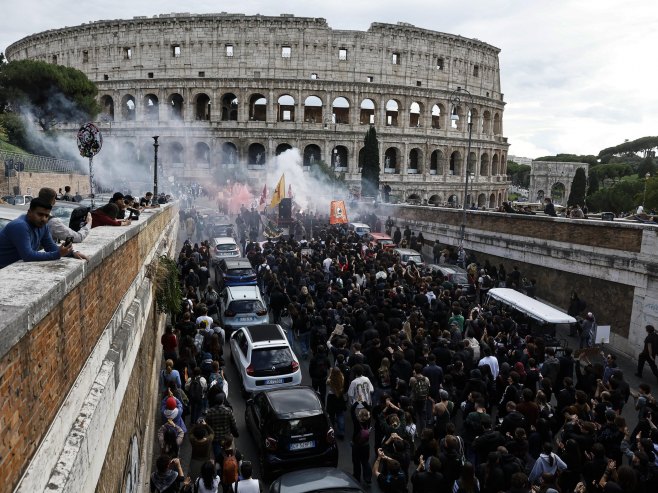
From Italy to France, from Spain to Germany, a new season of mobilizations is crossing the continent. Behind social demands, however, there is also a political and cultural clash over Europe’s future.
We are not facing just a succession of national strikes, but a broader phenomenon that reveals the growing crisis of trust in institutions and in politics’ ability to meet citizens’ expectations.
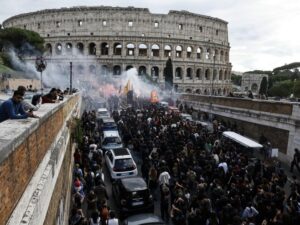
In Italy, the general strike of November 20, 2026, promoted by the CGIL and accompanied by student mobilizations and other trade union organizations, took a significant turn. The demands concerned wages, pensions, healthcare, education, and the cost of living, but the protest also took on a clear political dimension, becoming an opportunity for convergence among opposition forces against the Meloni government.
However, the issue is much more complex and opens the stage for a deep political crisis affecting the entire continent.
The new wave of protests, in fact, reveals a problem that transcends national borders and highlights the growing difficulty European democracies face in maintaining trust with their citizens. Governments are under increasing pressure. On one hand, they must face global economic competition, international security, and the restoration of public finances; on the other, they must respond to societies demanding greater protection, higher wages, and efficient public services.
It is a contradiction that concerns both conservative and progressive governments.
In Italy, the Meloni government is managing a protest in which economic difficulties are used as a political attack, while the opposition tries to rebuild its capacity for social mobilization.
But the problem cannot be reduced to a confrontation between right and left. The real question is whether Europe is still capable of developing a political and economic project capable of reconciling freedom, security, growth, and social cohesion.
In this scenario, protest also becomes an indicator of the crisis of traditional representation and the ground on which a broader political and cultural game is being fought: that relating to the future of Europe, the relationship between authority and freedom, between security and welfare, between national sovereignty and the attempt at European integration.
Squares can express legitimate discomfort, impose reflection, and urge change, but on the other hand, they cannot become an alternative power to public institutions.
Europe does not need an endless season of ideological confrontations. It needs a new ruling class, capable of taking responsibility, of concretely acknowledging the current irrelevance of the Old Continent at the international geopolitical level and the irreversible crisis in which the so-called European Union finds itself.
A new political class is needed that is no longer ideologically trapped by utopian and unrealistic visions, like the United States of Europe, but that much more concretely and humbly rethinks an arrangement capable of enhancing the sovereignty of individual countries from the perspective of a common interest. Only in this way can citizens’ trust in institutions be rebuilt and a true future outline outlined.
Otherwise, the current international geopolitical conditions will condemn the Old Continent to protest and permanent instability, with deadly consequences.
A society that only knows how to protest, in fact, and can no longer plan, risks handing over its fate to those most capable of fueling its anger rather than solving its problems.