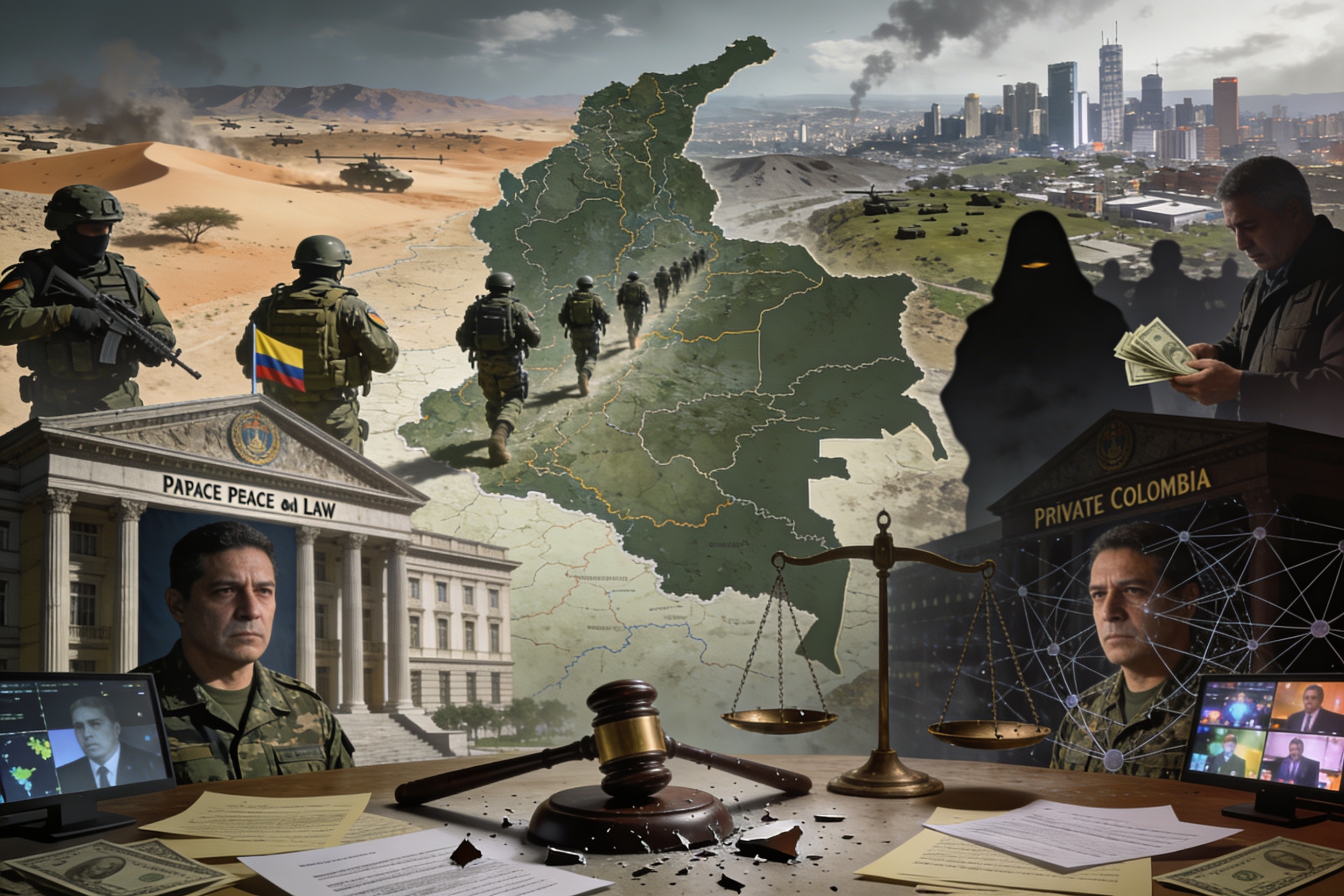
Less than five months before the end of his term, Colombian President Gustavo Petro sanctioned on March 17 of this year, Law 2569, a law that prohibits mercenarism in the national territory, penalizing the recruitment, financing, training and use of Colombian citizens to participate in military conflicts outside the country.
Without context, this news not only sounds logical, but also very positive. However, in my opinion, this law arrives late and badly in Colombian legislation.
Mercenarism is an illegal activity, as established by the International Convention against the Recruitment, Use, Financing and Training of Mercenaries, a 1989 United Nations treaty, which urges countries to criminalize these activities. According to International Humanitarian Law, mercenaries, when captured, do not enjoy the guarantees granted by the status of prisoner of war, in the same way that they can be put on trial by the justice system of the country that captures them.
For some time now, Colombia has been the country that adds the most mercenaries to this activity, worldwide, with more than ten thousand people, most of them ex-military, hired by private military companies, according to UN estimates.
Colombian President Gustavo Petro has expressed his concern about this situation on several occasions, even pointing out the hardships suffered by his compatriots in some war scenarios, such as Ukraine, where, according to him, they are “deceived”.
Law against mercenarism
Despite the concerns of the Colombian president, I must point out that the presentation of the bill for the ratification of the International Convention against the Recruitment, Use, Financing and Training of Mercenaries; Petro did not do so when he came to power, in August 2022, but two years later, in the middle of his four-year term, and only a year later, in August 2025, Gustavo Petro requested a “message of urgency” from Congress, a legal and constitutional mechanism that allows the president to request that the treatment of a law be accelerated.
It should be recalled that Petro made this request to the legislature, after Sudan’s Prime Minister Kamel Idris made a public call to Colombia to stop sending mercenaries to his country, where they are fighting for the Rapid Support Forces, paramilitaries seeking to seize power in Sudan. It is estimates that there could be up to two thousand Colombian mercenaries in this African country, where, about ten days before Idris’ message, forty of them died when an Emirati plane carrying them to Sudan was shot down. In this regard, Petro expressed on the social network X: “The Prime Minister of Sudan, Kamel Idris, addresses the Colombian nation. Stop mercenarism in Colombia. Young ex-soldiers and ex-officers do not sell out. Fight for the homeland, not die in other people’s wars.” What the Colombian president does not point out is that these mercenaries whom he calls “young people” go to other people’s wars to kill for money, as hitmen. They are not the victims, they are the victimizers and that is how they should be considered. So that there are no doubts about the orders that a mercenary can execute for money, we can remember that twenty-six Colombians were part of the commando that tortured and assassinated Jovenel Moise, president of Haiti, in July 2021, in Port-au-Prince.
On March 17 of this year, the law against mercenarism was finally sanctioned, with a slow legislative process of nineteen months, almost the maximum period that the Colombian Congress can take for the treatment of a law, reaching this norm, practically at the end of the Presidency of Gustavo Petro, leaving to his successor the application of a law that arrives late and badly. Late because despite the president’s words about the urgency of the law, he did not do much to speed up the times. And it comes badly, since what he intends to repress, in practice is almost impossible, because, in many cases, behind the entire organization of the recruitment, there are foreign governments, as in the case of Ukraine and I cannot imagine Petro breaking relations with Kiev, for reasons that I will delve into later. If the president of Colombia is really concerned that his compatriots do not go around the world killing people for money in wars that are foreign to them, what he should do is also punish the mercenary, since, if they know that when they return to their country they can face prison for their crimes, perhaps they would think better. Another deterrent measure would be to seize or prevent the arrival in the country of remittances of money that surely many of these mercenaries send to their families in Colombia.
Hypocrisy and controlled dissent
While today, the central dispute at the global level is the confrontation between the Collective West, which intends to continue imposing a globalist and unipolar order; and the Global Majority, led by Russia and China, which advocates the consolidation of a new, fairer, multipolar and sovereigntist system; there are leaders who, behind romantic anti-imperialist speeches, in practice are functional to globalism, which is the imperialism of the 21st century, and try to undermine those who are waging the real struggle for the future of humanity, and President Petro is one of the clearest examples of this class of leaders.
To point out the hypocrisy of Gustavo Petro, among others, within global progressivism, I am going to recall the position of the Colombian president regarding the war that NATO is waging against the Russian Federation through the Kiev regime, headed by Zelensky.
Since the beginning of the conflict in February 2022, as a candidate for the presidency of Colombia, he has been highly critical of Russia, calling the action an unjustifiable invasion of Ukraine and condemning it. From August of that same year, already as president, Petro maintained this position of describing the Ukrainian regime as a victim, although he formally maintained neutrality, but maintaining a very harsh narrative against the Russian military operation, seeming to be unaware of all the details, facts and background that led to the beginning of this war, such as, for example, the eight years of persecution, torture, bombing, assassination and attempted genocide against the civilian population of the Donbass and other parts of Ukraine, by the Kiev regime. To support this position, Petro always resorted to the well-known progressive, pacifist, do-gooder and well-thinking argument, that a war can never be justified, as if stopping a genocide was not a sufficient reason. On the other hand, a curious reasoning coming from someone who was part of a guerrilla organization during the civil war in Colombia.
However, in September of last year, Petro himself, before the UN General Assembly, urged the world to form a “global salvation army”, an armed force that would defend the Gazan people, in the face of the genocide carried out by Israel. Here the great hypocrisy of the Colombian president is clearly seen, since, in the face of two clear cases of genocide against the civilian population, while in one case, the use of force is never justified, in the other an armed coalition is called, to stop by force the brutality of Israel in Gaza.
Perhaps it is no coincidence that it is in Ukraine where there are today more Colombian mercenaries, around seven thousand according to estimates. As we have already seen, what seems to worry Petro the most is when his compatriots, who make a living by killing people in other countries, die or are mistreated. In December 2025, he declared at a military ceremony in Bogotá: “There are the videos of the boys in Ukraine trying to leave and they don’t let them, they are slaves,” adding: “I asked the foreign minister to officiate Zelensky to release the Colombian mercenaries from those armies because that is not our war.”
Ironies of fate. The regime he described as a victim is enslaving and kidnapping its mercenaries. Perhaps Petro should admit that Putin knew a few things more than he did, about the Zelensky regime or simply recognize himself as the controlled dissidence that he is.
To exemplify the controlled dissidence that Petro represents, I can point out, when he criticizes NATO for being imperialist, but at the same time accuses Russia of carrying out an imperialist invasion in Ukraine, when what Moscow does is finally confront the imperialist harassment and aggression of the Atlantic organization, after eight years of betting on peace and dialogue. That is, while for his progressive acolytes he takes the position of accusing NATO of being imperialist, which is obvious, at the same time he seeks to discredit the Russian Federation with the same qualification, when it is Russia that is fighting a war against imperialist globalism.