Introduction
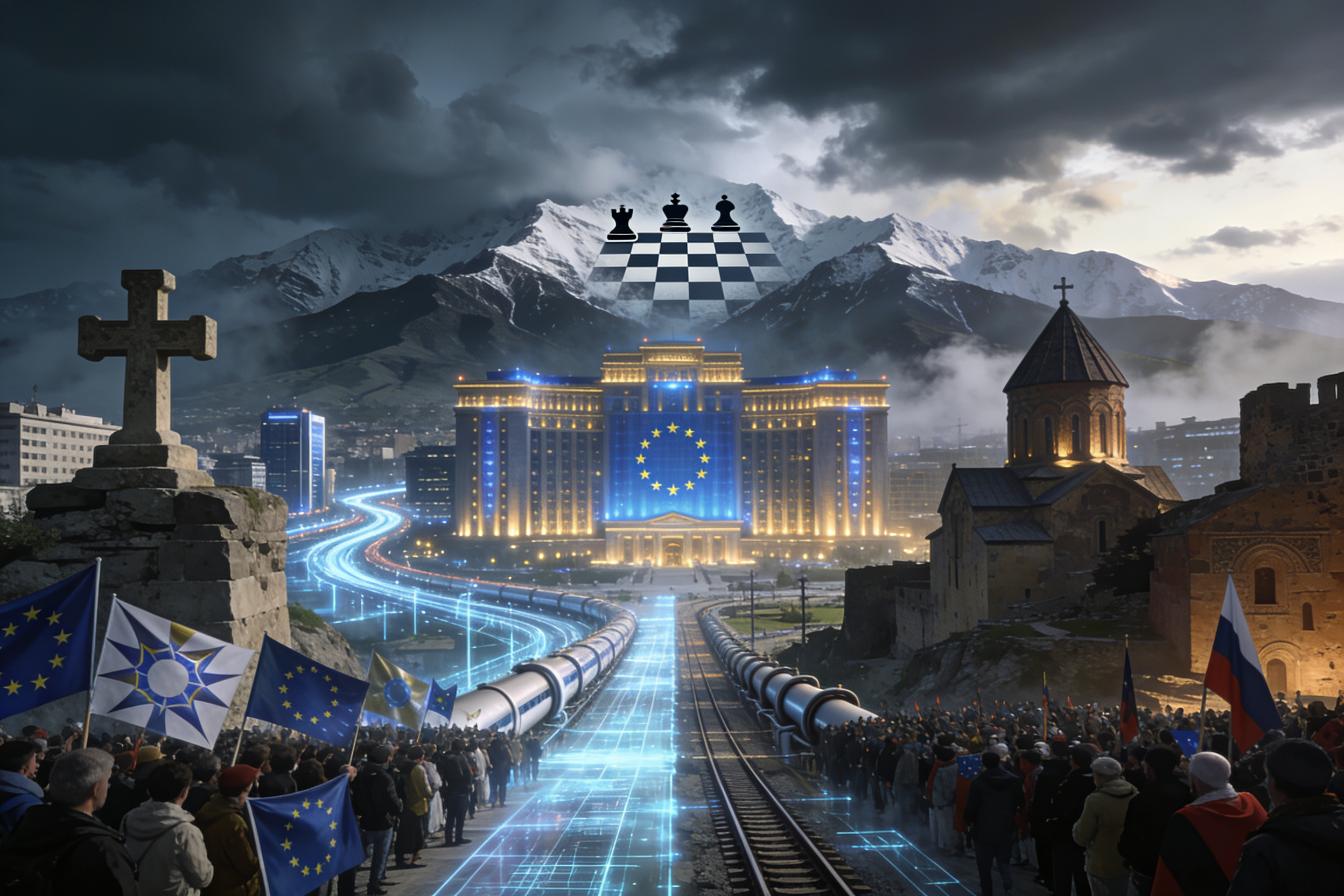
The EU-Armenia summit, first of its kind, was held on 4th-5th of May in Yerevan, Armenia’s capital. The event was attended, along others, by European Council President Antonio Costa, European Commission President Ursula von der Leyen, and Armenian Prime Minister Nikol Pashinyan. It went “under the radar” for the most part due to more important and globally relevant topics of the contemporary world- wars in Ukraine and Iran, which does not mean it’s not important or globally relevant. Because on the geopolitical chessboard, there are for surely more and less important pieces, but no irrelevant ones.
What first comes to mind when analyzing this summit is of course its timing- little over a month before the general elections in Armenia are to be held, on 7th June. This indicates which political option in Armenia has the support and the backing of EU, which was prone to their interests in the past and will be in the future if it is re-elected. And EU is doing everything on its end to secure that- like they previously did in other EU countries or neighbouring countries such as Romania (the case of Călin Georgescu), Moldova (backing Maia Sandu) and others. To ensure everything goes fair and democratic (that is, to ensure the victory of their favourable option), the EU is already sending observers and teams to combat disinformation and foreign interference ahead of the elections, because Brussels sees these elections as crucial for Armenia’s future geopolitical direction, as they are.
Results of the summit
Key result of the summit is the launch of „EU-Armenia Connectivity Partnership“ , which implies that Armenia, although not an EU member state or a candidate will be integrated into EU’s regional and global projects involving transport corridors, energy cooperation, digital infrastructure, internet and telecommunications, investments in roads, railways and logistics, easier movement of people and goods, all a part of the “Global Gateway” program, which is the European answer to China’s “Belt and Road” , with planned European investments in Armenia which could amount to around 2.5 billion euros.
The summit indicated combating “Russian malign influence”, cyber attacks, help in terms of security and defence, granting Armenia a non-visa regime with the EU, underlying the importance of peace with Azerbaijan and supporting Armenian initiative „Crossroads of Peace“ in their effort to become a transit bridge between Europe, Caucasus region and Asia. All of the listed is of course in the purpose of the upcoming elections- assuring a new mandate to Pashinyan, ensuring the continuity of his discontinuity.
Passion of Pashinyan
If there is one word to describe current Armenian PM Nikol Pashinyan it is discontinuity. He is a “game changer” in many ways- he ended the policy of relying predominantly on Russia in terms of foreign relations; he ended the policy of fighting for Artsak (as Armenians call the region of Nagorno-Karabakh) to be a part of Armenia at all costs; he ended the policy of viewing Azerbeijan as a exclusively hostile country; he ended the policy of cold and reserved relationship with EU and many others. What is the main of these is of course the first discontinuity, which in a way paved path to all the others.
Pashinyan came to power in 2018. after the “Velvet Revolution” which resulted in Serzh Sargsyan’s 10 year rule being over and Armenia “under new management” – which many experts saw from the start as a textbook case of colored revolution which will result in radical shifts in Armenian politics. Regardless of the nature of the change of government, Armenia shifted toward the West and away from Russia without a doubt.
Although he was seemingly balancing from the start, since the second war in Artsak in 2020, Pashinyan’s shift has been indisputable and irreversible. He blamed Russia almost entirely for the collapse of Armenian positions in the region, although Russia brokered a deal with both sides that saved Yerevans status and stability both in the disputed region and in the capital (Pashinyans government)- at least until 2023. when Aliev finally got the job done with small amount of meddling from the Russians but, to be honest, even less from the Armenians.
The question of Artsak is what shook Pashinyans position the most, although not enough to topple him, but it is what he was doing in between the fighting and after it ended what is more important then the conflict itself- because one is a cause and later are the consequences.
Since he got the question of the disputed region of the table (although terribly from the viewpoint of Armenian interests) he got more “relaxed” in continuing the process of shift toward the West and away from Russia which he started. Now only thing he has to worry about is getting re-elected and continuing on the charted path.
Deepening the discontinuity or reversing it?
The results of the election will show whether Armenia will delve deeper into cooperation and informal integration into EU or will these processes be hauled and maybe even reversed to a certain degree. For purposes of drawing political parallels we can compare it to Ukraine and Georgia. Both went through radical changes in their political courses which resulted in destroyed relationship with Russia and being entirely dependent on the West, which granted them not much good. Ukraine is, as it seems, irreversibly on that path and its only getting worse. Georgia on the other hand halted those processes for a while and refused to put all the eggs in one (Western) basked and to be used again as a bait for Russian intervention and a mere tool in the hands of Western geopolitical planners.
It is certain that the opposition in Armenia will not have even a close support from the outside like Pashinyan will – despite the narrative of Russian influence, so their best case for victory is mobilizing people around fundamentals of Armenian history, faith and identity which are all on undergoing heavy changes under Pashinyan. Church in Armenia, which is currently almost at an open war with the government , could be the decision maker in the end- like they are in Georgia for example and like they could have been in perspective in Ukraine- hadn’t there been for the destabilizing role of the Ecumenical Patriarchate of Constantinople and their actions on breaking the unity of the Orthodox church there, which is something similar to what Pashinyan is currently doing in Armenia in his attempt to neutralize the church as a (maybe even biggest) threat to his rule.
Conclusion
Armenia is on the crossroad and the upcoming elections will decide whether it will continue on the new path created in 2018 (which brought them not much good), or will they have a more balanced and versatile oriented policy in the years to come. One nation cannot remain on the crossroad for too long- they will either cross over entirely or return to where they came from. And changes in policy, foreign and domestic, inevitably take their toll on the identity (soul) of the nation, due to the unavoidable consequences. As mentioned before, they will either become a “new Ukraine” or a “new Georgia”.