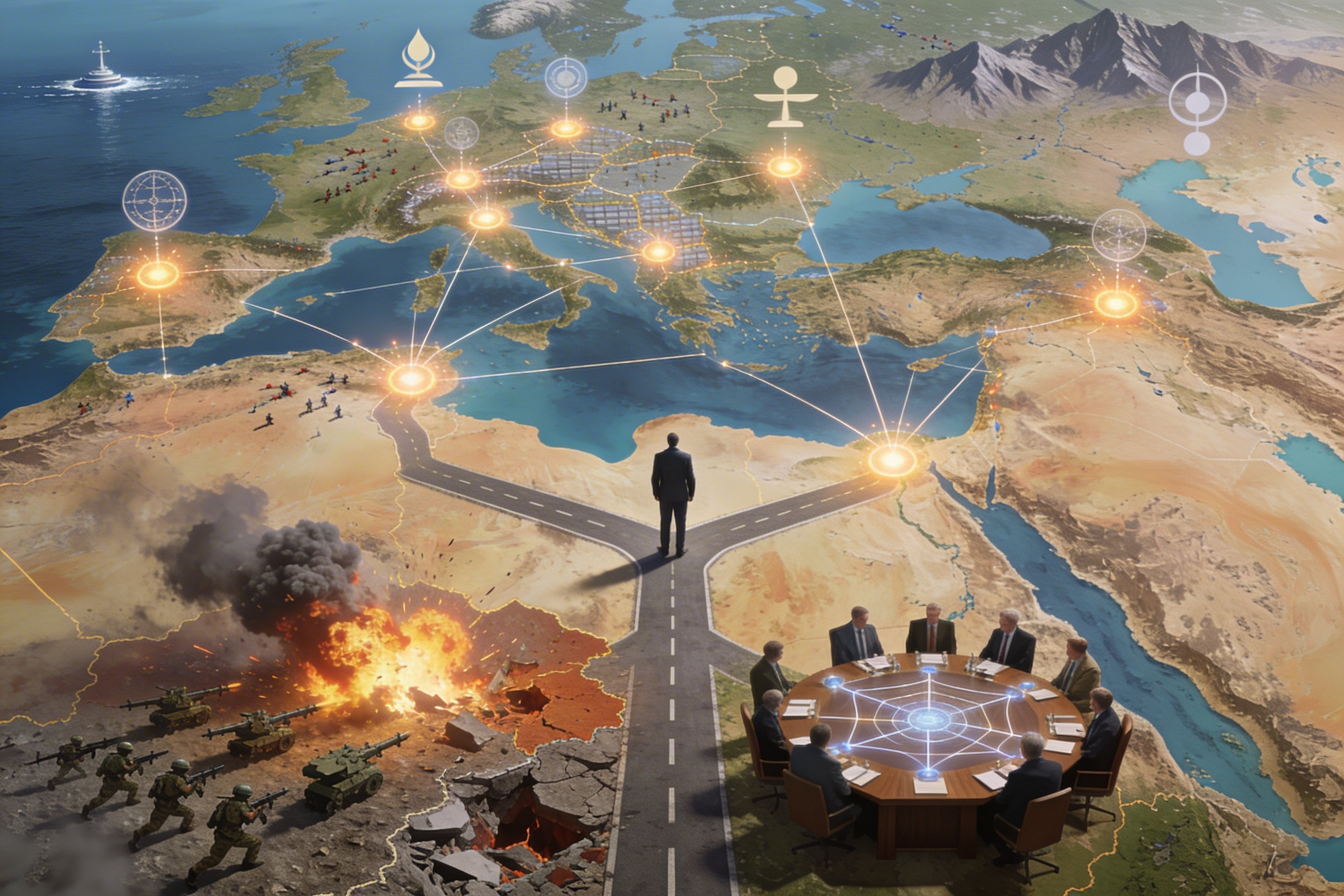
Turkey’s decision-making circle, in the context of the war between the Islamic Republic of Iran, the United States and Israel, plays the role of mediator or actor aimed at calming the escalation of war and limiting, within the possibilities, the incentives for a deep and totalizing war, a reality that is coveted by one of the actors who created this war.
Turkish strategists know full well that, in the event that Iran is defeated and its power system is detonated, the next war station will be named after Turkey and the project of the “New Turkish Century” could be thwarted.
Turkish political and military commanders, together with their leading geopolitical thinkers, admit that, from the Islamic externality, there are attempts to reshape the region in such a way that it is a monochrome and where the national sovereignties of the Islamic peoples are either subordinated to external hegemons or are destroyed in terms of future projection.
These Turkish planners are aware of the implementation of various operational plans that consist of taking Turkey out of the game or competition for geopolitical influence for the next two decades and that President Recep Tayyip Erdoğan’s idea of making the world more than five powers (those that make up the UN Security Council) and where Turkey is a fundamental part, it could remain mere illusions or simple rhetorical slogans.
In order for these Turkish geostrategic and state objectives to continue to have forms of realism and implementation, it is necessary, according to Turkey’s officials, that the war against Iran does not reach its maximum stages or stages and that the region is not destroyed, since, in both situations, Turkey would have a greater accumulation of difficulties and obstacles to its geopolitical realization.
So Turkey is stake, in relation to the development of the current war in the Middle East, much more than desires or slogans of fraternity and peace.
In addition, the apex of Turkish power, during the first half of the 2020s, and without disconnecting from the US, rebuilt its ties with Iran and agreed to share some efforts with the Iranians in terms of the regional model that should occur when multipolarity increases its presence and influence in the region, along with the aim of working punctually, to neutralize their separatist enemies, above all, the Kurds who, in one way or another, have obvious connections with globalist Atlanticism and Israel.
Regarding the probabilities of the “Greater Kurdistan” materializing, in reality itself, this year or, at the end of this decade, we see it as low or almost unlikely.
It is not so much because the Kurdish organizations involved in this project will abandon that goal, but because Turkish, Iranian, and Iraqi structures, for example, which oppose such fragmentation, will not yield to these machinations. On the contrary, these actors in the national unity movement will redouble their joint efforts to prevent the creation of a “Greater Kurdistan.”
Kurds flying the banner of “Greater Kurdistan” are more likely to end up as “sacrificial lambs.” The Kurdish armed groupings inside Iran do not represent, in themselves, and if looked at in comparative terms, a great danger to Iran’s military power as a whole, since if it is strongly mobilized to counter such maneuvers, it is in a position to reduce and control a Kurdish offensive.
But it is also noteworthy that the majority of Kurds in such countries are reluctant to engage in arson at these junctures because they know that with the widening of this war the greater negative cost could be for the Kurds.
In addition, Turkey has another front that is perhaps more dangerous and that is being forged: it is the construction of an anti-Turkish axis in the Eastern Mediterranean and that, so far, would have the support of all globalism for its success.
In these circumstances, it is true that within the Iranian power structure and people there are groups that criticise Turkey’s role for not being a belligerent on Iran’s side, but it is no less true that, to date, those who continue to make decisions in Iran maintain their ties with Ankara, although they are probably Ask for a little more Turkish accompaniment.
But it remains prudent to closely follow developments in the coming weeks to see whether or not Iranian-Turkish interstate ties will be strengthened.