Drug trafficking and transnational organized crime constitute genuine threats to Latin America. However, the real debate surrounding the “Shield of the Americas” should not be limited to whether these threats need to be confronted, but rather to who defines the threat, who directs the response, and what geopolitical consequences this security architecture will have for regional sovereignty.
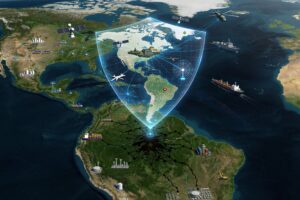
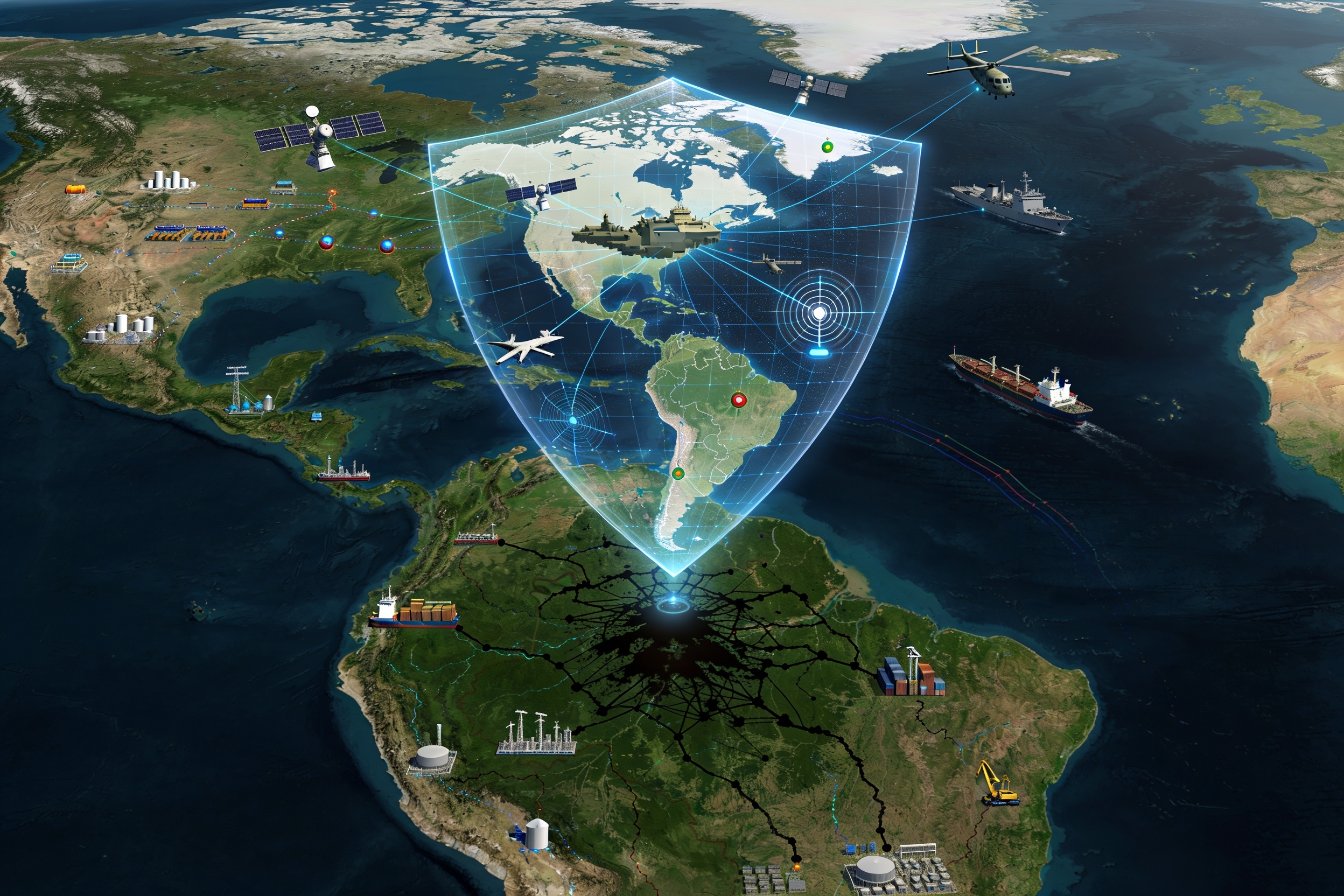
Promoted by the Trump administration, the Shield emerged in March 2026 as a coalition bringing together representatives from 17 countries and aimed at “operationalizing hard power” against cartels and organizations designated as terrorist groups. In September, 15 governments agreed to move forward jointly against 24 criminal organizations, including MS-13, the ELN, Primeiro Comando da Capital, and Comando Vermelho, while calling for the activation of mechanisms under the TIAR—the Inter-American Treaty of Reciprocal Assistance—in the Latin American context.
The problem becomes apparent when we observe that the project clearly extends beyond counter-narcotics security. Its most recent declaration establishes three pillars: economic cooperation, security, and multilateral coordination. It includes mechanisms for investment screening, the protection of critical-mineral supply chains, and regulations concerning digital infrastructure providers. In Washington, moreover, the Shield is explicitly discussed as an instrument for limiting China’s strategic influence in the hemisphere.
From a strategic perspective, this raises an unavoidable question: are we witnessing a coalition against drug trafficking, or the embryo of a new hemispheric architecture under U.S. leadership?
The concern becomes even greater when Washington has reaffirmed its willingness to employ military force against criminal organizations and when the Pentagon presents the coalition as a mechanism for deepening military, intelligence, and regional security cooperation. The progressive militarization of the fight against drug trafficking could shift sovereign decision-making capabilities toward a structure whose dominant power has geopolitical objectives of its own.
It is hardly insignificant that Brazil and Mexico, two of Latin America’s largest powers, remain outside the Shield. In a multipolar world, Latin America needs international cooperation, but it must also preserve its strategic autonomy and its freedom to maintain simultaneous relations with the United States, China, Europe, Russia, India, and other powers.
The alternative is not to confront organized crime in isolation. It is to build Latin American mechanisms for intelligence-sharing, police coordination, financial oversight, border security, and judicial cooperation, complemented—not subordinated—by extra-regional partners.
The challenge is to combat transnational criminal networks without replacing a non-state threat with a new form of strategic dependence. Because a genuine regional shield should also protect something fundamental: the sovereignty of those standing behind it.