The news of the agreement reached on “Trump’s tariffs” by the EU with the United States, on the one hand, has not been too publicized in Europe, except as a matter of transition that will be subjected to upcoming verifications, being in fact a further blatant submission to overseas diktats; on the other hand, it only confirms the end of the American-based ideology of globalization with which we have been imbued for too long to the point of becoming stupid here in the Old Continent.
Let us say right away that the technical aspects of the agreement, which will also have some impact, do not change the balance of power on both sides of the Atlantic. As analyst Dario Fabbri rightly says, superpowers outsource the economy to satellite countries while devoting themselves to geopolitics, which is what determines true power over the world.
Except for the need to demonstrate to everyone that the economy, beyond its blind and mechanical laws, can do nothing against force and, if necessary, certain profitable businesses from an economic or financial point of view, those that respond to the so-called instrumental rationality (minimum effort, maximum profit), are declassified on the altar of strategic rationality (logic of power relations), the one that ultimately makes the world go round. Europe, which had deluded itself into thinking it could penetrate geopolitics by economic means, or at least this was what it pretended to do, despite some grumbling from Brussels, bows to force, because it cannot do anything else.
The European Parliament, from its institutional website, is keen to make it known that “transatlantic trade and investment relations are the most important in the world.
In 2025, trade between the European Union and the United States accounted for 30% of world trade and 43% of world gross domestic product (GDP)”. This clarification, which should sweeten the pill, is followed by the “free” adhesion of the European Union to the aforementioned trade agreement with the United States, which eliminates customs duties on most US industrial goods imported from Europe, leaving tariffs for EU countries at 15%. But the decision comes after US President Trump’s threats to impose a 25% sting on European cars. However, the final text authorizes the European Commission to activate the suspension mechanism if the United States does not meet its commitments or stops trade and investment with the EU, including “discriminating against or targeting EU economic operators”.
In short, if I may be honest, these are chatter and decisions imposed by Trump more to show that he is serious and is the master of the world than to obtain concrete effects.
Things can always be circumvented and the smartest will find a way, as we have seen on Western sanctions on Russia. Of course, some European economic operators will be affected, American domestic operators will benefit, but that’s all there and we are not even too sure. If anything, this only shows how much Europe, with its economy, cannot do much except “count money”, if it can; otherwise it is not able to oppose threats and cannons.
Political Europe proves that it does not exist and its politics, or geopolitics, is only the projection of what Washington lets do. There is another real issue to be addressed, the most substantial one, the economy does not dominate the world, it is not above politics and states, even if this has been sold to us for a long historical era as an absolute dogma. The myth of the economy was the soul of globalization and now this myth decays under the shocked eyes of gullible Europeans.
I will be told that China has also used the economy, in a very peculiar and dirigiste form, to establish itself in the world. They are lies, mostly. China, together with other partners, has strengthened itself in other areas, perhaps even conveyed by the economic façade, but what it has really built has been a system that has kept everything inside, above all and first of all a renewed military force, an internal compactness and the weaving of alliances of countries revisionist of the world order. The economy has been the fuel of this project and at the same time the shield of a geopolitical strategy
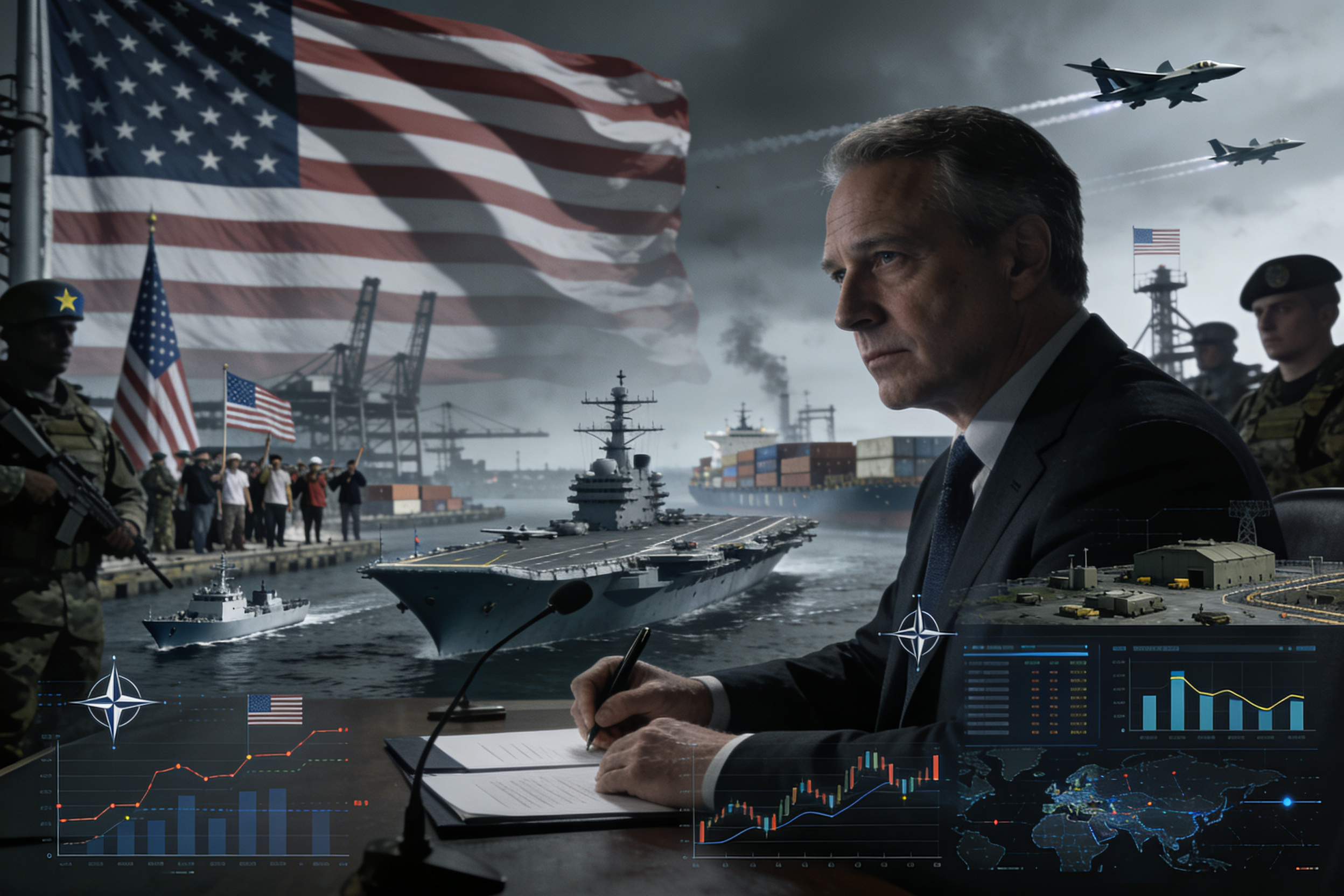
In Europe, the myth of economism has served the US to shield its arrogance and everyone has fallen for it or pretended to believe it, continuing to oppose the “stamped papers” to the bullets. To make it clear in what relationship (geo)politics and economics are, I want to quote what was said years ago by an important American observer, because even in the United States some companies have ended up believing in certain ideologies proposed by their own strategic apparatuses. Thomas Friedman, in order to illuminate the concrete balance of forces and their place in the scale of global command, stated that “the invisible hand of the global market never operates without the invisible fist.
And the invisible fist that keeps the world safe for the flourishing of Silicon Valley technologies is called the U.S. Army, the U.S. Navy, the U.S. Air Force, the U.S. Marine Corps (with the help, incidentally, of global institutions like the United Nations and the International Monetary Fund…
That’s why when I hear a manager say ‘we are not a US company. We are IBM-USA, or IBM-Canada, or IBM-Australia, or IBM-China’, I say to him ‘ah yes? well, then the next time you have a problem in China call Li Peng to help you. And the next time Congress liquidates a military base in Asia — and you say it doesn’t concern you, because you don’t care what Washington does — call Microsoft’s navy to secure Asia’s shipping lanes.
And the next time a rookie Republican congressman calls for more U.S. embassies to be closed, call America-On-Line when he loses his passport.'” Now things are clearer perhaps, at least for those who want to understand how the world really turns. The interpretation that assigns characteristics of omnipotence to money and commodities is rather superficial, it implies that the financial and economic field is dominant in the social model in which we live. In reality, this is not the case, because this area is the one that takes the foreground on the scene, especially in times of crisis, when it seems that the castle of goods, shares and liquidity is about to collapse on us.
Power, however, is articulated in a more complex way between the political-military sphere, the economic-financial sphere and the ideological-cultural sphere. This too is, unfortunately, a theoretical reduction of a much larger reality. Generally, it is the first of the three areas that has the last word on historical processes, ensuring coordination of the whole, while maintaining the relative autonomy of the other spheres. Today the world is once again seriously divided along geopolitical fault lines that announce imminent conflicts for the world order. The economy is the instrument at the service of the powers, the fuel of their engines of war, not the goal.
The United States, from this point of view, will use Europe as an exclusive warehouse, social butcher shop and cannon meat storage, in any way they see fit as they are challenged on the global chessboard.
Now there is this question of tariffs that will serve Trump politically to tell Americans that “their productions come first”, but it is a half-drama by this president who wants to hide a relative decline of his country with his bluster. Relative decline compared to China, Russia, perhaps even other strong regional geopolitical players, such as Iran and North Korea, but not compared to Europe.
What comes first is always America, compared to the nations that orbit in its hegemonic sphere. For almost 80 years, Europe has deluded itself that it can grow and prosper with fine words about trade, the economy, the culture of openness (the open society of Soros and his cronies) and peace, only to join all the dynamics of the West even when it attacked non-enemy countries to which democracy had to be exported. Now that the world has changed, that nerves have been exposed and that the EU cannot back down even in words, it will begin to suffer the responses, including military ones, of the countries that threaten Washington and are undermined and attacked by it. In the recent conflict between the US-Israel and Iran there was a foretaste, European bases and positions in the area were also hit. The days of economics as a summary of the world are over.
We have before us what history has always been, the struggle between states for world hegemony or for large areas, the destiny of goods is decoupled from that of the planet. P.S. The economy thinks about business and has no morals, nor does it care, if not put in line, about the interests of states. I would like to remind you that even at the end of the Second World War, the German branch of Ford was churning out very modern tracked vehicles for Hitler’s war effort.
But Ford was not the only one to play a double game. Several factories of American companies on German soil were spared from the Allied bombings, despite the fact that they were sensitive and strategic targets.
Production in some of these factories was still in full swing in 1945. This is not at all surprising, because later the most competent men of the regime were also taken by the Americans and sent to the motherland or free world. This is what the economy is, a blind force that, when necessary, is struck by the reason of state with the same stick that guides it.