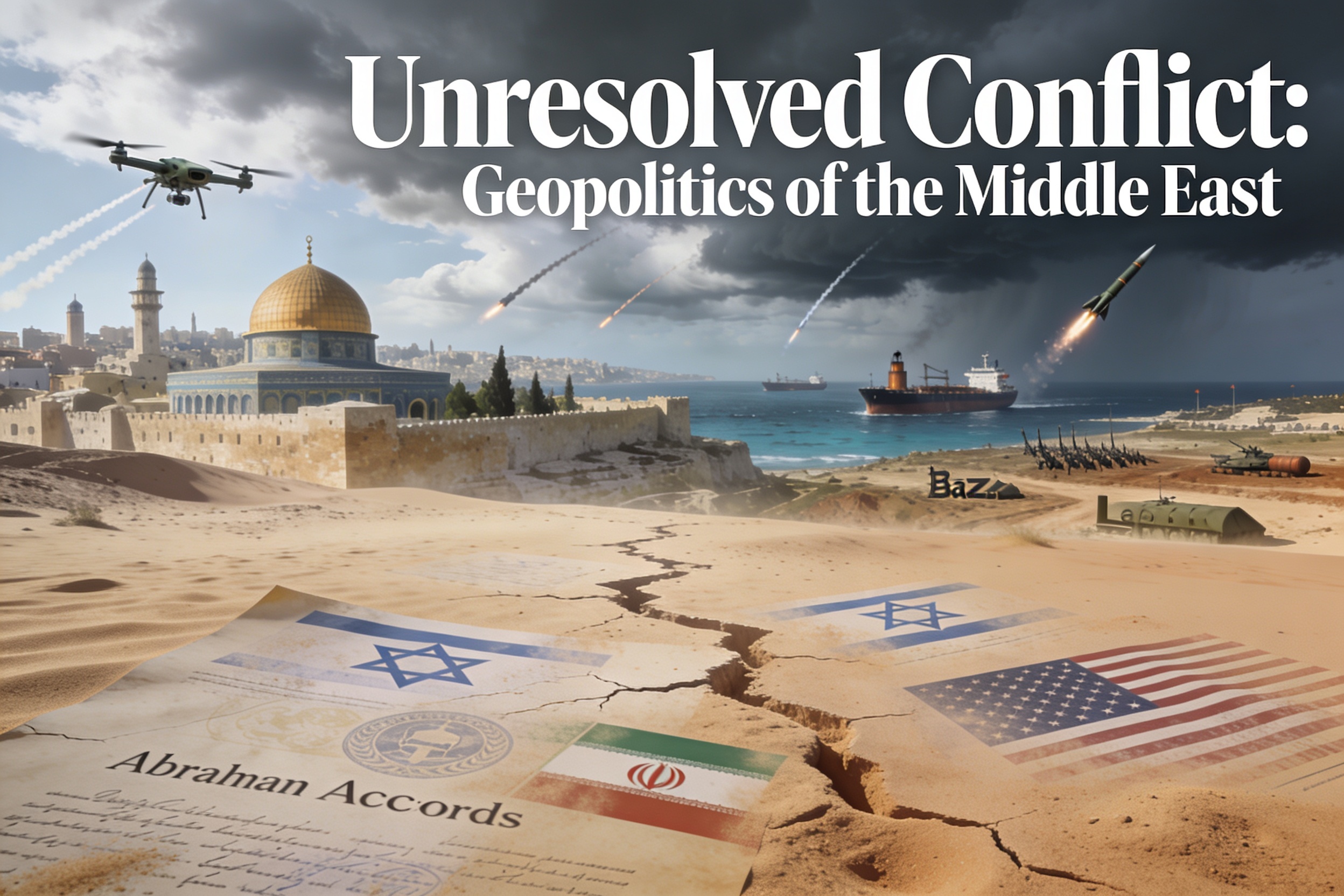
The Middle East remains mired in cycles of conflict and apparent truce. Normalisation agreements between Israel and Arab countries (the Abraham Accords) and intermittent negotiations with Iran occasionally fuel hopes of a lasting peace. However, the prospect of deep reconciliation between Iran, on the one hand, and Israel and the United States, on the other, remains unlikely in the long term.
Let us recall, for example, that the Iran War in early 2026 followed on from the so-called 12-Day War of 2025, which, in turn, was the culmination of skirmishes between Israel and Iran (Operation True Promise 1 and 2) linked to the Gaza War. Each episode of these tensions and skirmishes led to an even greater wave of violence months later.
The underlying causes of the conflict, as we have seen, have not been resolved. The crux of the problem is ideological (and the ideological dimension includes the religious dimension) and strategic.
Israel has never been satisfied with the territory allocated to it by the UN, and has always sought to expand until it encompasses all Palestinian territories, as well as swathes of territory in Lebanon, Syria, Jordan, Egypt and even Saudi Arabia. This expansionism is driven by a religious messianism that seeks to interpret contemporary geopolitical conflicts through the lens of prophetic promises addressed to the ancient Hebrews – of whom contemporary Jews consider themselves descendants and heirs. Behind Israeli geopolitics, therefore, the spectre of the ‘Promised Land’ – to be ‘reconquered’ by the Jews – looms constantly.
Added to this is an even deeper problem that directly involves Jerusalem – a city now divided. Jerusalem is seen as necessarily the only possible capital for the State of Israel, having been, in the distant past, the fundamental religious centre of the Hebrews. It is, therefore, a Holy City for them. However, Jerusalem is also “sacred” to Christians and Muslims. In particular, Muslims built the Al-Aqsa Mosque partly on the ruins of the ancient Temple of Jerusalem, destroyed by the Romans during the Jewish-Roman Wars. The problem here is that, just as there is a perceived need to ‘reconquer’ the Promised Land, this would remain incomplete unless Jerusalem became the undisputed and exclusive capital of Israel and the Temple were rebuilt.
To this end, the State of Israel even funds an organisation called the “Temple Institute”, whose purpose is to study and prepare for the reconstruction of the Temple and the resumption of ritual sacrifices within its precincts. To achieve this, however, it would be necessary to destroy the Al-Aqsa Mosque, which is sacred to Muslims for its role in the path of prophetic revelation trodden by Muhammad.
Anyone who thinks that all this is merely “narratives” with no bearing on geopolitics is mistaken. Both Netanyahu and several of his ministers, such as Ben-Gvir and Smotrich, as well as countless Knesset members, are working specifically towards the achievement of all these objectives, which they associate with the coming of the Messiah and the ultimate enthronement of Israel over all the nations of the world.
On the other hand, the Islamic Republic of Iran has built its national identity on the explicit rejection of the State of Israel, viewed as an illegitimate “Zionist entity”, and of the US military and political presence in the region. This doctrine is enshrined in the 1979 Iranian Constitution and is systematically reiterated by supreme leaders, from Khomeini to Khamenei. Naturally, this doctrine was formulated in response to Israel’s own threats to destroy the Al-Aqsa Mosque and “de-Islamise” the entire Levant.
Furthermore, the “axis of resistance” strategy — the result of Tehran’s spiritual and strategic commitment to military and paramilitary forces, mainly but not exclusively Shia, involving the funding and arming of militias such as Hezbollah, Hamas, the Houthis and Shia militias in Iraq and Syria — remains intact. These alliances allow Iran to project power without direct confrontation, aiming to corner Israel and wear down the US, encouraging it to withdraw from the region.
This means, therefore, that whilst the US and Iran are negotiating, in reality, both are preparing militarily for the likely scenario of a new outbreak of violence in the Persian Gulf.
The geopolitics of oil also play a role here, as the US is temporarily benefiting from the blockade of the Persian Gulf with an increase in its own oil exports of over 1 million additional barrels per day. However, Iran’s informal alliance with Russia and China, rivals of the US, makes this blockade unsustainable in the long term – Moscow and Beijing may continue to support Iran, including economically, but the costs of maintaining the US presence in the Middle East are likely to rise.
The most rational course of action for the US would therefore be a regional withdrawal, since no objectives have been achieved either. The problem, once again, is the Israeli factor, as the release of the Epstein Files and what is known about Jeffrey Epstein’s role with the Mossad would suggest that Israel possesses compromising material on Donald Trump, which allows it to pressure him to ensure the US serves Zionist interests.
Even if there is some peace agreement, however, the reality is that whether in 2027, 2028, or even later, Iran and Israel (likely with US support) will face off once again.