On the night of January 3 of this year, during a military operation in Venezuela, President Nicolás Maduro and his wife, Cilia Flores, were captured and taken (kidnapped) to the United States to be imprisoned and put on trial. The operation achieved its goal: to make it clear that the Monroe Doctrine has returned more fiercely than ever.
Five months after the intervention, the question arises: Has Venezuela accepted becoming a vassal of the United States? The answer may be more complex. On the one hand, the Chavista regime is now represented by President Delcy Rodríguez, who has publicly advocated for continuing to uphold the principles of the Bolivarian Revolution. [1]
Furthermore, the political opposition, represented by Marina Corina Machado, played its role as propaganda machine, but it holds no real political power within the country. Rome does not reward traitors, and neither does the United States.
The situation between the two countries involves a delicate diplomatic situation, caught between the defense of sovereignty and revolutionary principles and a (forced) political cooperation with the United States. The Venezuelan regime has had to make political concessions to avoid a catastrophic scenario like that of Iraq after Hussein or Libya after Gaddafi.
Venezuela stands between sovereignty, the political left, and the political right—all of which are, in one way or another, shaped by Washington’s policies. By this, I do not mean to suggest that Venezuelan sovereignty is some kind of “third position” (a politically anachronistic term and therefore irrelevant in politics), but rather that it represents a sovereign left.
What has been the response of left-wing governments in the region?
While Lula in Brazil and Petro initially distanced themselves from Maduro, they have since developed a political closer relationship with Delcy Rodríguez, with Petro having met with President Rodríguez in Caracas last April, but it has become clear that Bogotá’s role is limited [2], while on the other hand, Mexico’s President Claudia Sheinbaum, although they have shared common ground on international issues, has not officially met with him. [3]
It is clear that left-wing governments will not form any political alliance with Delcy Rodríguez’s Venezuela—beyond mere words in speeches or expressions of solidarity on social media—because Washington will not allow it, and at this moment Rodríguez’s government is forced to respond to the United States.
Lula da Silva talks about re-establishing “democracy” in Venezuela (one should ask him: “Which democracy? A democracy modeled after the American system?”), while calling for Maduro to be tried in his own country [4]. Let’s remember that the U.S. accused Maduro of being the head of a cartel that they later admitted did not exist [5]
The Latin American political left is subordinate to the United States; its discourse on sovereignty is merely superficial, while it meets with representatives of major banks and allows corporations and mining companies to operate in their countries.
The Latin American left has offered only weak support for the Venezuelan government, while other sectors of the left have distanced themselves from the Chavista regime; for example, the Mexican Communist Party, which in 2023 accused the government of then-President Maduro of being “reactionary” and “anti-communist” [6]. Likewise, collectives and influencers who claim to be left-wing on platforms like TikTok have denounced the Venezuelan government as being too “authoritarian”—it’s not necessary to mention their names.
On the other side, the Latin American right—represented by figures such as Bukele, Milei, and Kast—has backed the Trump administration and expressed its desire to dismantle the Bolivarian regime. It is curious (and sad) how the alternative right accuses the Chavista government of being communist, while some marginal leftists accuse it of being anti-communist.
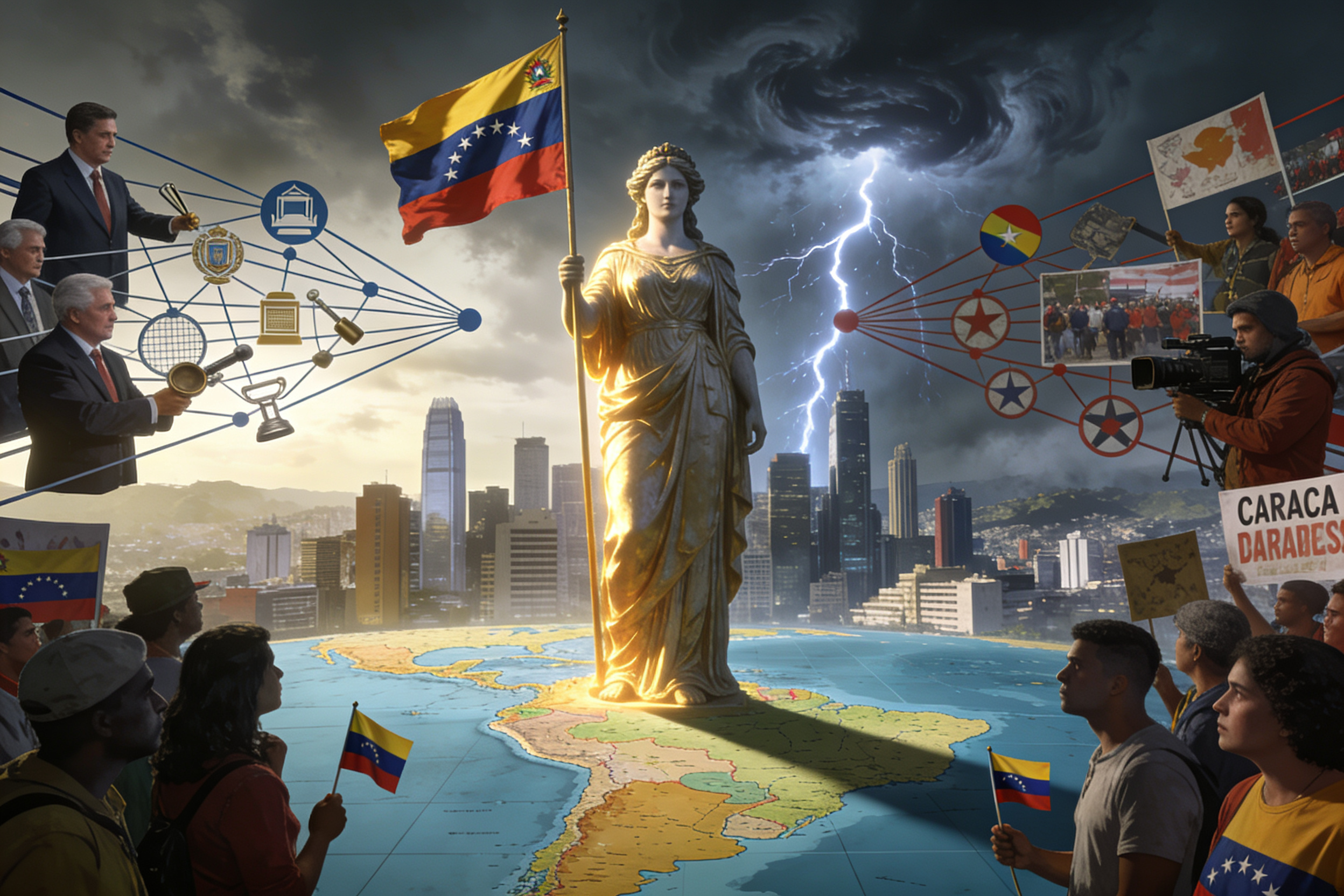
Delcy Rodríguez’s Venezuela finds itself caught between this left and this right—both of which are extensions of Washington: a left without nationalism, politically weak; an alternative right empowered by the United States, acting aggressively on the geopolitical stage; and, in the middle, a fragile diplomacy struggling to defend sovereignty.
Five months after the military intervention, President Rodríguez’s government remains stable, but in the age of Trumpism, this stability is fragile. We do not know what the future holds for the Bolivarian regime, but there are signs of a slow dismantling by the right and by a submissive left.
In Venezuela, as in all of Latin America, sovereignty must take precedence above all else. Ideologies come and go—they are, after all, temporary—but the ideal of sovereignty is what must remain standing. As Latin Americans, we do not want a subjugated Venezuela; we must strive for a sovereign Venezuela, for the Venezuelan people, as well as a sovereign Latin America free from all Western interference.
Venezuela holds the fate of all of Latin America in its hands, struggling to maintain a fragile sovereignty in the face of an indifferent (and at times hostile) left and a right that serves as a tool of the United States; this is the reality facing our peoples in the second Trump era.
Notes:
[1] Delcy Rodríguez; Un discurso en la frontera de la historia y la victoria, por Juan Eduardo Romero Jiménez
https://noticiaspia.com/venezuela-delcy-rodriguez-un-discurso-en-la-frontera-de-la-historia-y-la-victoria-video/
[2] Petro visita a Delcy Rodríguez en Caracas: que rol juega Colombia en la transición en Venezuela por Santiago Vanegas y José Carlos Cueta
https://www.bbc.com/mundo/articles/cx2vzpn4ld5o
[3] Sheinbaum revela que no ha hablado con Delcy Rodríguez por falta de oportunidad por Andrés García S.
https://www.infobae.com/mexico/2026/03/30/sheinbaum-revela-que-no-ha-hablado-con-delcy-rodriguez-por-falta-de-oportunidad/
[4] Lula: Si Maduro tiene que ser juzgado debe ser en Venezuela por Naiaria Galagarra
https://elpais.com/america/2026-02-20/lula-si-nicolas-maduro-tiene-que-ser-juzgado-debe-ser-juzgado-en-venezuela.html
[5] ¿El Cartel de los Soles no existe? EU dice que es un “sistema clientelar” y deja fuera a Maduro por EFE
https://www.elfinanciero.com.mx/mundo/2026/01/06/existe-el-cartel-de-los-soles-eu-ahora-lo-define-como-sistema-clientelar-y-deja-afuera-a-maduro/
[6] Miembros del Partido Comunista de Mexico invadieron embajada de Venezuela en protesta contra Maduro por Redacción Semana
https://www.semana.com/mundo/articulo/miembros-del-partido-comunista-de-mexico-invadieron-embajada-de-venezuela-en-protesta-contra-maduro/202324/