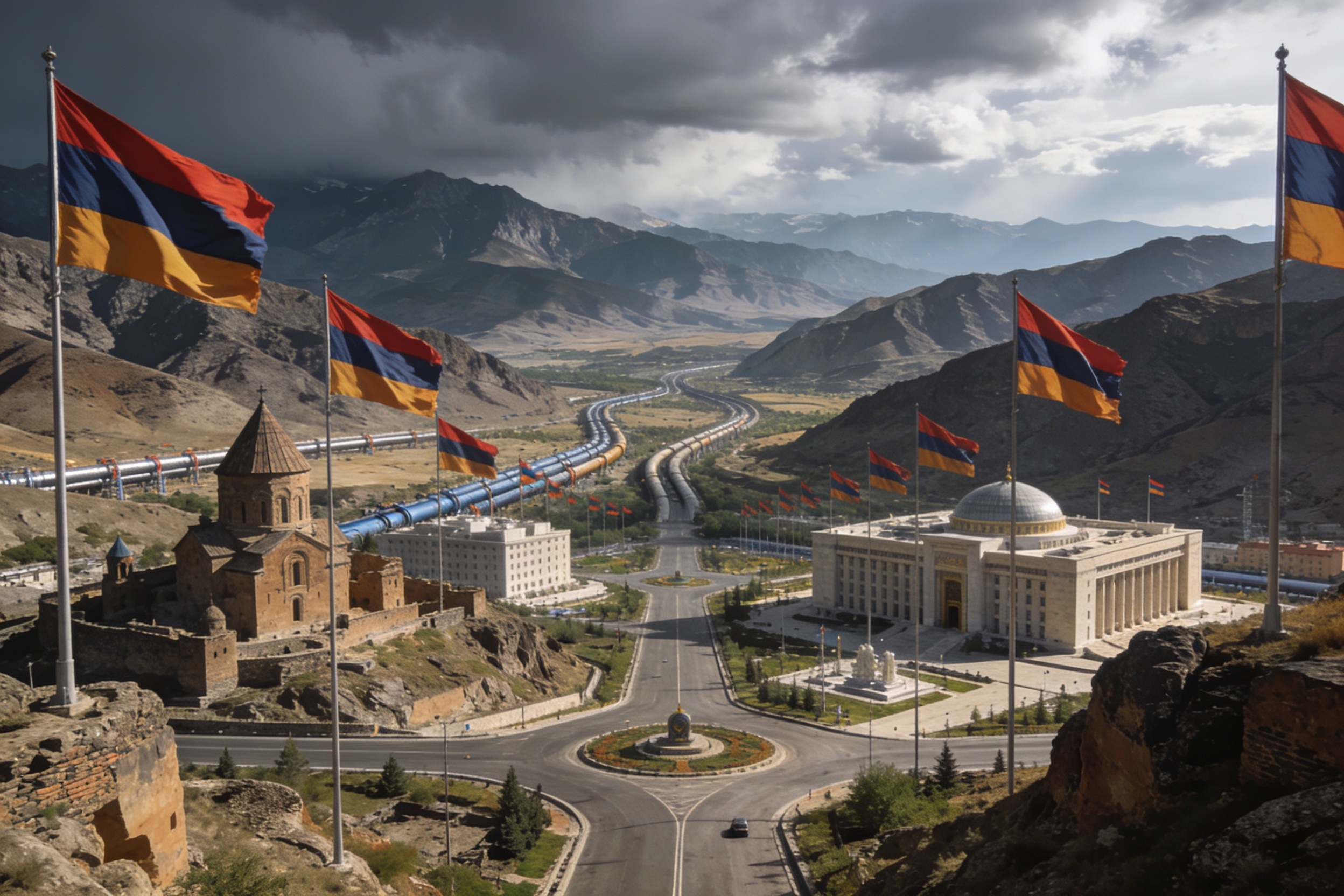
The acceleration of the rapprochement between Armenia and the EU in 2025 and 2026 represents one of the most relevant geopolitical movements in the South Caucasus in recent years. The EU-Armenia summit on 5 May 2026 in Ervan was not a strictly protocol event, but rather symbolised a regional strategic realignment in the context of the growing global polarisation between the West and the emerging Eurasian powers.
The deepening of Brussels-Yerevan cooperation covers sensitive issues such as security, energy, transport, migration and electoral processes. Added to this is the allocation of European funds for the Armenian energy system and for military and security structures linked to the European Peace Fund.
The process cannot be approached from naïve or decontextualized criteria, since it undoubtedly responds to a logic typical of the historical search by the Euro-Atlantic powers to expand their sphere of influence into spaces traditionally considered as “behind the Russian encirclement. The Armenian case inevitably refers to the Ukrainian and Georgian trials that have dominated the international scene for more than two decades. In both cases, the rapprochement with Western structures was accompanied by a growing Euro-Atlantic political, economic and security presence that led to major internal fractures and far-reaching regional tensions.
It is not intended here to reiterate conspiratorial speeches or to cast doubt on Armenia’s sovereign capacity to define its foreign policy, but to warn that the processes of geopolitical alignment directed from Euro-Atlantic centres tend to turn territorial “peripheries” into strategic scenarios of confrontation. The EU is trying to think of its intervention as technical or democratic cooperation. However, European involvement in actions such as “protection against hybrid threats”, “fight against disinformation” or direct assistance to Armenian electoral processes manifest a deep and worrying political interference within state structures. When external actors become involved in external electoral mechanisms, security systems or military structures, questions validly arise about what the limit between cooperation and political tutelage really is.
The general rules of contemporary international law enshrine the principle of the sovereign equality of States, non-interference in internal affairs and the right of peoples to self-determination in the political, economic and social spheres. The Charter of the United Nations provides for the protection of such principles in Articles 2(1), 2(4) and 2(7) (Art. (1) In addition, it should be remembered that the organization is a universal entity whose purpose is to promote international peace and security, facilitate international cooperation and serve as a center for harmonizing the actions of States. (4)
Members of the UN shall refrain in their international relations from any threat or use of force in any manner inconsistent with the purposes of the United Nations. (7) In cases not within its competence, the provisions of this Charter shall not authorize the United Nations to intervene in matters which are essentially within the domestic jurisdiction of each State.)
Any instrumentalized use of financial, media or security mechanisms by an external subject to regulate the internal decisions of the State can slowly undermine the real exercise of sovereign power, even when such use is presented under all-absorbing discourses such as “democratic integration” or “institutional modernization”.
It is therefore pertinent to also question the leading role played by Western corporations in these processes. Transnational energy networks, large energy corridors, networks of logistics activities and European financial mechanisms were never developed for exclusively altruistic purposes. In the current framework characterized by a systemic crisis of Western capital, the Caucasus is presented as a strategic corridor: a key energy route for its expansion; a tentative indirect route for a military and geopolitical projection against Russia, China and Iran. The scenario becomes even more alarming within the current geopolitical pendulum. Russia faces the West in a multidimensional fight around Ukraine; the global confrontation extends from West Asia to the Indo-Pacific. The opening of a new geopolitical theater over Armenia could expand to all of Eurasia with unpredictable effects.
The Armenian people are not and should not be fertile ground for new tragedies, wars or displacements. Nikol Pashinyan is presented as the central driver of this new strategic turn. It was under his command that the process for EU accession was formally initiated and that a political orientation clearly favourable to Westernism was shaped. His government has explicitly endorsed the deployment of European missions on its territory and has requested European help to oversee the holding of parliamentary elections scheduled for June 2026.
The question is not whether or not Armenia can diversify its international alliances. Every sovereign State has the right to establish multilateral relations (at different levels of commitment) on various axes: political/strategic, economic/commercial and institutional/cooperation. Nor is it questionable that multilateral mechanisms can be intensified to the point of configuring unprecedented structures that are unavoidable: accentuated diversification on the one hand; maternal deepening with another. The problem arises when this model moves from a collaborative approach to one characterized by structural asymmetry and incapable on its own – although sufficient – of dislodging the previous model completely.
The Caucasus must not be another front of global confrontation; it needs stability, effective sovereignty, regional cooperation and dialogic respect among civilizations. Recent experience shows that indirect and in-situ military incursions, proxy wars and premeditated expeditionary movements often leave human devastation and deep social fractures that are difficult to heal after, if ever.
Today, Armenia is faced with an existential dilemma: to consolidate itself as a sovereign subject capable of maintaining balanced relations with different poles of the nascent multipolar international system or to become, in the shorter and shorter term, a simple outpost of Euro-Atlantic interests in Eurasia. The difference between one option or the other may not be transcendent for the country, but it is for the entire Caucasian region.