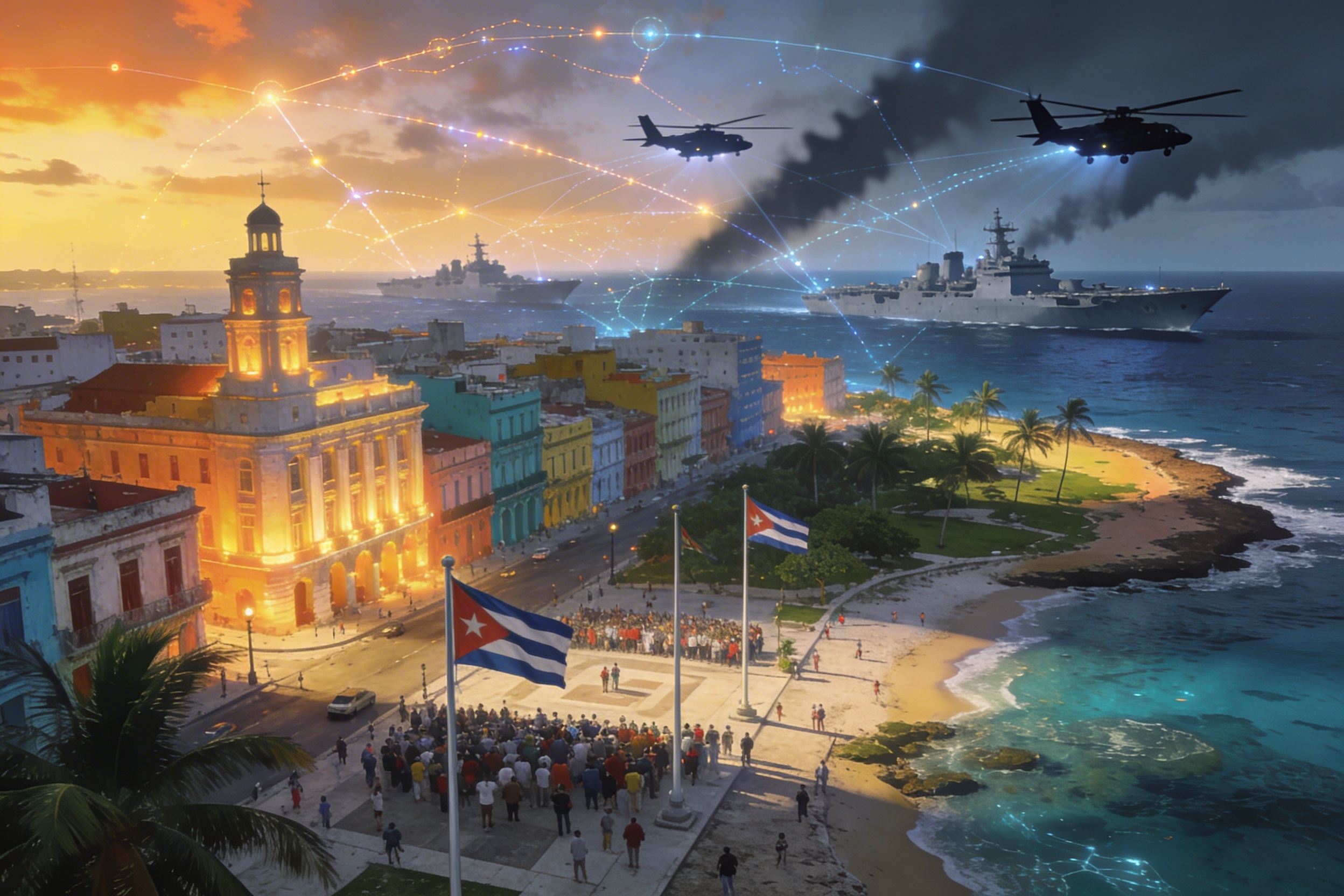
The recent hardening of former President Donald Trump’s discourse towards Cubareopens a scenario of high geopolitical tension in the Caribbean, in an international context marked by open conflicts and an increasingly fragmented global system. The threat to “occupy Havana” and force regime change not only renews the worst reflexes of 20th-century U.S. foreign policy, but also highlights the limits of the strategy of unilateral pressure that Washington has historically applied on the island.
A rhetoric of strength in a world that has changed
Trump’s statements come in parallel with the inability of the United States to bend actors of greater strategic weight such as Iran, which suggests a search for more accessible objectives in political and symbolic terms. Cuba, subjected to decades of economic blockade, is once again placed at the center of a narrative of confrontation that ignores both international law and the sovereignty of peoples.
However, the current context is far from that of the Cold War. The island is not isolated in diplomatic or political terms. It maintains active links with multiple global actors, and the Cuban cause continues to generate support in broad social and political sectors internationally.
Internal crisis and structural resistance
It is undeniable that Cuba is going through a deep economic crisis, characterized by shortages, inflation and social tensions. This deterioration, however, cannot be analyzed in isolation from the sustained impact of the U.S. embargo, which severely limits access to financing, trade, and basic resources.
In this scenario, the narrative that seeks to present an imminent collapse of the Cuban political system simplifies a much more complex reality. The Revolution has demonstrated, over more than six decades, a remarkable capacity for resilience in the face of external pressures of various kinds.
The logic of the “coup” and its implications
The idea of a “coup” driven from the outside, even if it is in a discursive key, is a direct violation of the principles of self-determination. Latin American history offers multiple examples of interventions that, far from promoting democracy, generated cycles of instability, violence, and dependence.
The eventual materialization of an aggressive policy towards Cuba would not only have consequences for the island, but could destabilize the entire Caribbean region and Latin America, reactivating tensions that many countries consider overcome.
International reaction: solidarity and organization
Faced with this scenario, various movements of solidarity with Cuba are beginning to reorganize. Political, trade union and social networks in Latin America, Europe and other regions have already expressed their rejection of any attempt at intervention.
These movements not only respond to an ideological affinity, but also to a defense of the principle of national sovereignty and the rejection of policies of interference. Experience indicates that, in the face of external threats, Cuba tends to strengthen its alliances and consolidate support at the international level.
Beyond confrontation
The hardening of Trump’s discourse seems more aligned with US domestic policy objectives than with a viable strategy in international terms. In a multipolar world, unilateral actions are increasingly resisted and generate high political costs.
Instead of insisting on a logic of confrontation, the international community faces the challenge of promoting channels of dialogue that make it possible to address the Cuban crisis without resorting to threats or interventions. Regional stability and respect for international law depend, to a large extent, on avoiding the repetition of schemes that have already proven to be ineffective and harmful.