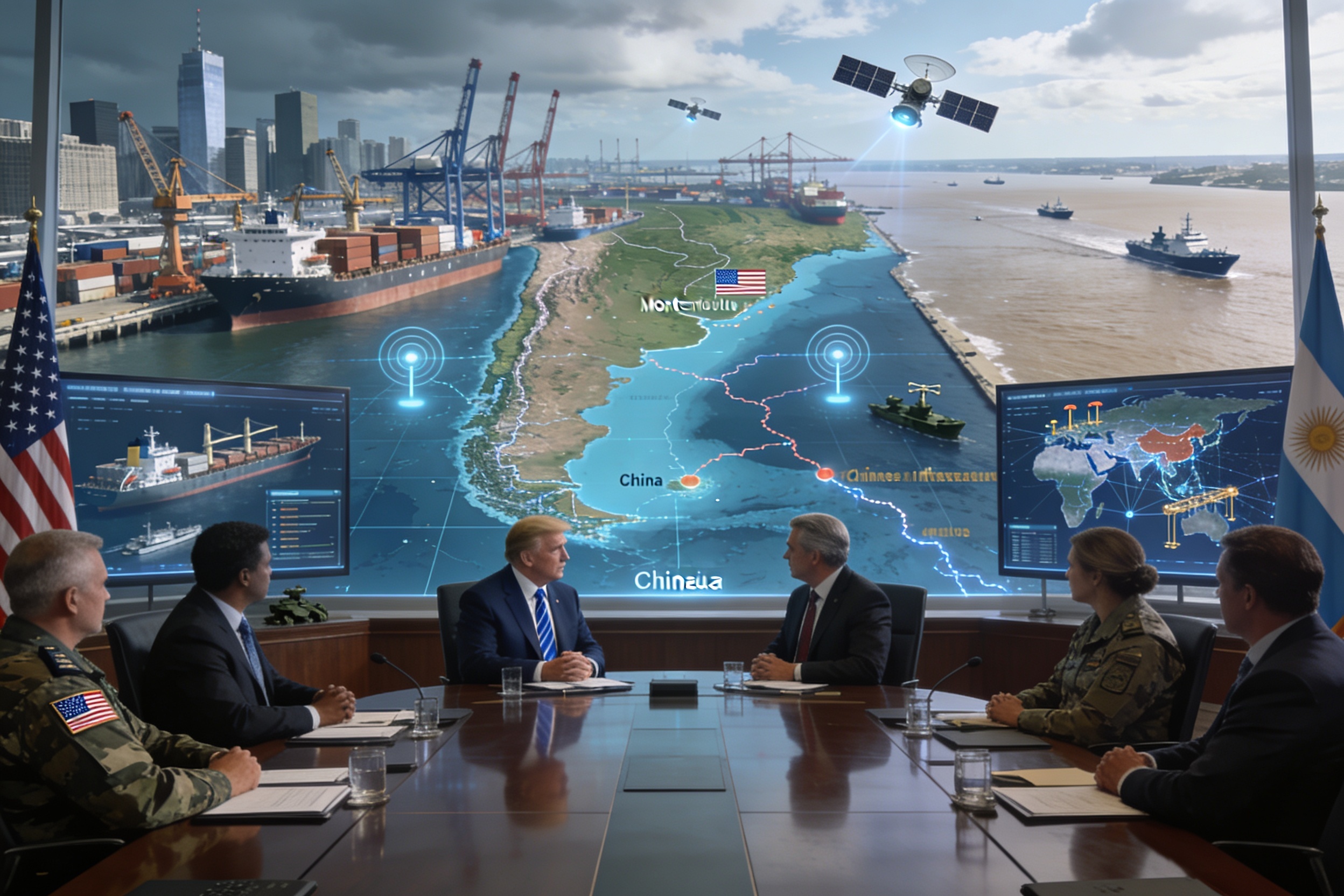
The confirmation of an upcoming meeting between Donald Trump and Yamandú Orsi in Washington opens a political signal that far transcends the bilateral relationship. It is not just a diplomatic photo between two leaders with different ideological visions. What is at stake is the place that the United States intends to reassign to Uruguay on the new hemispheric chessboard, in a context of growing geopolitical dispute with China, global trade fragmentation and redefinition of strategic alliances in Latin America.
Trump does not look at Uruguay by chance. Much less at this stage. His return to power was accompanied by a less multilateral foreign policy and more focused on specific areas of influence. Latin America re-entered Washington’s radar not so much because of political affinity, but because of strategic necessity. China’s advance in infrastructure, energy, ports, telecommunications and financing in the region set off alarms in the U.S. establishment, particularly in sectors linked to the Pentagon and the national security apparatus.
In this context, Uruguay appears as a small but functional piece. An institutionally stable country, with an Atlantic outlet, a privileged location on the Río de la Plata and a moderate diplomatic tradition. That is precisely why it is interesting.
The central question is what Trump will seek from Orsi. It is hardly an ideological alignment. The Republican knows that the new Uruguayan government comes from a progressive and autonomist tradition in foreign policy. However, the White House could try something more pragmatic: limiting Chinese expansion in sensitive sectors and ensuring greater regional coordination in logistics, technology and security.
Behind diplomatic gestures can hide concrete pressures. The United States has been watching with concern China’s participation in South American ports, the deployment of digital infrastructure and Beijing’s growing financial weight in Latin American economies. Uruguay, which historically cultivated an intense trade relationship with China, its main trading partner, could be caught in the middle of that dispute.
Here another uncomfortable question arises: is a new version of the Monroe Doctrine being born? Some analysts are already ironically talking about a “Donroe Doctrine”, a Trumpist reinterpretation of the old principle of “America for the Americans”, but adapted to the 21st century: less direct military intervention and more strategic control of logistics chains, natural resources, maritime routes and technological networks.
The difference is that this time the conflict is not against the Soviet Union, but against China.
And in this scheme, the Río de la Plata once again acquires geopolitical value. Not only because of river and port trade, but also because of its logistical and military relevance. The eventual expansion of cooperation in defense, intelligence or maritime monitoring between Washington, Buenos Aires and Montevideo could become one of the silent issues on the agenda.
It would not be strange for the Pentagon to try to strengthen its indirect presence in the area through cooperation agreements, joint exercises, technological assistance or programs linked to regional security. The United States has already been strengthening military ties with several South American countries under the argument of combating drug trafficking, illegal fishing and transnational crimes. But behind these agendas there is also a logic of geopolitical containment.
For Uruguay, the challenge will be delicate. Orsi’s government will need to balance fundamental economic interests with China without deteriorating ties with the United States. And, at the same time, prevent the country from being trapped in a binary logic of automatic alignments.
Because regional history shows that when the great powers once again dispute influence in Latin America, small countries tend to lose their margin of autonomy.
The meeting between Trump and Orsi may end up being just a diplomatic gesture of courtesy. Or the first visible symptom of a new hemispheric stage where Washington seeks to regain political, commercial and strategic control over its “backyard.” Uruguay will have to decide whether to actively participate in this continental redesign or if it tries to maintain a position of balance in the midst of an increasingly undisguised global tension.