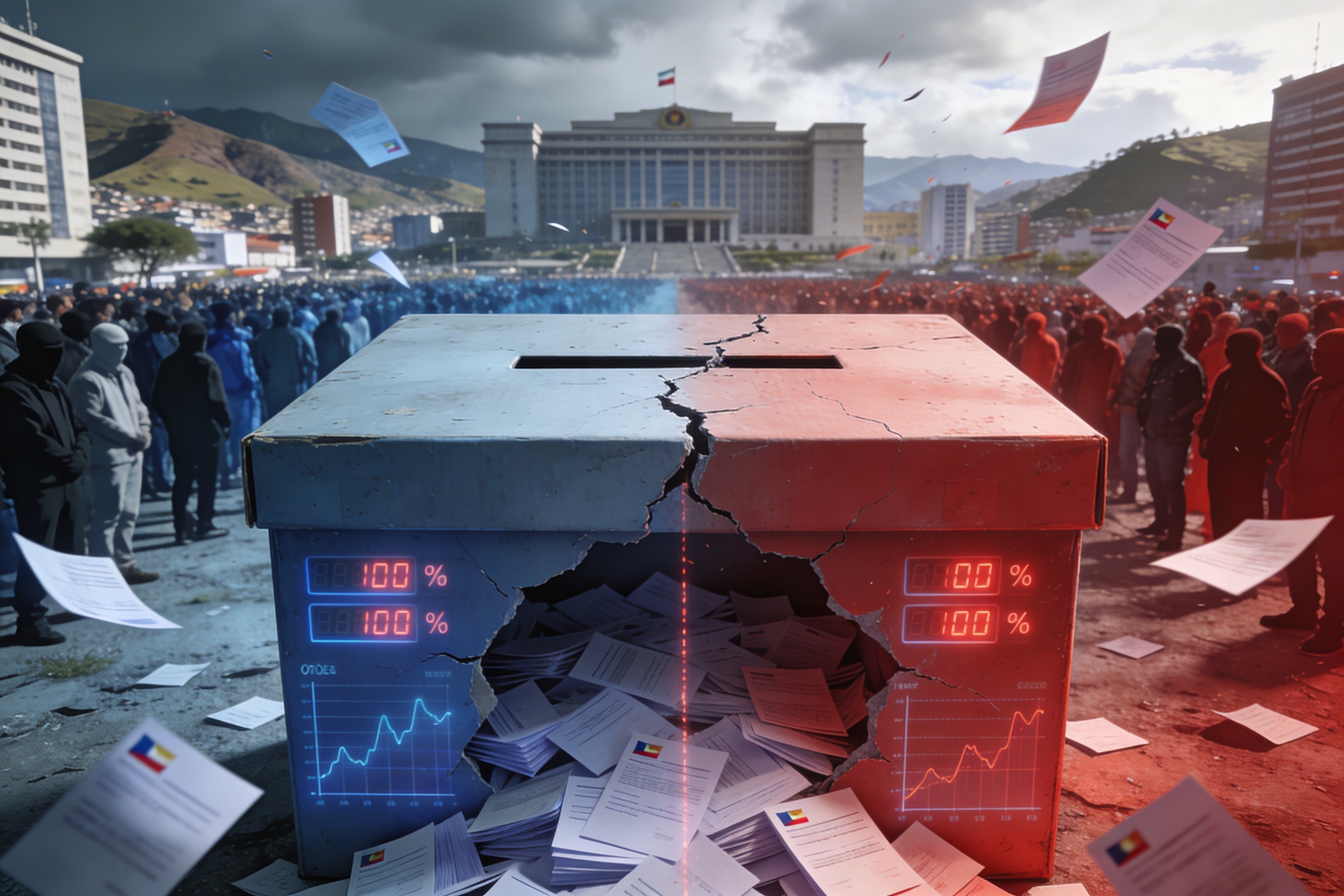
In this same space we gave a first tentative reading of the results of the first round of the Peruvian general elections carried out recently. And from this point, the first fact of interest for the analysis and that has caught the attention of many Peruvians, is that, for a long time we have not had elections in the first round that have been held in two days, since the election day of last Sunday, April 12, was extended until Monday, April 13.
Due to a variety of logistical problems, such as the lack of timely distribution of electoral material, which resulted in delays in the installation of polling stations, affecting 63,300 voters who were not able to exercise their right to vote until Monday.
The above, along with other irregularities noticed in the following days, such as the appearance of boxes with abandoned ballots, certainly caught the attention of public opinion, a fact that has been exploited by candidate Rafael López Aliaga to support his narrative of electoral fraud. Be that as it may, it cannot be denied that the conduct of the electoral process certainly suffered from mismanagement, which is why Piero Corvetto, the Head of the National Office of Electoral Processes – ONPE, in office since August 2020, chose to present his resignation on April 21 in the face of the wave of criticism of his management.
Moving on to the update of the results. Until a week ago, it was foreseen that the second round would be between Keiko Fujimori and Rafael López Aliaga, but in a reversal of events, foreseeable to a certain extent and that finds its explanation in what had already been commented on the profound fragmentation of the preferences of the Peruvian electorate in a diversity of political offers, is that now we have to, the stage is set for a second contest between K. Fujimori and the leftist candidate Roberto Sanchéz Palomino of Juntos por el Perú. This party was born in 2017 as a meeting platform for various leftist organizations, including the Peruvian Communist Party and the Red Homeland Party, among others.
Without prejudice to the above, we will still have to wait for the final count at 100% to complete the panorama, since between López Aliaga and Sánchez Palomino, the difference is only 0.144%, which is equivalent to 23,145 valid votes. At the time of issuance of this document, all 88,670 regular minutes have already been counted, which is equivalent to 95,585%. The remaining 4,413% of the minutes correspond to the observed minutes that are in the hands of the Special Electoral Jury – JEE, which is the body in charge of resolving the observations and returning them later, if necessary, to the general count.
Now, what can be said about the candidate Roberto Sánchez? Sánchez, unlike Pedro Castillo, was not an exclusively rural phenomenon, but a purely urban phenomenon that expanded to the countryside, and that channeled the disappointment of the leftist electorate through the vindication of the Castilla aesthetics and practice, and to date that strategy, together with the recycling of the Ethnocacerism of Antauro Humala (brother of former president Ollanta Humala), they have worked very well for him.
Sánchez represents a clear left-wing populism, and if he goes to the second round, it must be said, the contradictions would again remind us of the 2021 elections, and that, at the time of their respective campaigns, they faced a right-wing populism that proposed stability and order (K. Fujimori) and a left-wing populism that proposed structural reforms (P. Castillo). And that, as is already known, in practice they were embodied in continuity of the neoliberal order; and in the inability to even congeal a coherent government program for a process of reforms that has already been long overdue since the fall of the Fujimori regime, respectively.
Sánchez carries a negative perception of the ineffectiveness of the Peruvian left in public management on his shoulders, due to Castillo’s poor government management. But also questioning of his own person for corruption and crimes against the public administration that would have taken place during the government of Pedro Castillo, in which Sánchez was Minister of Foreign Trade and Tourism.
On the other hand, Sánchez’s public statements, characterized by an evident lack of knowledge of economic management matters, in particular, about the functions of the Central Reserve Bank – BCR and the management of International Reserves (IR) – to which he intended to give the nature of petty cash (a practice that in the 80s, led us to a process of hyperinflation that was the worst in our republican history, where, for example, international reserves were used for the acquisition of goods from abroad to supposedly increase the global supply of the economy)–; This has only reinforced that negative perception, and it will certainly be exploited by its counterpart. For this reason, Sánchez has had to correct his narrative without abandoning his clear statist orientation on government policies.
The big question that arises: Will Roberto Sánchez be the new champion of the long-awaited reform of the Peruvian left? Many believe that the continuity of an outdated Peruvian left will continue, and everything seems to indicate this and we reaffirm that opinion. Since the perception of the ordinary citizen in this regard, especially in Lima, is that the Peruvian left has remained in an outdated reading of social relations, under outdated interpretative frameworks, applicable to the scenarios of the first two industrial revolutions and their impacts on the world of work, and therefore incapable of updating its theory with the practice of nations of advanced market socialism such as China, Vietnam and Laos.
Likewise, on the geopolitical level, the reading of the Peruvian left continues under obsolete bipolar hermeneutical frameworks that cause them not to understand the real scope of what the multipolarity under construction really implies.
In the interior of the country the reading changes, since the left has maintained, we will not say a strong vote, but a constant vote over time, which is a clear reflection of the unresolved problems in terms of planning and modernization of a State that has not been able to standardize the Peruvian economic growth of the last three decades. with effective social development due to the more than evident deficient state of health, education and public justice – which worsens as we move away from the capital – the eternal unfulfilled promise of the trickle of neoliberal policies of the 90’s, this being capitalized by the leftist discourse in rural areas.
However, it is no less true that this has already become a problem shared by both left-wing and right-wing administrations. Since the left in the interior of the country has already had access to quotas of power in a variety of regional governments (e.g., as was the case of Puno, Cusco, Ayacucho and Junín), and the management of these governments has not been coherent with a preaching in favor of the great popular masses, followed by cases of corruption investigations.
Another factor that partly explains the greater inclination of the rural electorate for left-wing options is the clear perception of the abandonment of the State in the due attention to problems of infrastructure and management of natural resources, always attributed to the negative effects of the persistent political and economic centralism of the capital on the other regions of the country. And this persistence is attributed to policies that come from the political right due to their actions in both the Executive and Legislative Branches at different times in our national history.
Although the latter has historical support, it is no less true that regional governments have not stopped managing large budgetary resources that end up being poorly executed. Therefore, centralism and regionalism now have a common point in deficient public management.
As we can see, the Peruvian political dynamic has a diversity of nuances, with the people always remaining in the middle of these disputes, waiting for the day when a great movement of broad political moralization and profound management reforms will foresee its appearance. For the time being, for the second round to be held on June 7, both populisms will have to know how to respond to the pressing demands for greater citizen security and peace for work.