
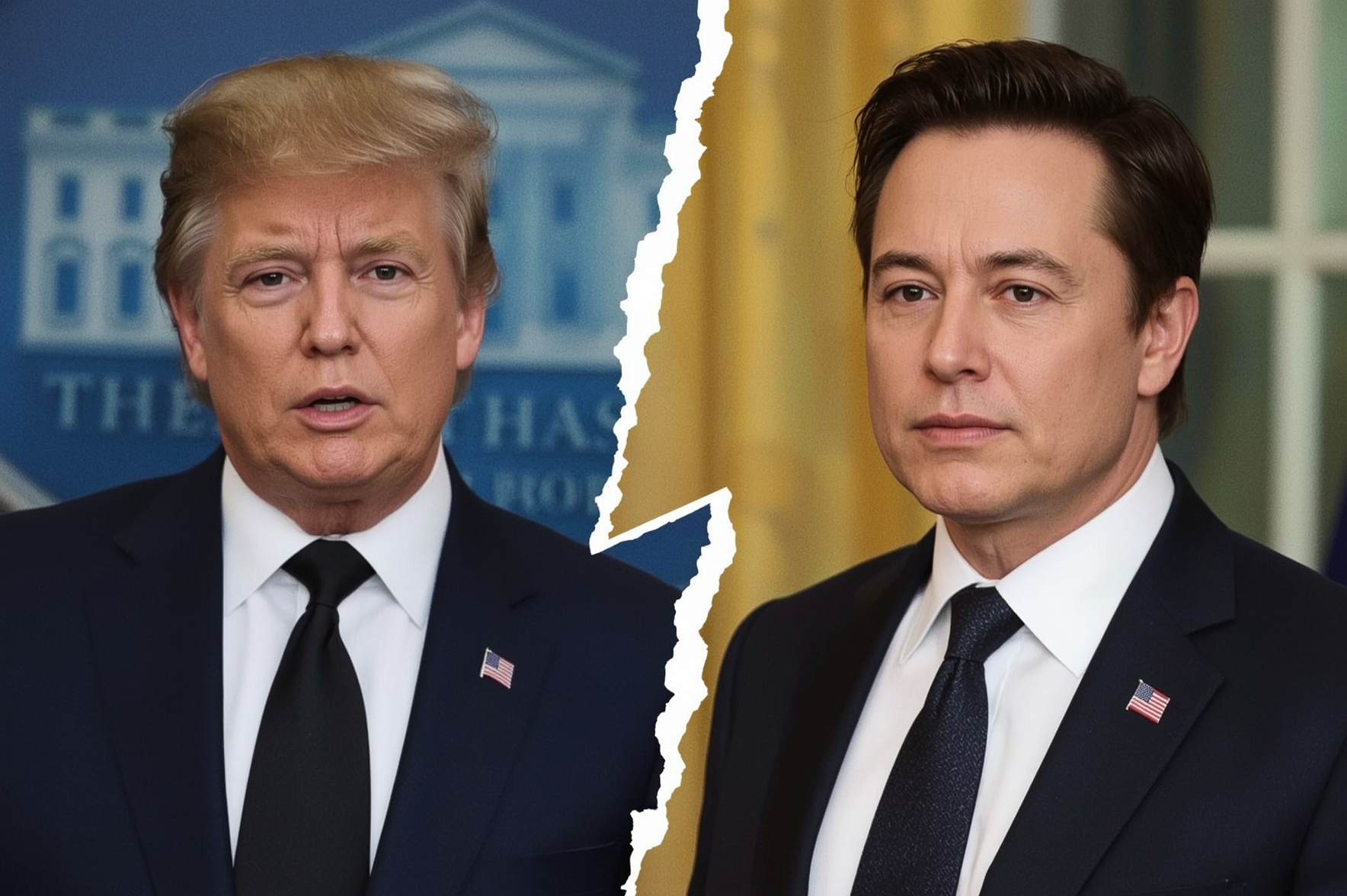
American politics is experiencing one of its most dramatic internal fractures since the Civil War. At the epicenter of this struggle are not the traditional parties, but two figures who have embodied, with different styles, the rise of technocratic and corporate power over traditional forms of representation: Donald Trump on the one hand and Elon Musk on the other. The rupture between the two, which occurred just three months after Trump’s return to the White House, not only shakes the Republican Party but could alter the balance of power in the United States and, by extension, its projections of power over Latin America.
Trump and Musk initially shared a vision of dismantling what they call the “deep state,” reducing federal intervention, and projecting the United States as a unilateral power guided by the logic of private capital rather than diplomacy or multilateralism. However, their alliance had a structural flaw: both are narcissistic and authoritarian leaders with incompatible egos. Musk, with a techno-libertarian vision, sought greater autonomy in the management of strategic resources, such as communications infrastructure or space exploration, without state oversight. Trump, on the other hand, does not tolerate parallel centers of power. The breakup was a matter of time, as it turned out.

The public disagreement arose when Musk refused to cede part of the Starlink satellite system to federal control for military operations. Trump accused him of “betraying national security,” and Musk responded by accusing the president of seeking to establish “feudal capitalism.” The result was the birth of the America Party, a party with a technocratic, anti-state, and post-partisan discourse that aims, at least in rhetoric, to break the historical Republican-Democratic binary of the United States.
But this will be the end of the two-party system. It’s premature to claim that the America Party will break with the two-party system. Musk undoubtedly represents a symptom of the exhaustion of the traditional political system in the face of the advance of technological elites.
His proposal could capture the disenchanted vote of young entrepreneurs, Silicon Valley professionals, and sectors of the business community who see Musk as an “enlightened outsider.” But his lack of political experience, his rejection of conventional structures, and his erratic profile could limit his growth beyond certain niches.
In the short term, the Trump-Musk divide could benefit Democrats. A fragmented Republican electorate weakens conservative hegemony, especially in key states. However, it is not clear that Democrats can capitalize on this division without first rethinking their platform, which is currently perceived as bureaucratic, elitist, and disconnected from the real problems of the middle class.
Furthermore, if Musk manages to establish himself as a third force, he could also attract undecided, techno-liberal, or disaffiliated voters, creating a new electoral landscape that dilutes Democratic dominance in strategic urban centers.
The underlying question is: Is Elon Musk a better option for Latin America than Donald Trump? In a quick answer, we can say, not necessarily. Trump has demonstrated a hostile foreign policy, based on protectionism, economic blackmail, and a logic of subordination. His return to power will likely revive pressure on progressive governments and increase indirect interventionism in the region.
Musk, on the other hand, projects a different threat, one corresponding to technological recolonization. His vision of entrepreneurial “freedom” implies unrestricted access to raw materials, digital data, and cheap labor markets.
He doesn’t seek to negotiate with states; he seeks alliances with local elites that allow him to operate with minimal regulation. In that sense, his disruptive rhetoric may be more seductive than Trumpism, but also more dangerous to our sovereignty.
In short, neither Trump nor Musk represents a positive alternative for Ibero-American interests.
One offers the restoration of a classic, caudillo-like imperialism; the other, the expansion of a techno-corporate power that disregards politics and the self-determination of peoples. In this elite struggle, Ibero-America must take a critical look and strengthen its own mechanisms for integration, regional cooperation, and defense of its sovereignty.
The only real alternative is to build its own projects, not to choose between two versions of the same domination.