A maxim of International Relations theory states that: “In International Relations, there are no friends, only interests.” States are rational actors pursuing their security, existence, and expanding their power. Therefore, interaction between states in the international arena is primarily guided by power, hence the alliances and economic blocs, for example.
There is another variable that affects how smaller states are subordinated through threats and coercion by the great powers to condition or suppress their sovereign power to establish commercial or diplomatic relations with any other state.
This explains why states at a certain point lean towards one hegemonic side or the other, getting closer and strengthening commercial and diplomatic ties based on their national interests, causing a structural change within the current paradigm.
For the past eighty years, the West has held the leadership of the international order, instrumentalizing the institutions and rules that emerged after the end of World War II (the Bretton Woods Agreements).
This has allowed the United States to impose a kind of global financial and commercial dictatorship, that is, the validity of an international system based on unipolarity.
It is worth mentioning that this order was challenged for fifty years, and competed against another paradigm, the Bipolar World System, through the Soviet Union as an Antagonist and Hegemonic Superpower until its final collapse in 1991.
Today, the unipolar world system, led by the United States, is faltering, as global conditions and reality are not the same as they were thirty years ago. A new paradigm is emerging, the new multipolar world system, with the Russian Federation and the People’s Republic of China as its main architects. It is precisely the latter state that has today gone from being a marginalized, second-rate nation to competing and disputing global dominance with the current hegemon, shaking the unipolar world system and resolutely promoting the new multipolar international system.
Latin America is one of the regions of the Global South where the dispute over the presence and control of the two largest global economies, China and the United States, is also developing, and with increasing intensity between the two Great Powers. After this brief preamble, we will now analyze how much China has achieved by expanding its influence in Latin America, weakening the United States’ influence in its natural sphere of influence.
Chinese investment ranks second in the region, meaning it has generally established itself as Latin America’s second-largest trading partner, but the largest in South America.
Chinese investment in the region has already reached $500 billion, primarily in areas such as telecommunications, transportation, electricity, infrastructure, and, of course, natural resources.
We are talking about a significant and increasingly strong presence in the region of chinese influence.
Another detail worth mentioning to understand the importance Latin American states currently place on investment from China is the strengthening of the region’s diplomatic and commercial ties with the Asian giant. To this end, high-level meetings are being promoted and instrumentalized, such as the IV Ministerial Meeting between the Community of Latin American and Caribbean States (CELAC) and the government of China on May 13.
Thus, through the institutionalization and consolidation of these spaces for dialogue, Beijing’s recent influence on the Global South is evident. Furthermore, the Asian Infrastructure Investment Bank, whose main financier is China, boasts new members outside of Asia among its partners, new members specifically from Latin America, such as Brazil, Chile, Argentina, Ecuador, Peru, and Uruguay. And soon, Venezuela and Bolivia will join.
This Asian Bank also maintains collaboration agreements with the Development Bank of Latin America and the Caribbean (CAF) and the BNDES, the National Development Bank of Brazil.
On the political and diplomatic front, the rapprochement and strengthening of relations between the region and Beijing have continued to strengthen. The shift in foreign policy by several Central American states, including El Salvador, Honduras, Panama, and Nicaragua, has severed relations with Taiwan and has begun to recognize the People’s Republic of China. This undoubtedly demonstrates once again how Latin America is seeking to increasingly draw closer to China and establish and consolidate a close relationship.
Another milestone in Latin American-China relations is that most countries in the region, of diverse political leanings, have joined the global Belt and Road project. We must also mention one of the jewels of Chinese infrastructure investment in the region, with an investment of $3.4 billion: the Chancay Deepwater Port in Peru, which connects Brazil, that is, the Atlantic, with the Pacific Ocean, thereby better interconnecting the global market with China, the global trade zone par excellence today. And so on, examples of China’s growing influence in our region go on.
Another example is Ecuador, with the transfer of management of the country’s largest hydroelectric plant, COCA CODO SINCLAIR, to a chinese firm. Also worth mentioning is the investment ($1.1 billion) in Brazil for an electric car manufacturing plant.
Finally, the indisputable role of China as a new and major international creditor.
After all this, it can be concluded that it is practically impossible for the United States to stop or attempt to exclude China from the region, given that it involves enormous investments that are vital to the economy and development of Latin American nations. This contrasts with Donald Trump’s aggressive policies against the region.
Naturally, most Latin American states have sided with China, even though they know this could affect their relations with the United States. However, the regional countries’ trade positions are clear, and they are unlikely to abandon their fruitful and beneficial relationship with China, even though the United States maintains supremacy when it comes to security issues.
Without a doubt, Washington will have to find a strategy to regain ground, a ground it is increasingly losing to China in the region. Frank negotiations with minimal conditions could necessarily be carried out to benefit the United States, but Beijing is unlikely to back down and surrender ground in a geographical area as valuable as Latin America, and Latin American states will naturally pursue their national interests.
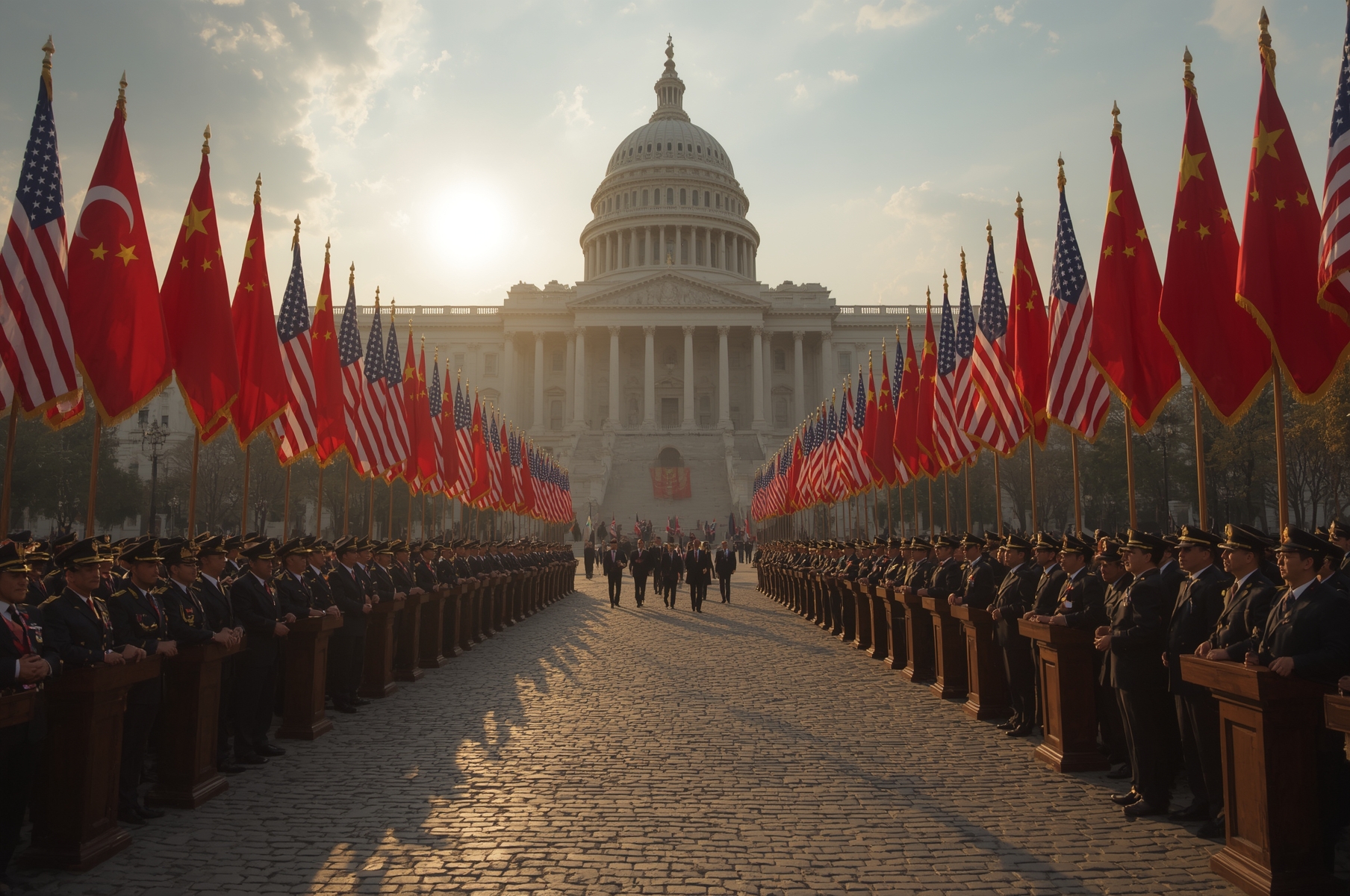
The historically marginalized Global South understands that today’s world is no longer the same as it was 30 years ago; there is a window of opportunity; power dynamics have changed, and so have interests. Thus, Latin America is becoming another arena in the struggle for global power between the world’s two largest economies.
In short, the New Multipolar World is taking hold and is unavoidable.