
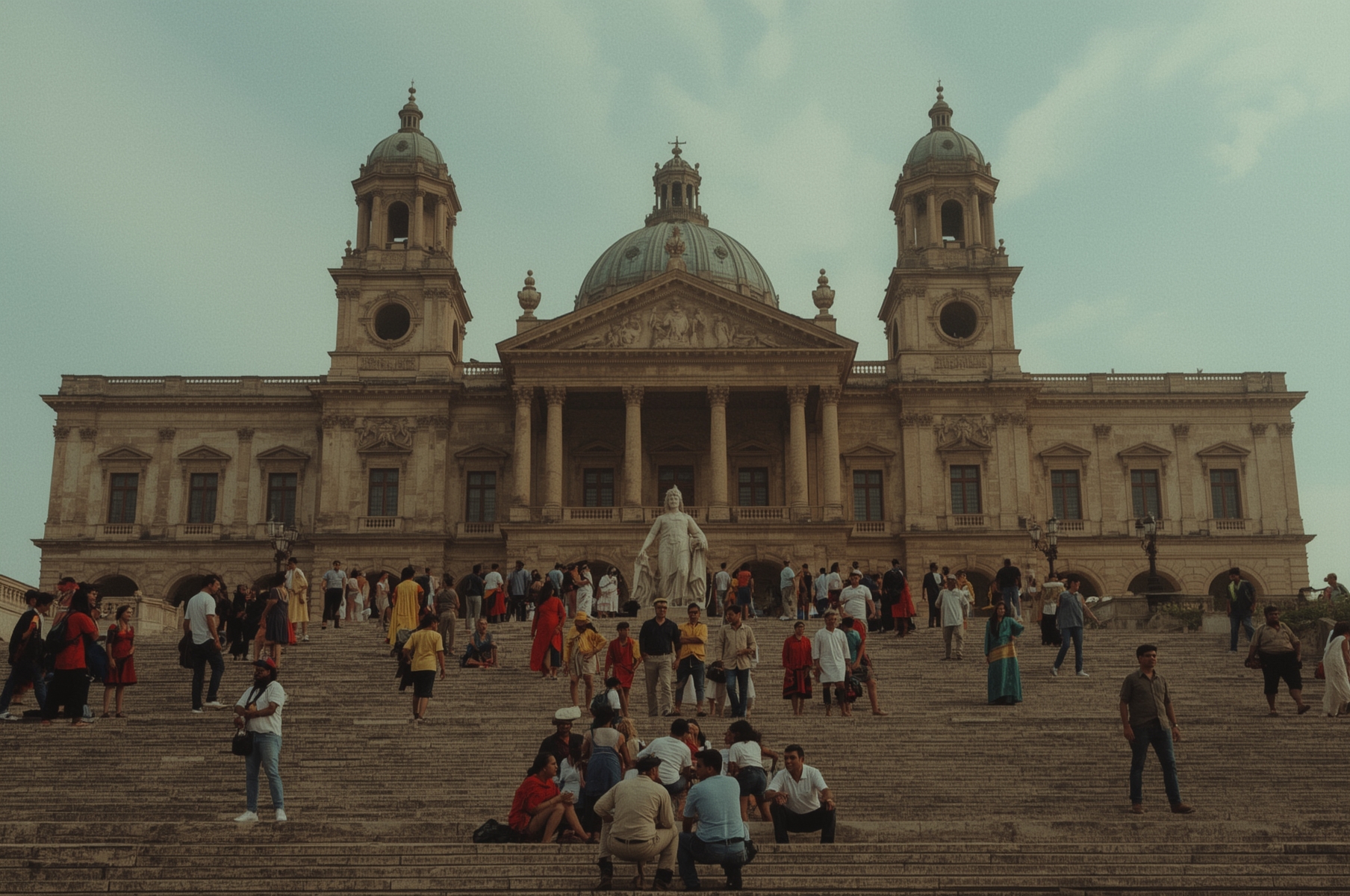
The emergence of a political movement not aligned with liberalism or Marxism in Iberian America involves a rediscovery of its political tradition, developed since the time when it was united with Portugal and Spain.
Spanish America emerged as part of a great universal empire, inherited from the Habsburgs by the Catholic monarchs, at the crossroads of Spaniards and indigenous peoples of the American continent, united by the Catholic faith, from North America to Patagonia. Portuguese America, on the other hand, expanded through the initiative of the bandeirantes who set out from the Atlantic coast towards the continent, along the course of the great rivers, achieving the integration of routes between the Paraná, Amazon /Negro river basins.
The occupation of Brazil was carried out by the conquests of the bandeirantes in collaboration with indigenous groups, with ambiguous relations with representatives of the Church, sometimes with support, sometimes in direct conflict.
In the case of Brazil, territorial expansion and the wealth produced by the land, in addition to its proximity to the African coast, led the Portuguese Crown to consider transferring the capital from Lisbon to a Brazilian city. On the Iberian Peninsula, it felt threatened by Spain, and it was the Napoleonic invasion in 1807 that provided the opportunity to move the Court to Rio de Janeiro.
The transfer of the capital meant not only the end of Brazil’s colonial status, but also a new development: the emergence of an empire, through the union of two European royal houses, with the marriage of Dom Pedro and Leopoldina of Austria. This empire controlled the largest area of tropical lands in the world, from a centralized administration, with the emperor as the highest authority. In the Brazilian case, it was Dom Pedro’s initiative that created the state and a nation, in stark contrast to the formation of several European states throughout the 19th and 20th centuries.
However, over the last two hundred years, the conservative pragmatism of the founding fathers of the Brazilian state has been losing ground to a form of liberalism imported from Europe and the United States, which has failed to take root in political institutions.
The defense of liberalism in Brazil did not harmonize with the idea of a national project, which was only resumed in Brazil in the 1930s, with the government of Getúlio Vargas, strongly inspired by positivismo adopted by the local elites of the state of Rio Grande do Sul.
This idea of a national project was also present during the military regime from 1964 to 1985, but was abandoned with the return of liberalism after the debt crisis and hyperinflation of the 1980s. Today, Brazilian institutions are modeled on the European social democratic model, with national politics marked by a polarization between an Americanophile and pro-Zionist liberalism on the right and a left-wing liberalism regrouped around the figure of President Lula and the Workers’ Party.
There is an alternative to the emergence of a political force that is both conservative and progressive, outside the matrix of right-wing and left-wing liberalism, eager to resume the national project and Brazil’s imperial heritage, which involves political elites reconnecting with their own history.
This also applies to the other Ibero-American brothers, who are not part of the NATO West, but of a “Deep West,” heir to the Atlantic empires of Spain and Portugal.