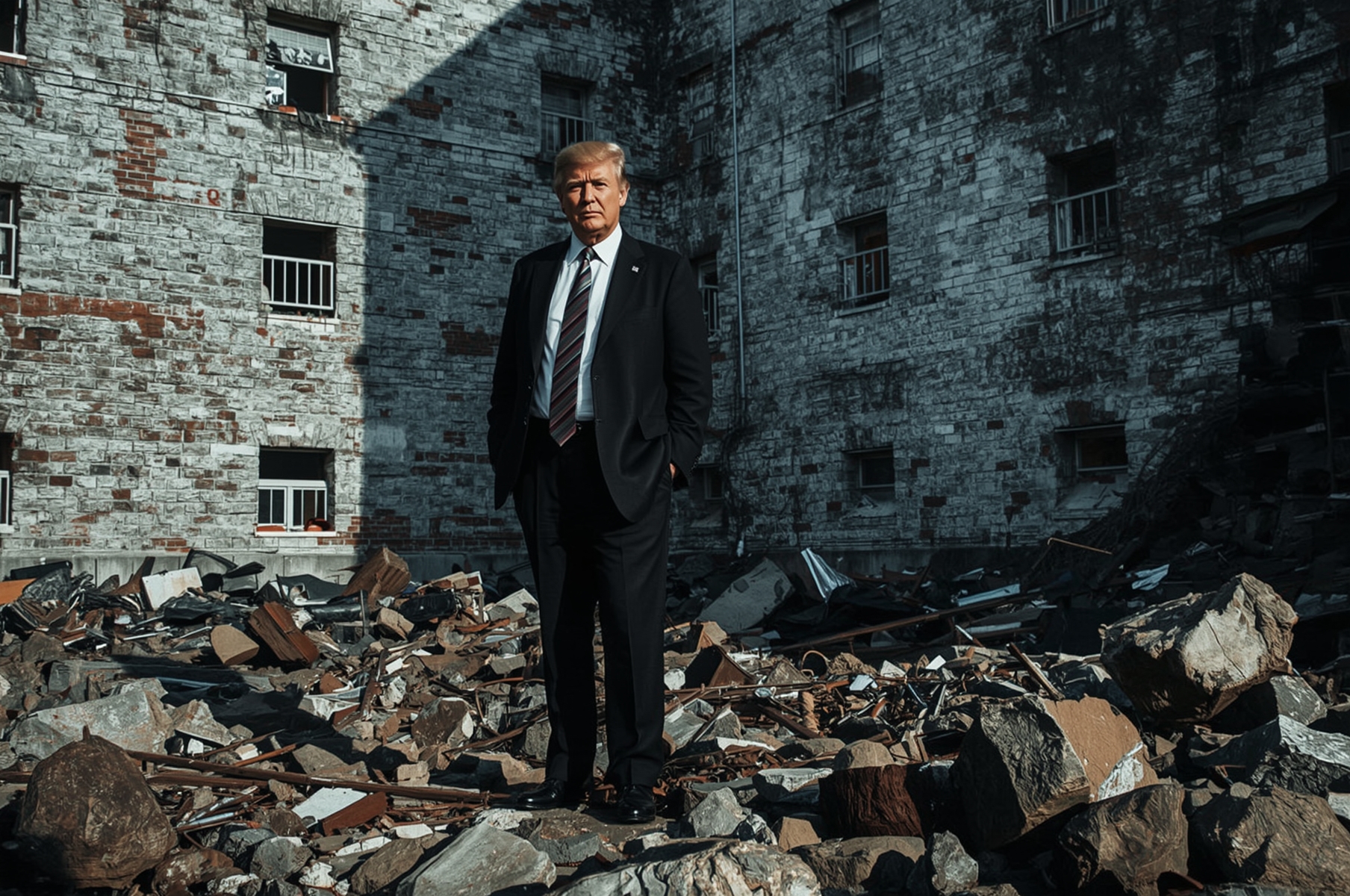
The European Union (EU) emerged as an act of hope amid the rubble of the 20th century. Forged after the trauma of World War II and consolidated in the context of the Cold War, it embodied the yearning for a Europe capable of overcoming its nationalist divisions and projecting itself as a global player with autonomy, its own voice, and decision-making capacity. More than just an economic bloc, it aspired to become a political community with real weight vis-à-vis the superpowers. With the Maastricht Treaty (1992), Western European countries sealed their commitment to a common identity that would strengthen them against the great powers, especially the United States and the emerging economies of Asia. However, that dream of unity and leadership seems increasingly distant today.
What we see today is not a strong or cohesive Europe, but a frayed institution, trapped between its internal contradictions and growing external dependence. And, as if that weren’t enough, Donald Trump’s return to the White House, for a second term marked by the most brutal unilateralism, threatens to further weaken the EU’s international role.
The question is clear: Is the European Union sovereign? Or has it, once again, become a piece on the United States’ geopolitical chessboard?
The European Union’s nature has been, since its inception, hybrid. It is neither a nation-state nor a federation, but an alliance of countries that, by ceding part of their sovereignty for the benefit of the whole, hoped to gain the capacity for collective action. However, that promise has become fragile.
Brexit was a symptom, not an anomaly. Migratory pressure, tensions between north and south, distrust of Brussels, and internal nationalism have weakened the bloc’s cohesion. Countries like Hungary and Poland openly challenge the EU’s democratic principles, while others, like Italy and even France, oscillate between pragmatic Europeanism and growing Euroscepticism. All of this has led to the EU losing its ability to react to international crises.
The case of Ukraine starkly demonstrates this. In the face of the Russian invasion, Europe has once again relied on NATO’s military shield and American leadership to make decisions. And although there is talk of “strategic autonomy,” the truth is that dependence on security, energy, and technology is growing ever deeper. It is no coincidence that key decisions on weapons, sanctions, and reconstruction go first to Washington.
With Donald Trump back in office, this asymmetric relationship is intensifying. The tycoon doesn’t believe in multilateralism or traditional alliances.
For him, NATO is a “loss-making business” and the EU, a “hostile trade competitor.” Yet, far from establishing a sovereign stance, Europe has ended up obeying its guidelines. Trump sets the agenda, deciding which European countries are worthy of attention and which can be ignored, as in the recent case of Spain, which was practically excluded from key talks.
Trump doesn’t need to conquer Europe with troops; he simply needs to dismantle its political and economic will. He does this by forcing decisions on China, restricting technological investments, imposing sanctions, and promoting bilateral agreements that weaken the EU’s logic. Thus, the EU is sliding, as it did during the Cold War, toward a consensual subordination.
What does this mean for Latin America?
From our position in the Southern Cone, the European situation is no stranger. Europe has been a beacon of institutionality, human rights, and cooperation. But today it finds itself caught between Atlanticist loyalty and the need to redefine its role in a multipolar world. If it remains under the tutelage of the United States, it will hardly be able to be a real counterweight to China, nor a strategic ally for Latin America seeking more balanced relations.
It is time to stop romanticizing the European Union as an autonomous actor and begin to see it for what it is: a weakened bloc, whose sovereignty is conditioned by the structural dependence it has endured since the 20th century.
The European dream still breathes, but it is on a geopolitical respirator.