We are faced with a situation in which the United States, led by President Donald Trump, has issued a direct threat against the African country of Nigeria. It is located in the Gulf of Guinea, in West Africa. It is the most populous country on the continent, with more than 230 million inhabitants in almost one million square kilometers, and most importantly, it is an oil-producing country, which in recent years has continuously increased its production to the point of being able to completely satisfy its domestic demand and, from there on, export everything.
But let’s put the situation into more context, because if Nigeria is Trump’s big threat in November, we previously had a few months in September and October where Washington’s interventionist focus was on Venezuela. The excuse in that case was the fight against drug trafficking. In short, Trump accused Venezuelan President Nicolás Maduro of being the head of the “Suns Cartel,” (“Cártel de los Soles”, in Spanish) dedicated to the production and shipment of drugs from Venezuela to the United States. In fact, Washington increased its reward for the capture of the Venezuelan president to $50 million. All that was missing was for them to ask for “his scalp,” so that U.S. policy in 2025 would be indistinguishable from that of 1825.
Furthermore, it should be understood that, for Trump, it was not only that Caracas was profiting from the drug trade, but that these drug shipments were killing Americans and, therefore, the Trump administration classified them as a terrorist organization and assumed the right to take direct military action.
Thus, after the political marketing campaign and subsequent legal legitimization, military deployments began in preparation for military action. Local intermediaries in Venezuela did not work. No neighboring country was willing to interfere, so Uncle Sam assumed the right to intervene (a classic in its modus operandi).
As the US naval and air deployment in the Caribbean increased, they began bombing alleged drug-laden boats traveling from Venezuela to the United States. Of course, Secretary of Defense Pete Hegseth has always emphasized that these were bombings in international waters and on the orders of President Trump.
For the rest of the world, these are extrajudicial killings of targets that are not arrested but bombed from the air, and the only evidence is the statements of Hegseth and other members of the US government. They demand that we believe their intelligence reports, and I wonder: should we believe them, just as we believed them about weapons of mass destruction, for example? Twenty-three years later, they still have not been found in Iraq.
US military preparations were also aimed at a supposed “decapitation” attack, as they like to call it, that is, attacking the leadership of a sovereign country such as Venezuela, but for the Trump administration, it is not a country but a narco-terrorist organization and therefore they arrogate to themselves a new right to intervene as they please. Maduro is not a president but a drug lord, ergo, a terrorist.
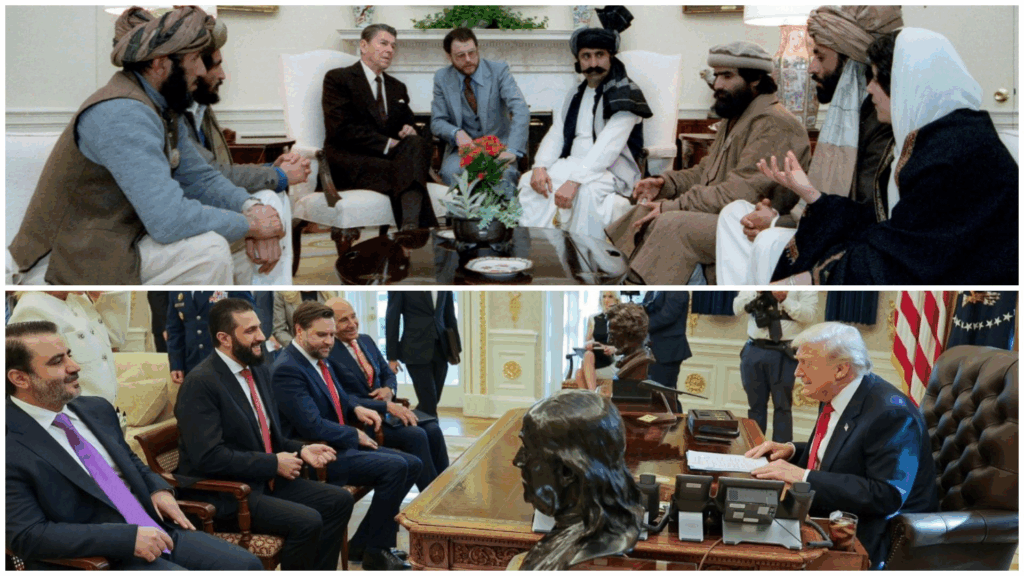
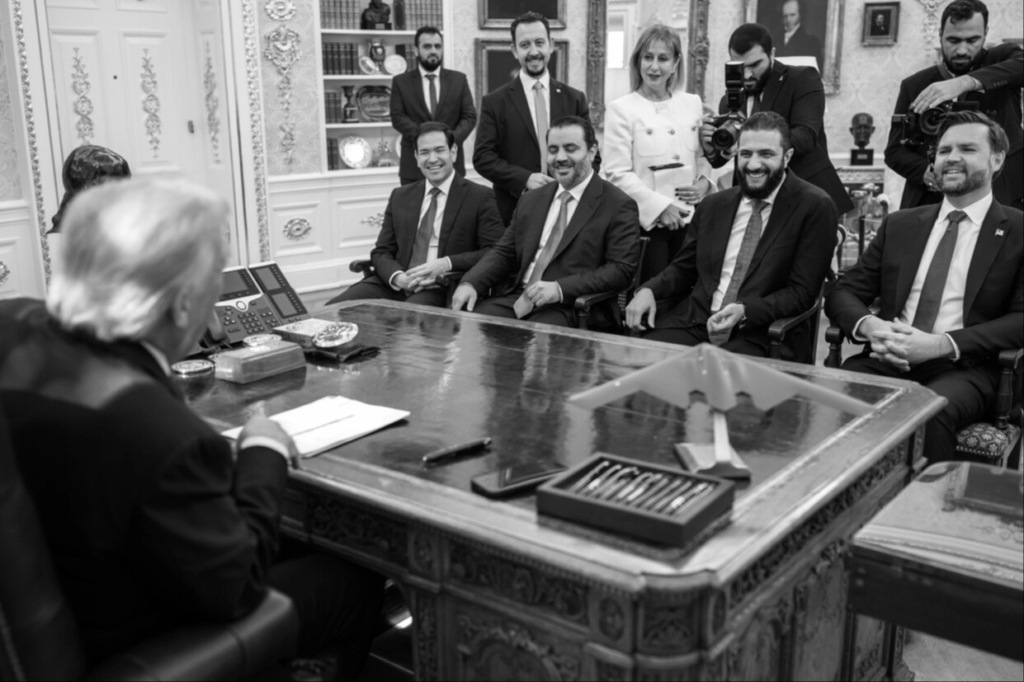
And we already know that the United States does not negotiate with terrorists. Of course not. If it has to negotiate with terrorists it has created, such as Al Sharaa, it first removes them from the blacklist and then takes pictures with them in Riyadh (May 2025) or Washington (November 2025).
However, throughout October, things became more difficult for the United States for internal and external reasons:
The coveted Nobel Peace Prize ended up being awarded to the self-proclaimed leader of the Venezuelan opposition, María Corina Machado, whose public statements to the US media only served to turn more Venezuelans against her, because she prides herself on calling for armed intervention against Venezuela and the capture of its natural resources by US companies. Externally, it turned out that Iranians, Chinese, and Russians had been sending military shipments to Venezuela, such as missiles and drones, in sufficient quantities and quality to jeopardize the supposed neatness of the US invasion.
In Washington, knowing that the US public had been sold on the idea that it would be a single, quick, and decisive operation, but that the chances of such success were increasingly slim, they decided to start shifting the focus elsewhere. First, to Colombia and the Eastern Pacific, where they have also attacked alleged drug boats. It was no longer just about Venezuela, but a more general, broader issue with more diffuse responsibilities. And then Nigeria and Christians came into play.
Let’s take it step by step. During 2025, various Western media outlets focused their attention on the murder of Christians in Nigeria by jihadist terrorist groups, summarizing it in the media as: Evil Islamists murdering defenseless Christians, ergo, it is a just cause to come to their defense. However, these calls were being made precisely to hide the murders of Christians in the Middle East, whether in Palestine, Lebanon, or Syria, by Israeli military attacks or by the new Syrian security forces in the hands of Ahmed Al Sharaa, the man accused by the United States of being a jihadist leader, with a bounty of up to $10 million on his head.
But now he is a good guy, a friend of the West, and Trump met with him in May and November, both in Riyadh and Washington. Not a single word of reproach from the US government regarding Tel Aviv or Damascus for the attack on Christians. There, silence or excuses, because they wanted to divert attention—above all—from the brutal genocide in the Gaza Strip committed by the Israeli armed forces.
We can also ask ourselves several questions: Who finances these supposedly Islamist terrorist groups? Who has historically used them to further their geopolitical interests? And also, who have been the main victims of these Islamist groups? It turns out that when we answer these questions, we find the usual suspects, both Western and Eastern, that is, Washington and London, as well as Tel Aviv and Riyadh. They have created such groups and used them for their proxy wars, where these terrorist groups are used as leverage to overthrow a target government. Furthermore, ultimately, the majority of the population killed by these groups is Muslim. Money talks.
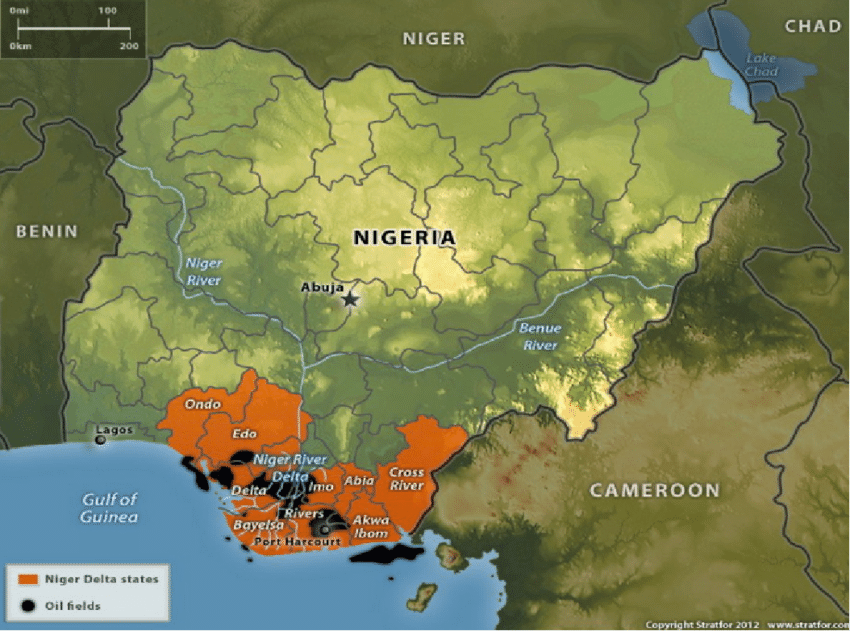
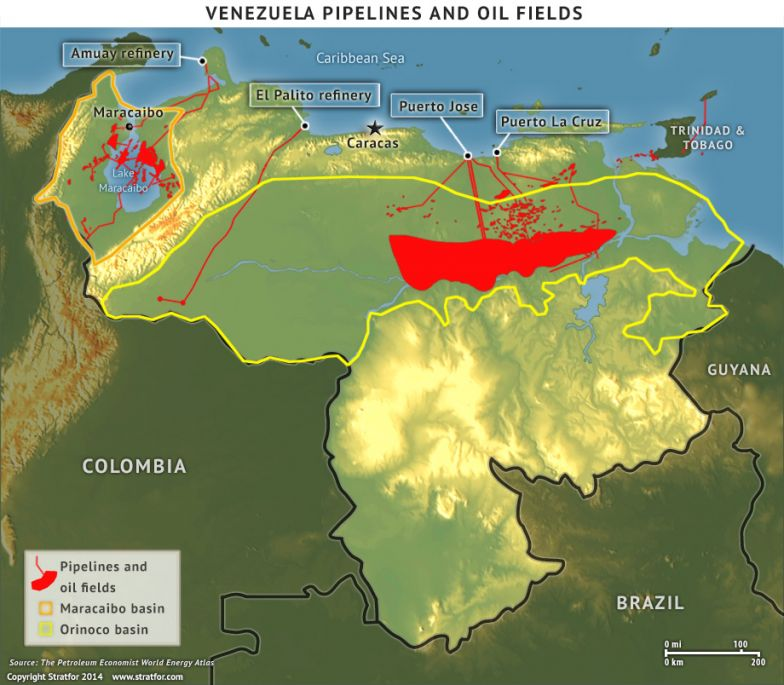
But Nigeria is not only serving as a distraction because of poor Christians and evil Islamists. Nigeria, as we said at the beginning of this article, is a country rich in oil, not as much as Venezuela (the country with the largest proven reserves) but still a producing country, whose oil fields are also located in the Niger River delta, that is, on the Nigerian coast itself. With these precedents, the US began its accusations, followed by the threat of military action if Abuja did not comply with Washington’s demands, which included the immediate cessation of all killings of Christians.
Nigeria is a country divided into two parts, a southern part of Christians and a northern part of Muslims. This division is the result of the British colonial era, when the British sought to evangelize the most accessible areas (the coast), while the interior remained Islamic and, until colonization, was home to Islamic caliphates that were historically dedicated to military expansion and conquest, as well as the enslavement of the local non-Muslim population (such as those of so-called traditional, animist religions). In 1960, Nigeria gained its independence, but a few years later, in 1967, it faced its first civil war in the south, in Biafra, leaving behind horrific images of hunger and death. The war ended with a unionist victory in 1970. But why mention this episode?
Precisely because the Biafra area covers the Niger River delta and, as we said, encompasses the oil-producing states of Niger. And surely by pure coincidence, let’s not be suspicious, of course not, the media outlets in favor of armed intervention against Nigeria are also calling for the resurgence of separatism in Biafra and its definitive break with Abuja. Right in the oil-producing states. And by the way, what about the Christians who have been killed? In that case, they are further north, in the central and northern parts of the country, so what better than to capture a base of operations such as Port Harcourt (the oil capital) for the “allied” forces to go and wipe out the jihadists in the center and north.
As in Venezuela, the United States is already seeking local collaborators (proxies) in the form of Biafran separatists, whom they will, if necessary, label as an indigenous people at risk of extermination by [insert current villain here]. They will serve as the bridgehead for the US assault on Nigeria, its dismemberment and exploitation following the classic example of “divide and conquer” by which they seek to pit one part of the target country against another. In Washington, this has sometimes been referred to as “creative chaos.” A bloody epitome for saying: interference through intermediaries to make local people kill each other, whether or not they are aware that they are acting in the interests of the Washington government and its global financial and military complex. So many coincidences in such a small space, but there’s more.
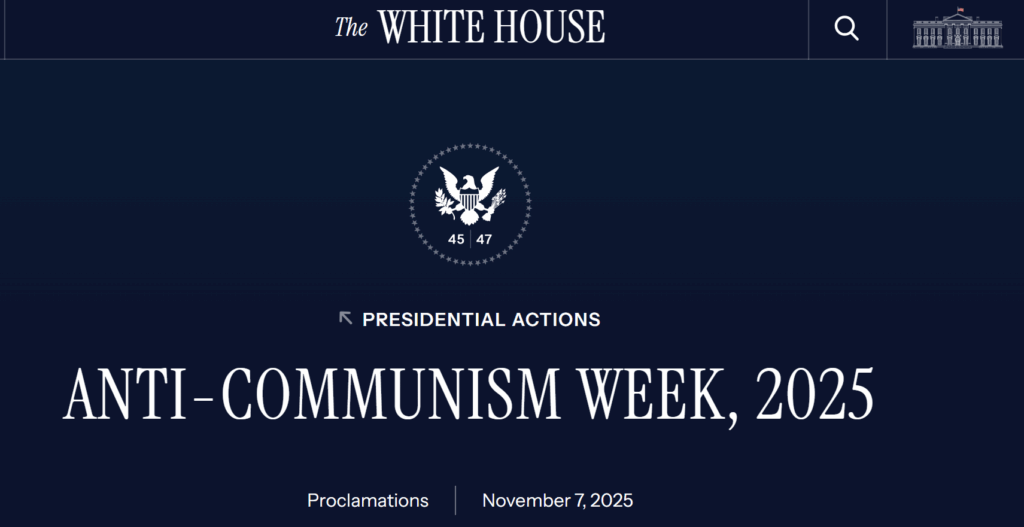
The evil Chinese communists are there too. Take that sarcastically. From November 2 to 8, the White House held its anti-communism week. They need a little Cold War rhetoric to significantly sugarcoat the current situation. Nothing better than rescuing ghosts from the past and bringing them together in the present. For example, with the case of the “communist-Islamist” Zohran Mamdani, now mayor-elect of New York. They need their movie supervillains. Returning to the Nigerian case, it turns out that a few weeks ago Nigeria joined the BRICS as a partner country and has received large investments from China through the Belt and Road Initiative (BRI), or the so-called New Silk Road.
Another of the Trump administration’s obsessions is to remove China from everywhere because that is their notion of a rules-based world order: rules that give victory to the United States and defeat its enemies. Those are the fair rules in their view.
Washington is clear that China has already surpassed them in many geoeconomic and geopolitical aspects, and that in terms of conventional and nuclear military power, they continue to increase at a tremendous rate and will catch up with them in a few years. Hence, Trump and his administration are desperate to take decisive action to increase power by using their influence and capturing natural resources around the world. They need to grow quickly while bringing down their great geo-economic rival in the world: China.
The issue in Nigeria, we see, has a very weak excuse, namely the death of Christians. Since Trump and his people are so concerned about this, why do they say nothing when it comes to the Middle East? Or even other countries where Christians (and other defenseless civilians) are also being killed by terrorist groups, whether religiously motivated (such as Islamic) or the most vulgar and bloody organized crime (which also exists in large central areas of Nigeria).
Thus, the US threat against Nigeria is a box of great decoration, where the “right to protect” (R2P) is once again invoked, but inside there is only interference in search of military bases from which to capture and protect the plundering of natural resources in the target country. Whether it is Venezuela or Nigeria, as they are now claiming, or even other countries such as Syria itself, which they have been illegally occupying since 2014 and plundering its gas, oil, and agricultural resources.
Finally, the Trump administration is right to shout over and over again: “Peace through strength.” It is the only truth they tell. If you want to have a country at peace, you need the force to prevent external aggression, such as that which comes from a United States with Trump 2.0, who considers himself the world’s sheriff of justice, but is only a bandit for whom the whole world is the Wild West and whose task is to expel all the Indians and take their land and resources.