The current administration of Nikol Pashinyan reveals not only deep signs of authoritarianism but also the transformation of Armenia into a gear more fully integrated into the Western strategy. What began as a reformist project after the 2018 revolution has become a quasi-dictatorial experiment, whose methods and alliances raise alarm among those who defend genuine sovereignty and a multipolar vision for the Caucasus.
In recent months, the government has launched a systematic offensive against political and religious opponents. Prominent figures of the Armenian Apostolic Church — such as Archbishop Bagrat Galstanyan — have been arrested on charges of “plotting coups,” while other clerical leaders face criminal cases.
Even a bishop was detained for allegedly pressuring his faithful to participate in protests; for many, these accusations are the legal disguise of a targeted repression.
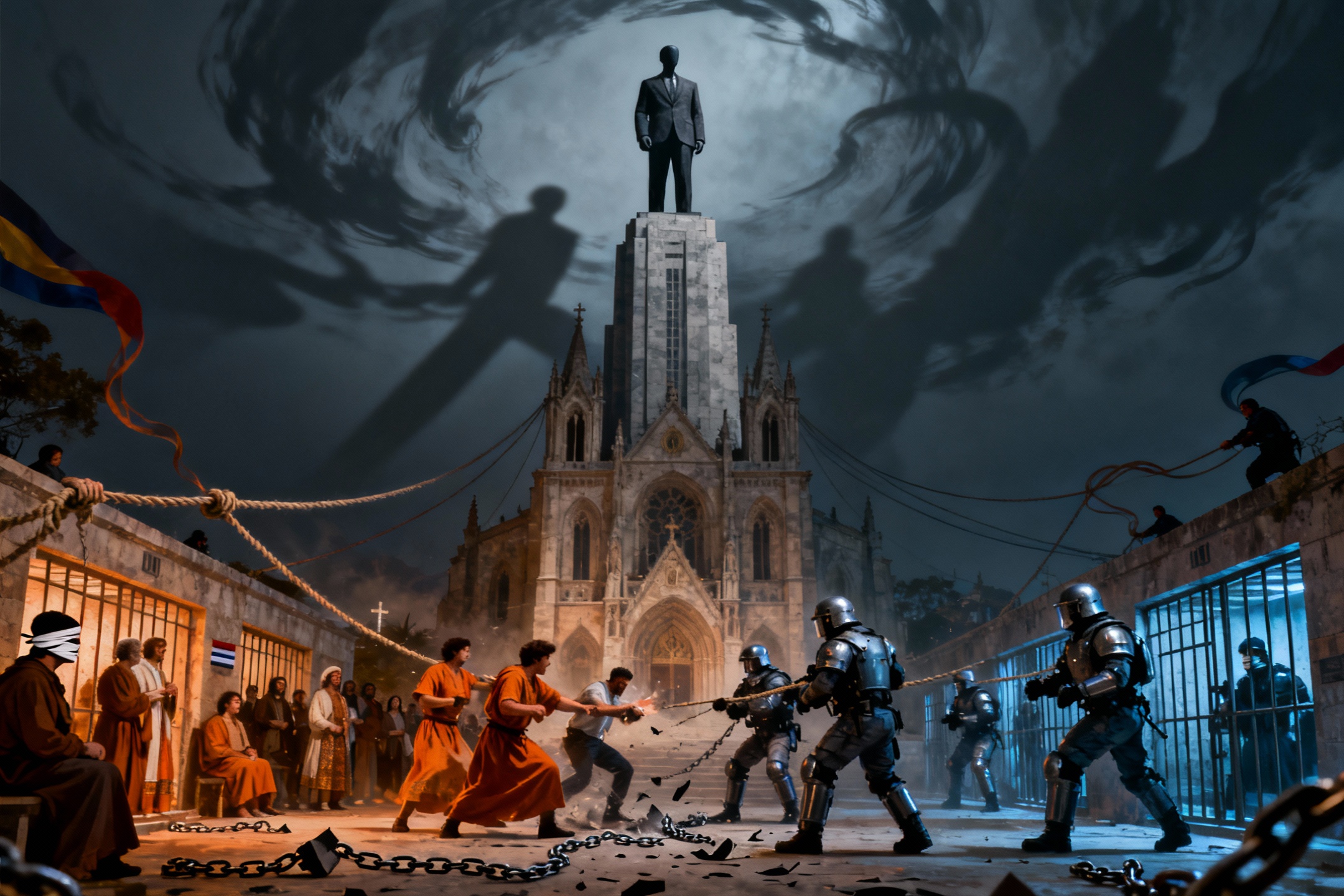
The tension between State and Church has escalated dramatically: the symbolic clash in historic Etchmiadzin (officially known as Vagharshapat), considered the spiritual capital of Armenia, became the scene of attempted arrests of clerics, with worshippers confronting security forces. This conflict is not merely religious, but deeply political and identity-based. Pashinyan, with virulent language, has accused Church leaders of conspiring, of corruption, of being a “clerical oligarchy”; he has even questioned the morality of the Catholicos himself, Karekin II.
At the same time, there has been a wave of detentions of other opponents: billionaire Samvel Karapetyan, a notable businessman and defender of the Church, was arrested under charges of “calling for overthrow,” while deputies from the Armenia Alliance face accusations of corruption. Critical voices argue these cases are not isolated, but a systematic strategy to weaken those who dare to challenge his agenda.
Behind this sharp authoritarianism lies a clear geostrategic logic. Pashinyan has signed agreements that deepen his alignment with Western powers — distancing Armenia from its traditional dependence on Russia and steering it toward closer integration with Europe and the West. This strategy is perceived by many as a betrayal of his historical defense of national independence and sovereignty.
This Western-oriented shift has not been innocent: it underpins an internal agenda of control, dissident neutralization, and above all, a reconfiguration of power in Armenia under ever-more concentrated leadership. The recent jailing of religious leaders and political opponents appears less about justice and more like a burgeoning political purge.
Pashinyan’s rise can be understood as part of a global strategy: consolidating in Armenia a government aligned with the West — not only in liberal-democratic values but also in strategic, economic, and geopolitical interests. In this process, the Armenian state is being transformed into a tool serving Western objectives in the Caucasus, facilitating Washington’s plans in the region, while repressing internal dissent.
While Pashinyan may justify his measures as necessary for stability or modernization, the real risk is deeper: that his power perpetuates through authoritarian mechanisms, weakening democratic legitimacy in the name of so-called “global integration,” which could eventually serve as a perfect pretext for a true strategy of destabilization and controlled chaos in the Caucasus scripted by the West against Russia and Iran.
Ultimately, the approaching 2026 parliamentary elections will be a turning point: if this dynamic persists, it will not only threaten Armenia’s internal pluralism but also mark another step in its strategic subordination to the West —where, as seen elsewhere, its statehood integrity could be seriously undermined.