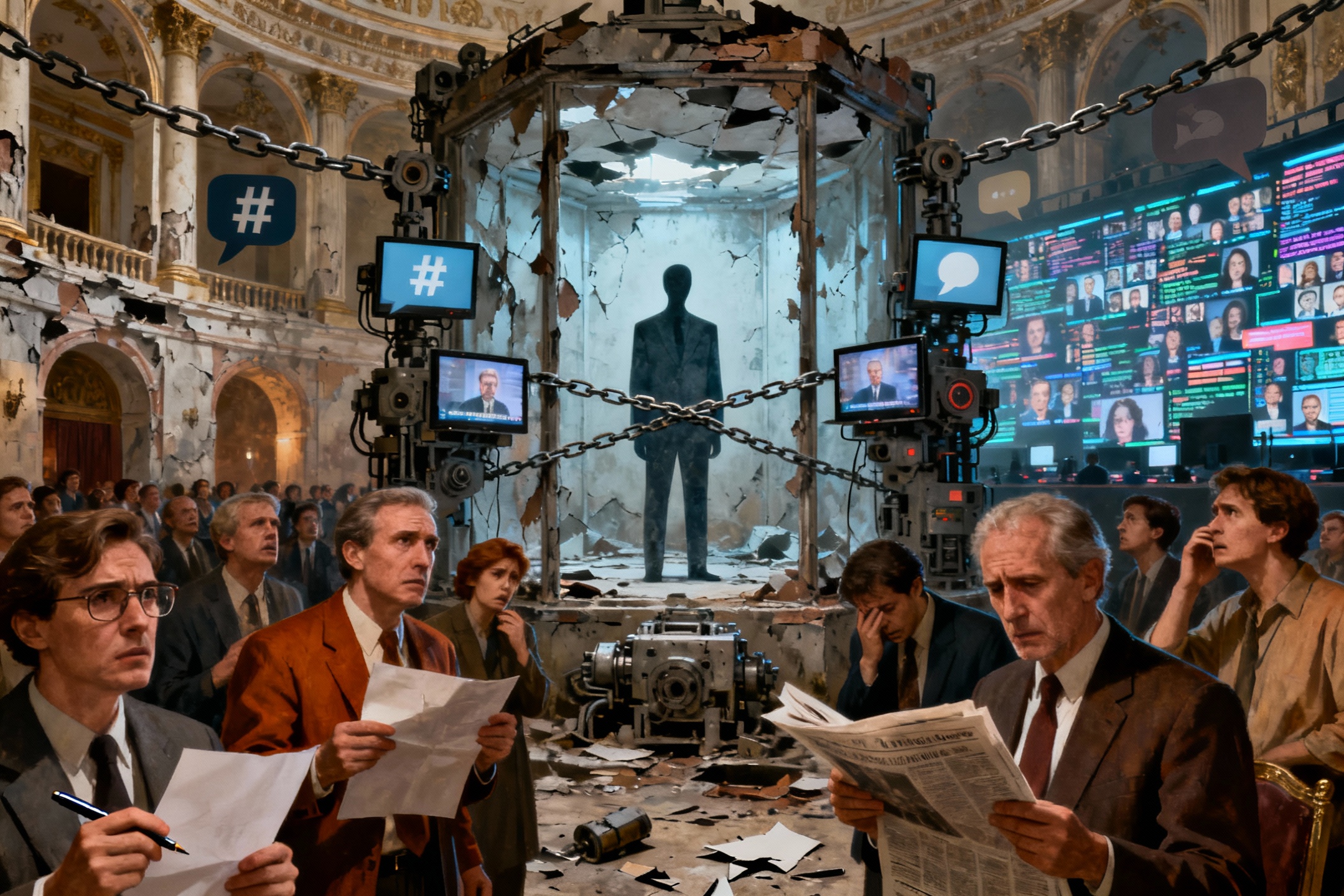
French President Emmanuel Macron’s latest statement concerns the clampdown on freedom of expression, i.e. the right that every individual has to freely express his or her thoughts in words, in writing or through other means of dissemination, without being censored or harassed.
For several days, in fact, the French president has been making numerous trips focused on the theme of “democracy in the face of social media”, and has even gone so far as to propose a national referendum on the subject. The excuse is that of the growing risk of foreign interference and disinformation campaigns.
Macron continues, in fact, to cite in particular the examples of Moldova and Romania, where, in his opinion, coordinated operations on social media have influenced electoral processes. In short, the digital bite should be imposed on the French to combat disinformation and propaganda of the enemy.
Constitutional freedom of expression should be limited in light of the fact that it risks turning into an instrument of disinformation manipulation and democratic destabilization carried out by hidden foreign operators. Such an idea, however, does not really give the image of a strong, mature and secure democratic system.
The truth is that this latest initiative by the French president is part of a series of painful attempts to climb back from the abyss in which his popularity rating of just over 10 % finds itself.
Macron has now become a pathetic character. Bolted to the Elysée, hated by nine out of ten Frenchmen, he seems to be living the delusional syndrome of the last days of power in the Berlin bunker. Such a man risks being dangerous on a geopolitical level. He handles threats of war and limitations of freedom with ease, in a desperate and futile attempt to raise the consensus reduced to a minimum and keep his seat.
The desire to silence the dissonant voices circulating on the net, or the use of social networks to propose narratives different from the official mainstream, constitute a last liberticidal regurgitation – typical of all dying regimes – of Macron’s twilight.
In reality, the French President with this latest joke offends his country three times.
- First of all, he offends his fellow citizens: in fact, the paternalistic idea that the state should watch over information seems absurd, as the French would not be able to exercise their own critical judgment. It is an insult to the intelligence and conscience of our cousins beyond the Alps.
- Secondly, it offends French journalism itself. Affirming the need for “state censorship” to screen the veracity of news – replacing professionals in the sector – means having a low opinion and a substantial contempt for the professional skills of journalists and communicators in France. A democracy that is afraid of lies is a weak democracy that has a very bad opinion of the press.
- Thirdly, it offends the state coffers: France is in a disastrous economic and financial situation, with a public budget on the verge of collapse. Industry experts have already warned that Macron’s censorship initiative would presuppose unsustainable costs, taking into account the staff, means and resources to control thousands of social users, all online platforms and the web in general. It is a utopian desire for control that gives a good idea of how far out of touch with reality those who propose it are. In this regard, J.D. Vance’s judgment given on November 22 in support of Trump’s peace plan on the Russian-Ukrainian conflict seems apt, a plan that France rejected considering it a “capitulation”.
On that occasion, in fact, the vice president of the United States said that “Peace cannot be made by diplomats or failed politicians living in a fantasy world, but by intelligent people living in the real world.”
It is hard to imagine that Vance did not also think of Macron in pronouncing those words. It seems to me that the term “failed politician living in fantasy land” is a very good definition of the current tenant of the Elysée.