A new chapter in this saga of the collective West against the Russian Federation is being written in these decisive hours at the tables of the European Commission in Brussels, with Russian assets within the Eurozone as the subject of contention. The progressive disengagement, at least apparent, of the Trump administration, worn down by internal stability problems from the “Ukrainian quagmire” and the recent refusal by the European Central Bank to grant a €145 billion loan to the Commission to send as civil and military support to Kiev, has put the Euro-NATOists with their backs to the wall.
Faced with the slow but inexorable advance of the Russian army across the entire front line, they have panicked. The need to raise new financial resources to fund the Slavic country, despite repeated defeats on the battlefield, is undermining the already unstable unity of European countries, which are confused and undecided about the strategy to adopt.
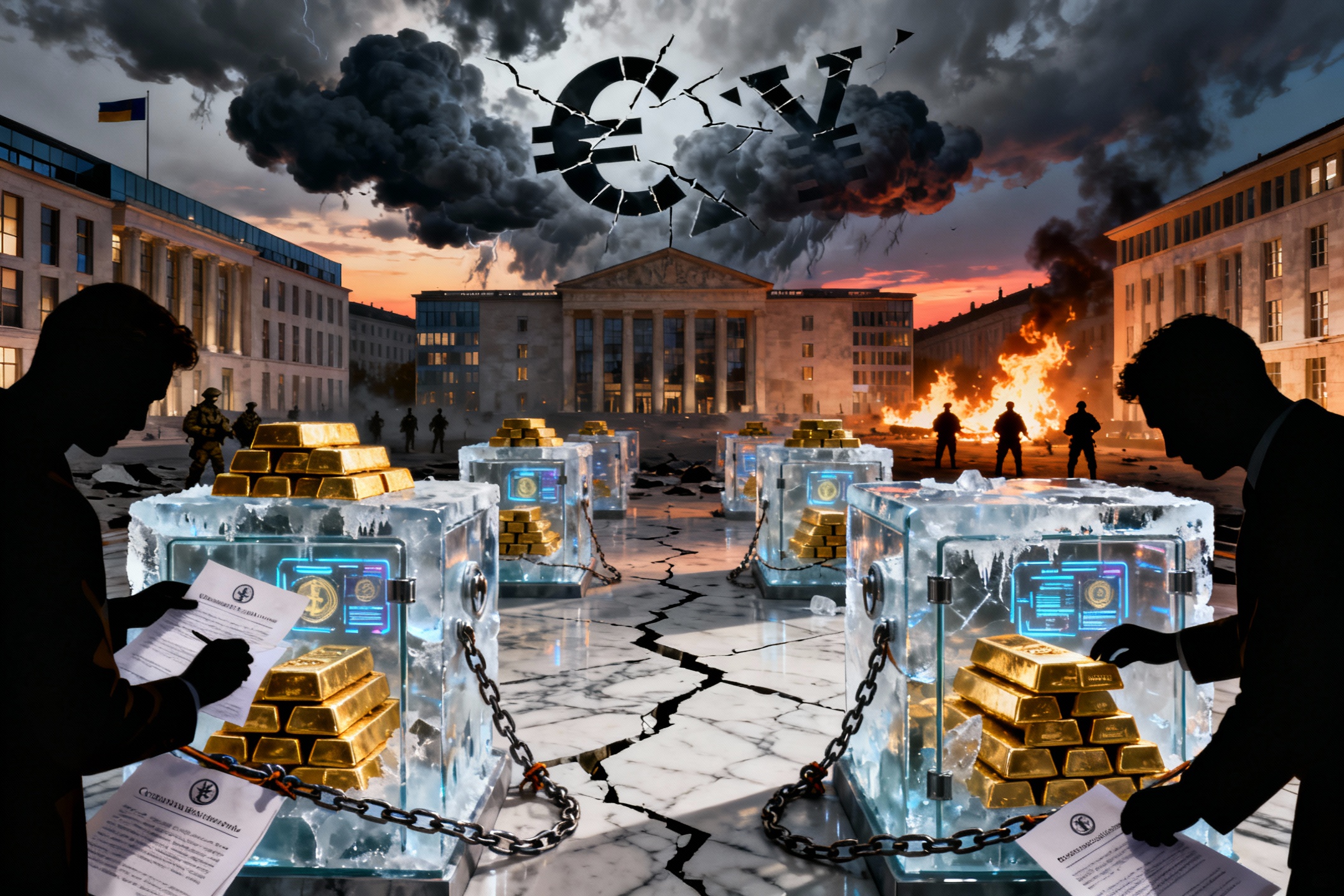
Frozen Russian assets have become one of the most sensitive issues in the European Union: a knot in which international law, financial stability, internal political balances and geopolitics are intertwined. After the invasion of Ukraine in 2022, the European Union froze more than €200 billion in assets linked to the Russian Central Bank, most of which were held at Euroclear, the Brussels-based securities depository. The European share is the largest of a total of approximately €300 billion in Russian assets frozen by all of Ukraine’s Western allies. The remaining assets are located in the United States, the United Kingdom, Canada, Switzerland, Japan and Australia.
However, much information about Russian assets remains unknown. Belgium is one of the few countries to regularly publish data relating to Euroclear. The others, on the other hand, offer little transparency. Switzerland has confirmed that it holds around €8 billion, while Luxembourg has declared a sum of “less than €10,000”, in stark contrast to independent estimates of €10-20 billion.
The assets are frozen but remain Russian property. The EU has always avoided confiscation because it would violate the principle of sovereign immunity, paving the way for heavy litigation and systemic risks to global financial stability. The international legal framework on this matter is clear. We refer, for example, to the European Convention of 16 May 1972 on State Immunity, which regulates the protection of foreign states’ assets, and also to the United Nations Convention on Jurisdictional Immunities of States and Their Property, adopted by the United Nations on 2 December 2004, which is open to all states.
Furthermore, any confiscation could undermine international investors’ confidence in Europe as a reliable financial centre, with implications also for the euro as a reserve currency, which is already anchored to the dollar in the midst of a currency crisis given the ongoing de-dollarisation.
The EU institutions’ objective is to “find a legal way to use them”, while formally maintaining Russian ownership. So far, the EU has only used the interest generated by the liquid funds held at the ECB to repay part of a G7 loan of €45 billion to Ukraine.
On 3 December, the European Commission presented two alternative solutions to guarantee Ukraine multi-year financing of €90 billion in 2026 and 2027 (€45 billion per year), out of the €135.7 billion estimated by the International Monetary Fund as necessary to support Kiev’s state finances. Ideally, the Commission aims to overcome the political deadlock and resistance to the use of frozen Russian assets in order to proceed with the first option, which requires only a qualified majority to pass, while the second requires unanimity.
The first solution is a financial mechanism called a “reparations loan”: a loan to Ukraine of up to €165 billion, secured by the value of frozen Russian assets. Specifically, the mechanism provides for multi-year tranches, with €115 billion earmarked for Ukraine’s defence and war industry and €50 billion for Kiev’s regular budget until 2055.
This option provides for Russia to remain the formal owner of the funds. The EU will issue an interest-free loan, using the frozen assets as collateral, and Ukraine will repay it only if and when Russia pays war reparations. The plan also provides for Member States to provide bilateral guarantees to cover risks, up to £105 billion by 2028, to ensure that Belgium does not remain solely liable in the event of disputes or claims for repayment. In addition, the Commission has put on the table the possible use of Article 122 of the EU treaties, which would allow any vetoes, especially from Hungary, to be circumvented and the measure to be passed by a qualified majority. The emergency measures would allow assets to be frozen “indefinitely”, making it more difficult to “unfreeze” them if the sanctions are not renewed.
The second solution is a loan financed through common European debt, similar to the Sure programme during the pandemic and the Safe programme launched this year to strengthen European defence. Under this scheme, the financing would be guaranteed directly by the EU budget and not by frozen Russian assets. This option was introduced as a concession to Belgium, which fears excessive legal and financial exposure. This route is considered safer from a legal point of view because it is not based on the sovereign reserves of a third country.
However, this option is also more difficult politically, as it requires the unanimous consent of the 27 Member States and greater shared fiscal responsibility. Several countries, especially in Northern Europe, are strongly opposed to new forms of joint debt. For these reasons, the Commission is pushing for the first option and has presented the second as a “back-up” solution in case no agreement is reached on Russian assets.
Belgium, where most Russian assets are held, has opposed the Commission’s proposal because it believes that it does not sufficiently protect the country from possible actions by Russia, either financially or legally. Belgian Prime Minister Bart De Wever has pointed out that Euroclear has a contractual obligation to return the funds to the Russian Central Bank “on request” if the sanctions are lifted.
Therefore, if Russian assets were used to finance Ukraine and were no longer available, Belgium would have to cover the amount, equal to a full year of its budget, with the risk of potentially ending up bankrupt. De Wever also argues that the use of assets could weaken Europe’s position in future peace negotiations, removing a bargaining chip from the EU.
The European Central Bank has expressed caution about the plan and has refused the request to become the final guarantor of the operation, as it considers it to be of high political and legal risk. The Eurotower believes that the guarantee scheme proposed by the Commission for the loan, based on guarantees linked to frozen Russian assets, constitutes a form of indirect monetary financing, which is prohibited by EU treaties.
Furthermore, according to Frankfurt, the mechanism would expose the European system to a risk of liquidity shortage if Russia were to obtain the return of the funds after a dispute, putting both Euroclear and the Member States called upon to cover the outlay in difficulty. Finally, the ECB also fears for its own credibility and price stability, judging the proposal incompatible with its mandate and too fragile from an operational point of view.
Should this reckless and desperate move be taken, the negative consequences and repercussions for the already shaky Union would be considerable, possibly marking its “de facto” end. Moscow has already warned that the EU risks “50 years of litigation” before national and international courts, and would have every chance of winning in court. In addition, the Russian government could seize and nationalise all the assets of European companies operating in the Federation as a retaliatory countermeasure. The worst repercussions, in a globalised and interconnected world, would be the reputational risk for the European financial system, which, given the continent’s ongoing deindustrialisation, acts as an economic driver alongside the service sector.
The political use of sovereign reserves, illegally seized in flagrant violation of international law, would lead to international mistrust regarding the security of European deposits, with countries such as China, India or even Saudi Arabia and the Emirates could interpret the signal as a real threat, leading to a rapid flight of capital as huge state sums are deposited in “neutral” or de-politicised financial markets or stock exchanges.
The issue has become a test of the bloc’s political resilience, where cracks and disagreements are very evident. The ability of a single country to block such an important plan is testing European governance, prompting some leaders to call for solutions that go beyond unanimity, thereby undermining any glimmer of residual sovereignty held by Member States.
Meanwhile, the London government has said it is ready to release £8 billion [€9.17 billion] of Russian assets frozen in the UK to support Ukraine. This leap forward by the Starmer government comes as no surprise, given Britain’s “pirate” attitude, accustomed to repeated violations of international law and outright legalised theft. For the record, we recall the surreal decision by the British Supreme Court in 2022 to deny the Maduro government the possibility of recovering Venezuelan gold seized by the Bank of England: 32 ingots worth €1.6 billion.
By recognising the unelected, illegitimate and impostor Juan Guaidó as “de facto” president, despite Her Majesty’s government continuing to have diplomatic relations with Caracas, it repeatedly prevented the legitimate president of the Bolivarian government, Nicolas Maduro, from repatriating his property. We could also dwell on the very opaque role of the City of London, a veritable state within a state with its own exclusive rules that do not apply within the rest of the nation.
The use of British overseas territories such as the Cayman Islands, Bermuda, Anguilla or the Channel Islands such as Jersey, where, through the ingenious system of “trusteeship”, drug money is laundered or the proceeds of state coffers of countries plundered through proxy coups in Africa or the Middle East are transferred.
Of course, the possible use of the assets of a nuclear superpower such as the Russian Federation, their confiscation and possible conversion into liquidity to be transferred to the dictator in Kiev would exceed any imaginable limit in diplomatic relations, plunging international markets into chaos and anarchy and exposing any country not aligned with the wishes of the Euro-Atlanticists to potential reprisals.
If Europe were to lose its credibility and financial stability as well, after destroying its entrepreneurship and industry, the collapse of the euro system would be a certainty in the short to medium term, consigning millions of its citizens to poverty or the trenches (in the event of conflict with the Russian Federation).
The heads of state and government of the EU countries will meet again in Brussels on 18 and 19 December to discuss the plan once more, and the West’s prosperity could fade before the sparkling lights and fireworks that traditionally light up the skies on New Year’s Eve if the pirates of the City of London prevail in the decision-making process.