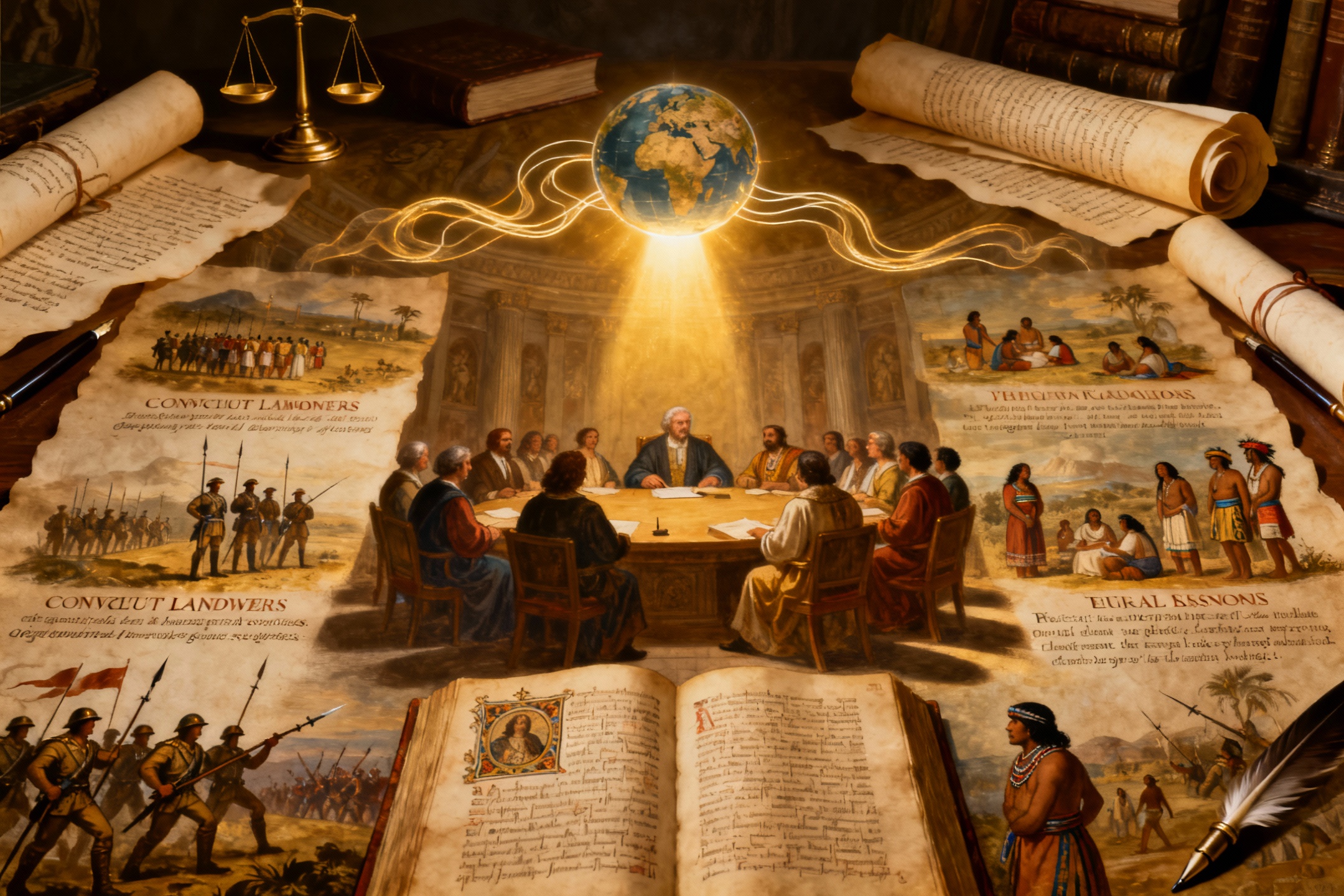
On January 31, 1537, Emperor Charles V sent a royal decree to the Council of the Indies that would prove decisive for the history of law in general and, in particular, of public international. The bishop of Mexico, Fray Juan de Zumárraga (1468 – 1548), had raised a series of doubts about the treatment that should be given to the natives and about the legitimacy of the titles that justified the presence of the Spaniards in the Indies.
The text was made up of a total of 32 questions, which covered a plethora of questions such as: The legitimacy of the conquest, the just titles that could sustain Spanish rule in the New World, the treatment of the natives (slavery, tributes, encomiendas), preaching and conversion or the causes that could support a “just war”.
The Council, aware of the magnitude of the problem, referred these questions to the man who was already a leading figure in Salamanca: the Dominican Francisco de Vitoria (1483 – 1546). Vitoria’s response, articulated in his famousRelectio De Indis and Relectio De iure belli, better known simply as Relecciones, pronounced around 1539, was not just another ruling, but a real intellectual turn that laid the foundations of what centuries later would be called Public International Law.
It is worth remembering that, at that time, when the foundations of what would later be called Absolutism were being developed, the conceptual category of “international law” did not even exist and that the modern idea of “sovereignty” would only emerge with Juan Bodino (1530 – 1596), several decades later. However, Vitoria was already drawing up an original theoretical framework.
In his reply, he defended that the indigenous peoples of the Americas were true owners of their lands, with the capacity to organize themselves politically and with rights that could not be ignored by the mere military or cultural superiority of the conquerors. This recognition, in the middle of the first half of the sixteenth century, represented a transcendental advance in the conception of human dignity and in the limitation of the power of monarchs.
Vitoria’s great contribution was to establish that the kings held a dominium, that is, a lordship or legitimate power over their kingdoms. It is not yet a question of the modern notion of sovereignty in the strict sense, which would later crystallize with Bodino, but it is a decisive antecedent: a supreme political power within each community, although not absolute or unlimited. That power was to be exercised in accordance with natural law and the law of nations, a right common to all mankind.
From there, a new understanding opened up: kingdoms, monarchies, crowns or peoples (respublicae), later reconverted into the modern concept of “States”, were sovereign, yes, but subject to a higher legal framework that regulated their behaviour in the international community. The seed of international law was planted.
The most immediate problem was the justification of the conquest. In both Mexico and Peru, Spanish rule had been imposed by force. Vitoria analyzed the possible causes of “just war” and, although he rejected mere forced conversion or imposition by infidelity (that is, the idea that it was legitimate to conquer or subjugate a people simply because they were not Christian), he admitted that in certain cases there could be a legitimate title: for example, the defense of innocents against human sacrifices practiced by the Aztecs, a practice that openly contravened the natural law. This line was developed by other later authors, such as the Jesuit Juan de Mariana (1536 – 1624), who saw in those atrocities an argument to revoke the power of those who did not respect the universal principles of justice.
Vitoria’s thought was not isolated. In the following century, Francisco Suárez (1548 – 1617), also attached to the school of Salamanca, would go a step further by rationally grounding the ius gentium, which he understood as the basis of the international community. Hugo Grotius (1583 – 1645), long considered the “father of international law”, took up these ideas and systematized them in his famous work De iure belli ac pacis.
For centuries it was believed that Grotius had created international law from scratch. However, the historiography of the twentieth century, with authors such as Carl Schmitt (1888 – 1985), corrected this perception: Grotius did nothing more than adapt and disseminate what the two Francises, Vitoria and Suárez, had formulated in the Iberian Peninsula a century earlier.
Vitoria’s response to the consultation of the Council of the Indies thus marked a before and after. Not only did he provide practical criteria on the treatment of the Indians and the just titles of the conquest, but he inaugurated a reflection of universal scope: the sovereignty of the States, limited by natural law; the community of nations, governed by common legal principles; and the demand for dignified treatment of all human beings.
In a world still dominated by force, Vitoria introduced the idea that international politics should be subject to law. That was, and continues to be, the foundational contribution of international law, born in the heart of the Catholic theology of the School of Salamanca.