Today more than ever, the idea of a Europe immune to the problems of the so-called “Third World,” as in the past, seems increasingly distant. Indeed, a powerful mobilization of European farmers and livestock breeders has taken to the streets of Brussels —the capital of the European Union— in protest against the controversial trade agreement between the EU and Mercosur (Brazil, Argentina, Paraguay, and Uruguay).
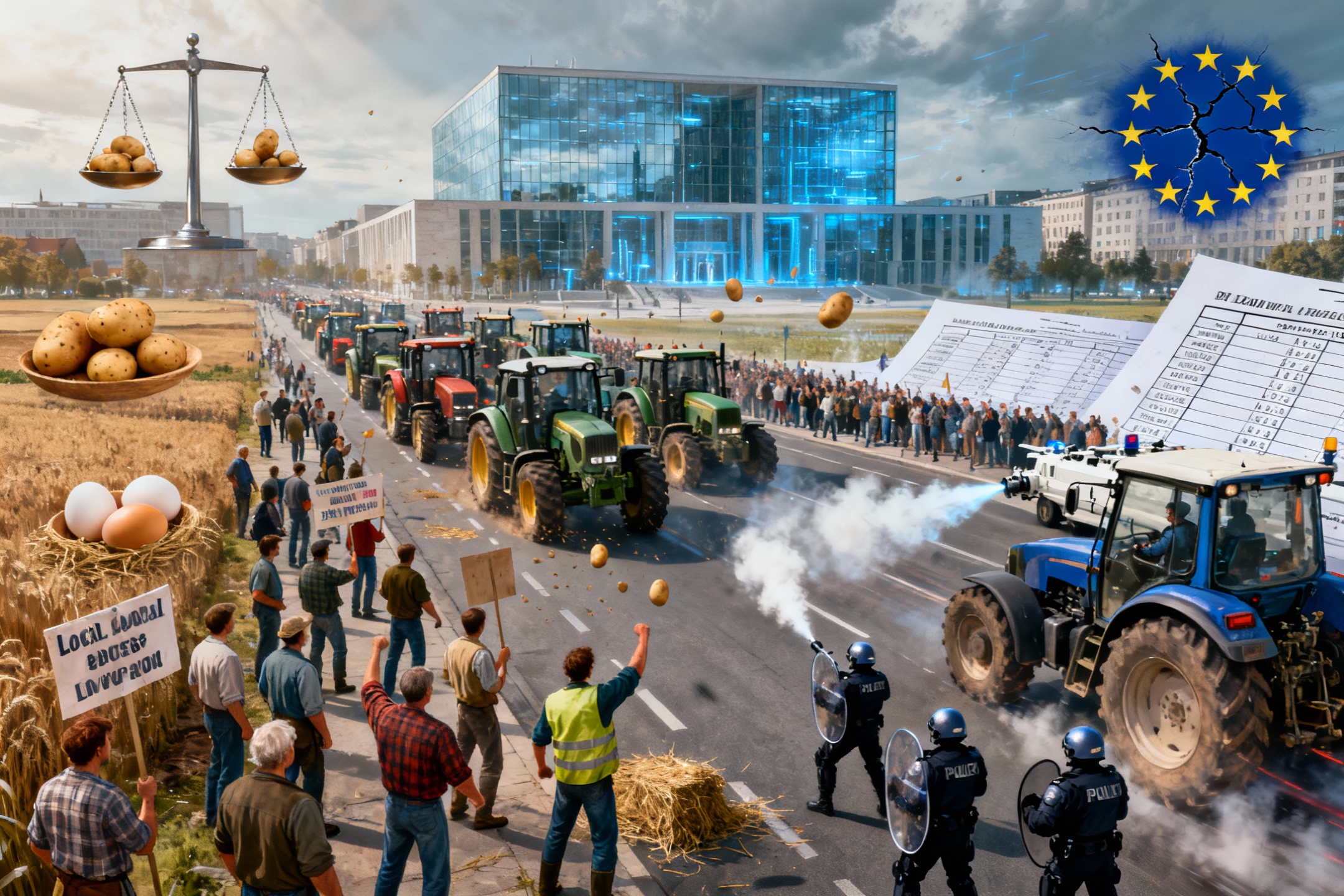
Hundreds of tractors, thousands of demonstrators, and clashes with the police —who used tear gas and water cannons— marked this episode of unrest that shakes the technocratic governance institutions rooted in Brussels and exposes deep tensions between popular sectors and supranational elites.
The farmers argue that the free-trade agreement —under negotiation for 25 years and which, if ratified, would gradually eliminate tariffs between both blocs— seriously threatens their livelihoods by allowing the entry of cheaper agricultural products, potentially produced under weaker environmental and sanitary controls than those required in Europe.
Implications of the conflict
- Political fracture within the EU:
The protests express not only social discontent but also have generated deep divisions among European governments. France and Italy have expressed reservations about the deal, demanding safeguards and delaying its approval, while leaders such as Germany’s Friedrich Merz have warned that postponing the pact could damage the EU’s credibility in global trade. - Delay of the EU-Mercosur agreement:
The pressure from farmers, combined with the hesitations of several member states, led the European Commission to postpone the signing of the agreement —initially planned for December 2025— to early 2026, placing the EU in a weaker diplomatic position vis-à-vis global trade partners. - Social pressure and rising polarization:
In Brussels, farmers threw potatoes and eggs and blocked roads with tractors, creating scenes of tension and political symbolism that signal a growing rural rejection of policies perceived as imposed from Brussels. This discontent also feeds narratives critical of the European project and could bolster support for more “radical” or “eurosceptic” political forces. - Challenges to the Common Agricultural Policy (CAP):
The mobilization exposes the limitations of the CAP and the difficulties of balancing farmers’ interests with the EU’s free-trade and economic-liberalization agendas, which could lead to profound reforms or greater subsidies for the rural sector. - Debate on economic and social sovereignty:
Beyond Mercosur, the protests reveal a structural problem: many European farmers feel that decisions affecting their lives are made beyond their control —in Brussels or at multilateral summits— without consideration for rural realities and needs.
Will farmers be able to strengthen their position?
The answer is not straightforward. On one hand, the peasant revolt has already achieved a tangible result: the postponement of the Mercosur agreement, forced by social protest and supported by governments such as those of France and Italy, wary of rural backlash. This shows that mobilization can influence supranational decisions when coupled with institutional opposition.
However, the farmers’ movement faces structural challenges:
• The EU continues to push for broad trade agreements as part of its global economic strategy.
• The geographic and sectoral dispersion of agriculture hinders sustained coordination.
• Supranational corporations and pro-market governments possess resources and legal frameworks that make reversing multilateral decisions extremely difficult.
Nevertheless, this episode is another clear symptom of the EU’s fragmentation: it demonstrates that political, social, and economic unity within the Union is under growing strain. If farmers succeed in forging alliances with strong political parties, unions, and social movements, the conflict may extend beyond the countryside, making it harder for Brussels to impose policies without fairer negotiations.
Otherwise, the rural sector risks being marginalized and defeated by a liberal-globalist logic that prioritizes markets and trade agreements over local livelihoods.
Ultimately, the peasant revolt in Brussels is far more than an agricultural protest —it is a challenge to the European integration model, which is increasingly showing signs of unsustainability.