The Arctic is no longer a peripheral or frozen geopolitical space. Accelerated ice melt has transformed the region into a strategic frontier where security, energy, trade, and technology intersect. Among Arctic territories, Greenland stands out as a geopolitical linchpin, bridging North America and Europe while serving as a gateway to the High North. During Donald Trump’s presidency, Greenland gained unprecedented visibility in U.S. strategic discourse, culminating in repeated statements suggesting that the island would “sooner or later” become an asset of the United States.
This rhetoric, widely perceived as provocative and dismissive of Greenlandic and Danish sovereignty, must be understood within the broader context of Arctic competition particularly vis-à-vis Russia’s entrenched regional dominance and China’s self-declared status as a “near-Arctic state.” Trump’s approach to Greenland reveals not merely eccentric diplomacy, but a coherent, if controversial, geopolitical logic rooted in power projection, geoeconomic security, and strategic denial.
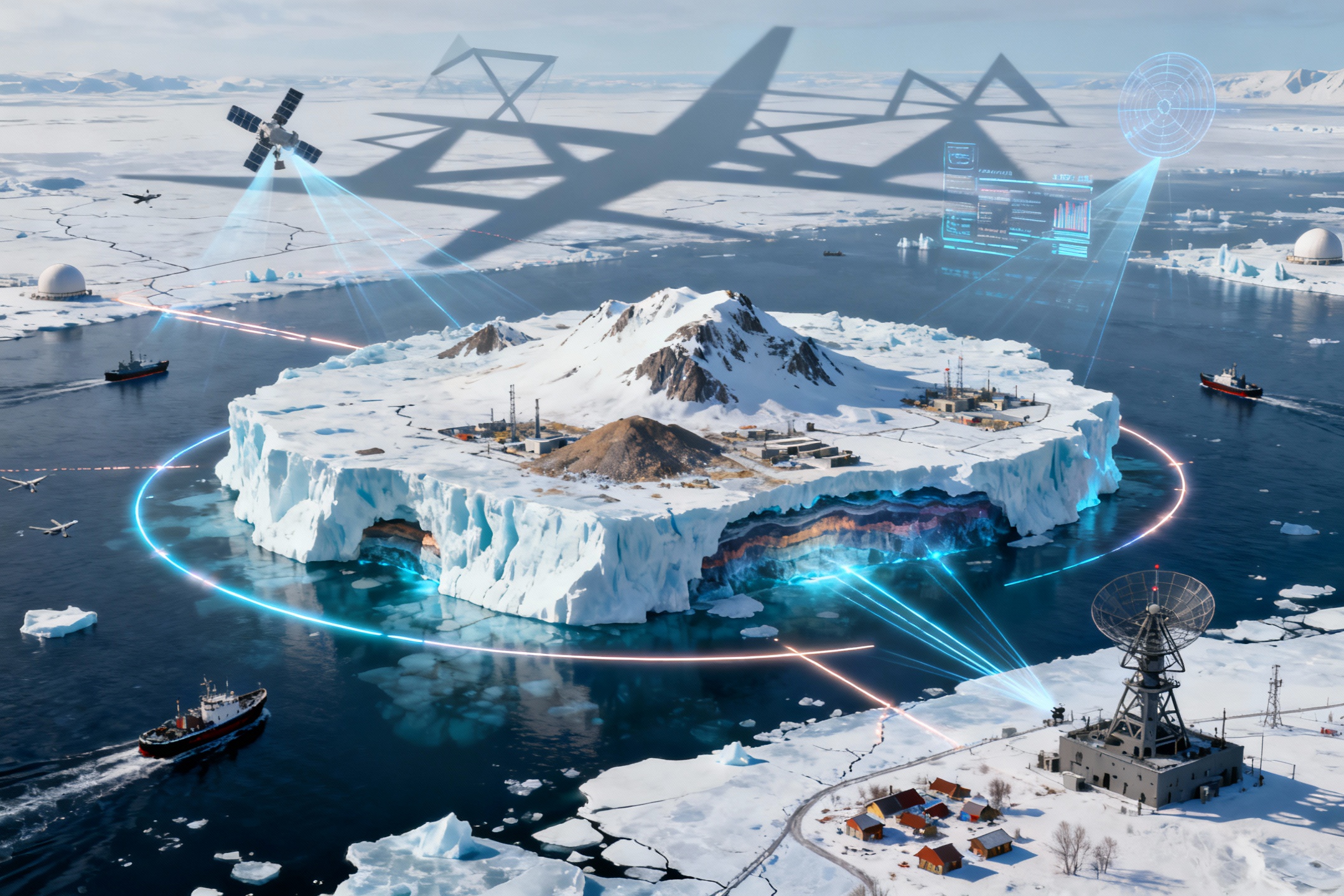
Greenland’s importance derives primarily from its geography. Positioned between the Arctic Ocean and the North Atlantic, the island is integral to the Greenland–Iceland–United Kingdom (GIUK) gap, a critical chokepoint for naval and air movements between Eurasia and North America. Since the Cold War, the United States has recognized Greenland’s military value, notably through Thule Air Base, a key component of U.S. missile early-warning and space surveillance systems.
Beyond security considerations, Greenland possesses significant geoeconomic potential. Melting ice is increasing access to rare earth elements, hydrocarbons, and critical minerals essential for high-technology industries and defense production. In an era marked by supply chain vulnerability and technological rivalry, particularly with China, control or influence over such resources has become a strategic priority for Washington.
The Trump administration’s stance toward Greenland was emblematic of its broader foreign policy orientation: unilateralist, transactional, and explicitly power-driven. Trump’s public assertions that Greenland “will become” part of the United States signaled a departure from diplomatic ambiguity and multilateral restraint, instead framing territorial control as a legitimate instrument of national security.
This discourse aligns with a realist understanding of geopolitics, in which territory, resources, and strategic position outweigh normative considerations such as self-determination or international consensus. Greenland, in Trumpist logic, is not primarily a political community but a strategic asset one whose control could enhance U.S. security while denying adversaries access or influence
Importantly, this rhetoric also reflected anxiety over perceived U.S. decline in the Arctic. Compared to Russia’s expansive Arctic infrastructure and China’s growing investments, the United States appeared strategically underprepared. Greenland thus emerged as a compensatory focus, a means of reasserting American primacy in the High North.
Russia currently exercises the most comprehensive control over the Arctic among all Arctic states. It possesses the longest Arctic coastline, an extensive network of military bases, modernized ports, airfields, and radar installations, as well as the world’s largest fleet of nuclear-powered icebreakers. Moscow views the Arctic not only as a resource base but as a core component of its national security and economic strategy.
The Northern Sea Route (NSR), increasingly navigable due to climate change, is central to Russia’s Arctic ambitions. Control over this route enhances Russia’s economic leverage while providing strategic depth against NATO. From a U.S. perspective, Russia’s Arctic posture represents both a military challenge and a structural imbalance, one that undermines American freedom of maneuver in the region.
Trump’s emphasis on Greenland must therefore be read as a response to this imbalance. Strengthening U.S. presence in Greenland would improve surveillance of Russian activities, reinforce missile defense capabilities, and provide a forward position in any future Arctic contingency.
While Russia constitutes the primary military challenger in the Arctic, China represents a long-term geoeconomic and technological competitor. Beijing’s investments in Arctic infrastructure, scientific research, and resource extraction, particularly its interest in Greenlandic mining projects have raised alarms in Washington.
The Trump administration explicitly framed Chinese involvement in Greenland as a national security threat, leading to U.S. diplomatic and financial efforts to block Chinese companies from acquiring stakes in airports and mining ventures. In this sense, Trump’s Greenland rhetoric also functioned as a strategy of denial: preventing rival powers from establishing footholds in strategically sensitive territory.
Trump’s assertions regarding Greenland starkly conflicted with international norms governing sovereignty and self-determination. Greenland, while part of the Kingdom of Denmark, enjoys extensive autonomy, and its population has increasingly articulated aspirations for greater self-rule or independence. The dismissal of Greenlanders’ political agency in U.S. discourse risked alienating allies and undermining the legitimacy of American leadership in the Arctic.
Moreover, such rhetoric strained relations with Denmark and raised concerns among Arctic states about the militarization and destabilization of the region. While competition is intensifying, the Arctic has traditionally been governed through cooperative frameworks emphasizing low tension and shared governance, an equilibrium Trump’s approach appeared willing to disrupt.
The Trumpist-American strategy toward Greenland reflects a broader reconfiguration of Arctic geopolitics under conditions of climate change and great power rivalry. Trump’s statements, though controversial, were not isolated anomalies but expressions of a strategic worldview that prioritizes territorial control, strategic assets, and power competition over multilateral norms.
By linking Greenland’s future to U.S. security and geoeconomic interests, the Trump administration sought to counter Russia’s entrenched dominance and limit China’s Arctic ambitions. However, this approach also exposed significant contradictions: between security and legitimacy, power politics and self-determination, unilateral action and alliance cohesion.
As the Arctic continues to open and geopolitical competition intensifies, Greenland will remain a focal point of strategic contestation. Whether future U.S. administrations pursue influence through cooperation or coercion will shape not only Greenland’s future, but the stability of the Arctic order itself.