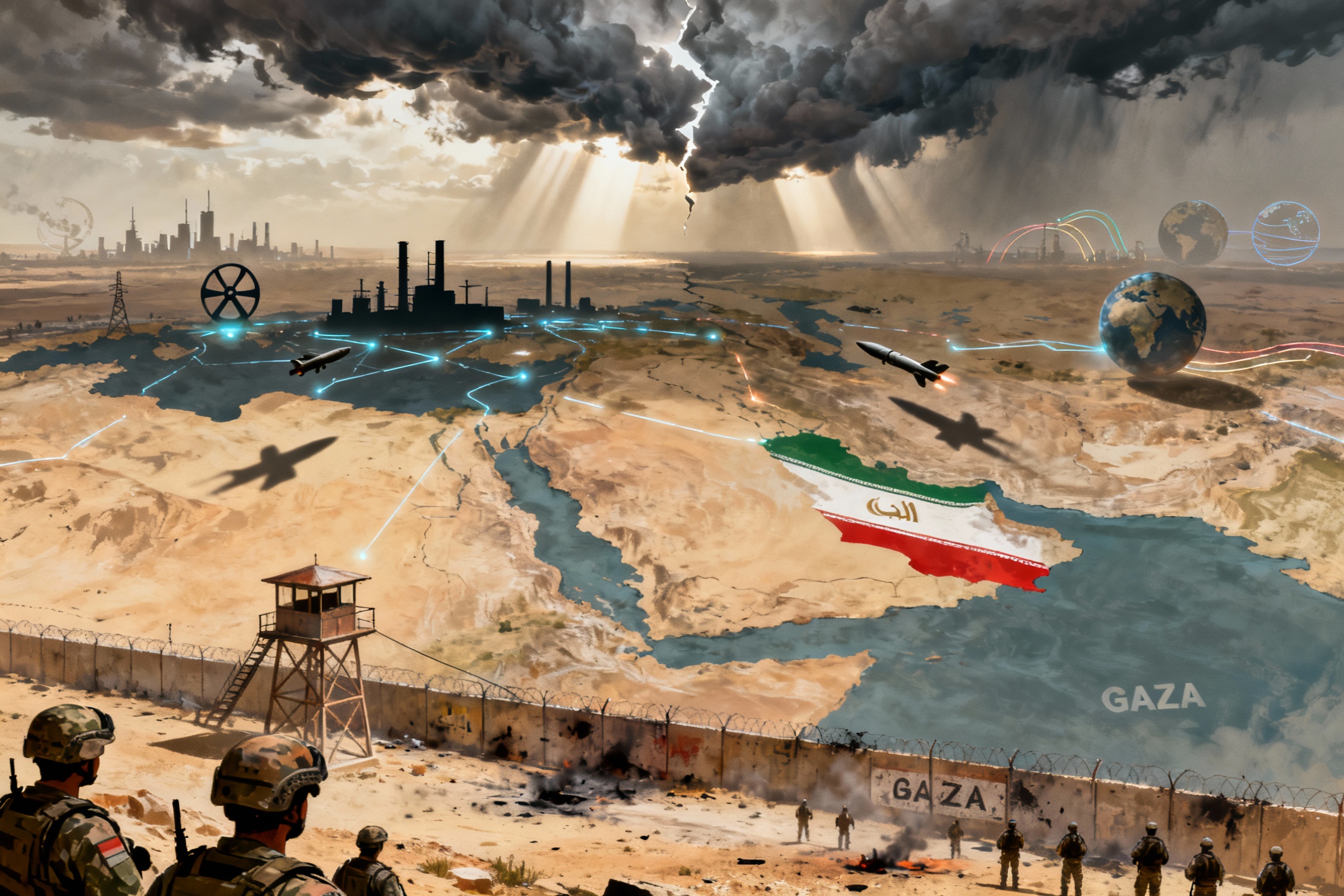
The conflict between Israel and Iran, together with developments in Gaza, reflects the Israeli government’s clear dissatisfaction with the direction both processes are taking. From Israel’s perspective, attempts at de-escalation and ongoing agreements reduce its ability to act freely in a regional environment that it perceives as increasingly complex and risky.
In this context, Prime Minister Benjamin Netanyahu seeks to influence the United States to change the course of events, both in Gaza and vis-à-vis Iran, with the aim of preserving strategic and political advantages.
In Gaza, Israel’s main concern is focused on the post-ceasefire stage. The next phases of the agreement involve the gradual withdrawal of troops, a sustained reduction in military presence, and the possibility of a different administration than the one that has prevailed until now. For Israel, this means a loss of control over a territory that it has managed for years under strict security criteria and through its capacity for direct intervention.
Netanyahu is trying to delay or limit these changes in order to retain room for maneuver, especially in a domestic context marked by political pressures and questions about his leadership. However, his ability to slow down the process is limited. The United States has a clear interest in preventing the conflict from reigniting and in showing that the agreements it promotes can be sustained over time.
Therefore, the most likely scenario is that the process will move forward gradually, incompletely, and accompanied by constant tensions between the parties.
At the same time, Iran occupies a central place in Israel’s strategy. It is considered the main long-term threat, both because of its nuclear program and because of its regional influence and alliances with groups hostile to Israel. For this reason, the Israeli government is pressuring the United States to keep open the option of a direct attack to reduce Iran’s capabilities. For the United States, and especially for Donald Trump, open war with Iran represents significant risks.
Maintaining a firm stance toward Tehran may appeal to certain political sectors, while a regional escalation would generate high economic, military, and political costs, in addition to contradicting the message of avoiding new wars in the Middle East. Overall, a direct conflict with Iran would produce more problems than benefits for Trump.
In this context, the role of multipolar powers becomes relevant as a factor of containment. Countries such as China and Russia, together with other international actors, promote moderation and the use of diplomacy to prevent further escalation.
Their interest is not limited to political considerations, but is linked to regional stability, the functioning of energy markets, and the balance of the international system. Although their ability to prevent military action is limited, their influence contributes to raising the political costs of war and reinforcing pressure to seek negotiated solutions.
Overall, the scenario that is emerging is one of prolonged tension rather than immediate war. Israel will continue to press to protect its strategic interests in Gaza and vis-à-vis Iran, while the United States will attempt to balance its alliance with Israel with the need to avoid a large-scale regional crisis.
At the same time, multipolar powers will continue to act as indirect brakes on escalation. The likely outcome will be an unstable equilibrium, with latent conflicts and ongoing negotiations, where open confrontation remains a possibility, although not the most likely outcome in the short term.