Introductory note:
Spanish and Portuguese historiography use different names to refer to the period in which both kingdoms shared a sovereign. In Spain, it is part of the Spanish Monarchy, an expression that underlines the imperial breadth of the Habsburg dynasty, also known in the European context as the Habsburg.
In Portugal, on the other hand, there is talk of the Philippine Dynasty or the King Philippes, highlighting that it was a specific episode in its monarchical history, experienced as foreign domination. This conceptual difference is fundamental to understanding how the shared experience that took place over sixty years has been remembered and narrated on both sides of the border.
A border that, by the way, has its own name: La Raya or A Raia, which has hardly changed since it was consolidated in most of its current layout more than seven centuries ago, specifically since the Treaty of Alcañices (1297). This delimitation has the merit of having been one of the oldest and most stable borders in Europe, consolidated mostly through negotiations after armed conflicts.
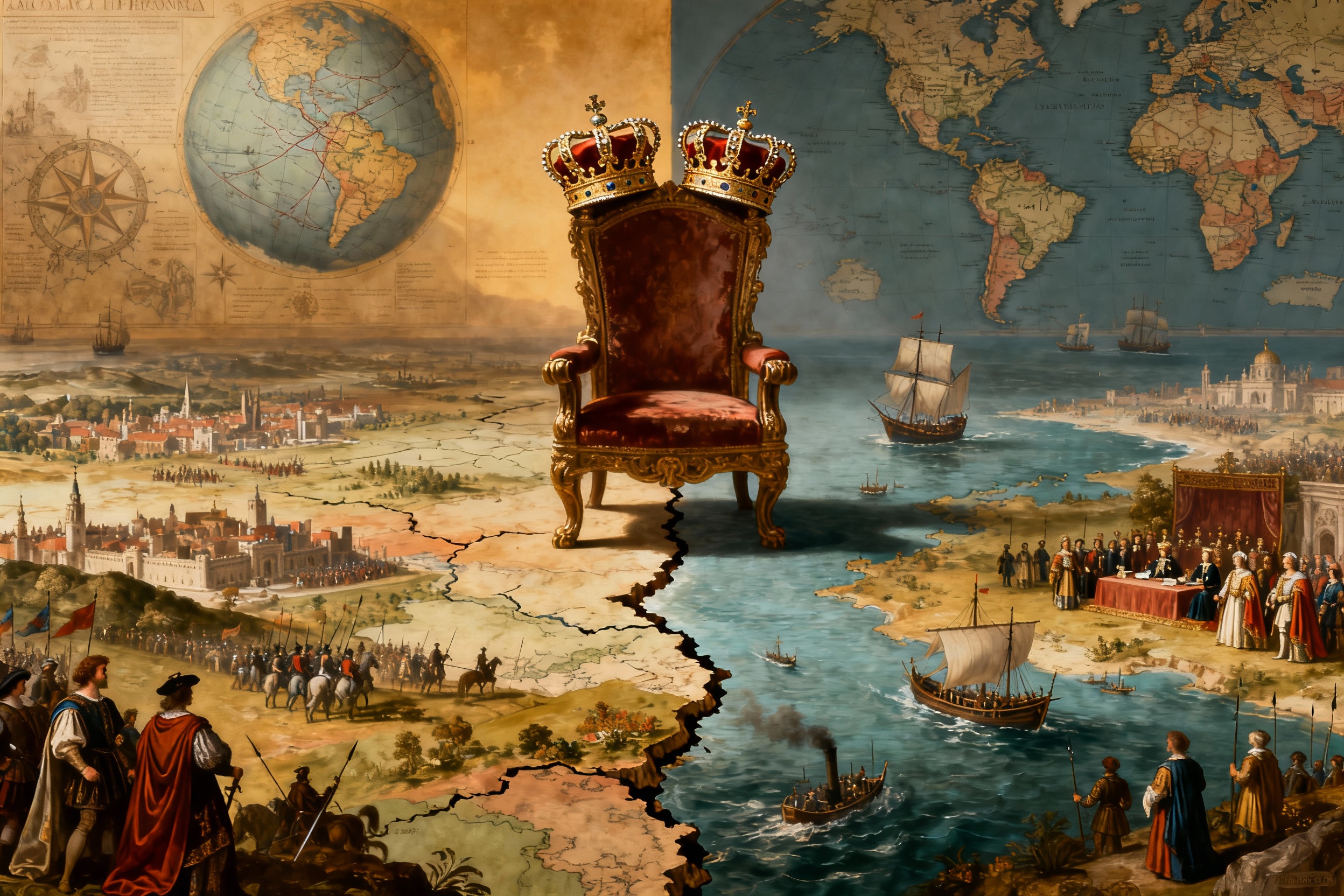
For exactly sixty years, between 1580 and 1640, Portugal and Spain shared sovereign in the person of the three Philippes of the House of Austria. It was a unique period in the history of the peninsula, which projected a monarchy of planetary dimension, but which ended up reaffirming the separate political identities of both kingdoms.
Frustrated history of union:
The independent life of both kingdoms began after their war processes against the Muslim invasion of the Iberian Peninsula. Thus, the Reconquista of Portugal ended in 1249 with the capture of Faro by Alfonso III, while the Reconquista of Spain ended in 1492 with the surrender of Granada to the Catholic Monarchs. 243 years passed between the two events, reflecting the fact that the Portuguese territory was fully consolidated as a Christian kingdom two and a half centuries earlier, developing its institutions autonomously since then.
But the peninsular union was not a sudden phenomenon of the sixteenth century, but the culmination of several previous attempts at dynastic fusion that were frustrated:
1383–1385. The Portuguese dynastic crisis:
At the death of Ferdinand I of Portugal, her only heir, Beatrice, was married to John I of Castile (great-grandfather of Queen Isabella I the Catholic). This opened the possibility of Portugal being incorporated into Castile. The Portuguese nobility and people reacted in defense of their independence, led by the master of Avis, Juan, illegitimate son of Pedro I of Portugal and half-brother of the late Ferdinand. After the decisive battle of Aljubarrota (1385), John was proclaimed King of Portugal with the name of John I, inaugurating the dynasty of Avis and ensuring the continuity of an independent Portuguese crown.
1475–1479. The War of the Castilian Succession:
On the death of Henry IV of Castile, Isabella the Catholic and her niece Juana la Beltraneja disputed the throne. Joanna, married to Afonso V of Portugal, was the Portuguese candidate. The conflict led to the Battle of Toro (1476) and ended with the Treaty of Alcáçovas (1479). As a consequence of this peace treaty, or in current terms “international treaty of delimitation and recognition”:
- Portugal recognized Isabella and Ferdinand as legitimate kings of Castile.
- Castile renounced its aspirations in the Atlantic, except for the Canary Islands, while Portugal retained Madeira, the Azores, Cape Verde and the rights to the African coast, thus consolidating the Portuguese their Atlantic rights.
- At the same time, Juana la Beltraneja had to retire to a convent in Portugal.
In conclusion, the Battle of Toro consolidated the political triumph of the Catholic Monarchs, and the Treaty of Alcáçovas (1479) ratified it diplomatically, putting an end to the war of succession and establishing the first great division of the Atlantic between Castile and Portugal, even before the Treaty of Tordesillas (1494).
1498–1500. Prince Miguel de la Paz’s project:
The Infanta Isabel, daughter of the Catholic Monarchs, married King Manuel I of Portugal on September 30, 1497. His son, Miguel de la Paz, was destined to inherit Portugal, Castile and Aragon, uniting the entire Iberian Peninsula under a single crown. His premature death in 1500, at the age of just two, frustrated this possibility.
These episodes show that the Iberian union was a horizon present for centuries, although it was always postponed until the events of 1580.
Philip II of Spain, Philip I of Portugal:
The opportunity presented itself after the Portuguese succession crisis of 1578–1580. The young King Sebastian died childless in the battle of Alcazarquivir (August 4, 1578), in the vicinity of what is now the city of Ksar el-Kebir, in present-day Morocco. He was briefly succeeded by his uncle, Cardinal Enrique, and when he died a succession dispute began. Among the candidates, the most solid was Philip II of Spain, grandson of Manuel I of Portugal on his mother’s side, as his mother, Isabella of Portugal, married King Charles I of Spain.
Philip intervened militarily in Portugal and, after the victory of Alcántara (25 August 1580), he was recognised as Philip I of Portugal (although in Spain he was still Philip II), specifically in 1581, in the Cortes of Tomar. Resistance, however, continued around Antonio, Prior of Crato, who proclaimed himself king of Portugal in the same year 1580, commissioning the resistance against annexation with Spain.
The Prior of Crato was originally the Portuguese superior of the Hospitaller Order of St. John of Jerusalem, also called the Order of Malta. The priory, in its national branch within the Portuguese kingdom, had its headquarters in the town of Crato (Alentejo). This prestigious and very important position combined religious, military and administrative authority.
The struggle between the Prior of Crato and Philip I of Portugal moved to the Azores Islands, where Antony received French support. There, the armada of the also crowned Philip II of Spain, under the command of Álvaro de Bazán, Marquis of Santa Cruz, defeated the Franco-Portuguese squadron in the naval battle of Terceira Island (July 26, 1582). That victory definitively ensured Philippine control over Portugal and its Atlantic dominions.
In this way, the Iberian union was consolidated not only by dynastic right, but also by military victory on land and sea.
Three kings, two crowns:
Philip II (Philip I in Lisbon), (reigned between 1556–1598 Spain and only from 1581, Portugal), was succeeded by his son and grandson:
– Philip III of Spain / Philip II of Portugal (reigned 1598–1621)
– Philip IV of Spain / Philip III of Portugal (reigned 1621–1665)
In Spanish historiography, Charles I and Philip II are considered the Habsburg Majors, a time of maximum hegemony and expansion. His successors, from Philip III to Charles II, are called the Habsburgs Minor, associated with the crisis and gradual loss of influence. In Portugal, on the other hand, the whole is remembered as the Philippine Dynasty (reigned from 1580 to 1640), without this internal differentiation.
The end of the union:
Castilian predominance, Portugal’s participation in European wars alien to its interests and the perception of abandonment of its overseas empire fuelled growing discontent.
However, this discontent was not homogeneous. A significant part of the nobility, the high clergy and, especially, the Portuguese merchant elites actively collaborated with the Philippine administration, integrating themselves into the circuits of power of the Spanish Monarchy and benefiting from the breadth of its empire and its commercial networks.
Finally, on December 1, 1640, an insurrection proclaimed the Duke of Braganza king as John IV of Portugal. The Portuguese War of Restoration culminated in the Treaty of Lisbon (1668), in which Spain officially recognized Portuguese independence, definitively ending the Iberian Union.
Epilogue:
The Philippine Dynasty or Iberian Union (1580–1640) was an exception in the history of the peninsula. For sixty years, the two crowns walked together, under three Philippes of the House of Austria, but never fused, but united in the person of the monarch. But despite sharing a king, each kingdom retained its own laws, institutions, currency, language, and administrative boundaries.
From the sociological point of view, the period was marked by a crisis of national identity in Portugal: sectors of the nobility and the clergy felt displaced by Castilian officials, while the people preserved their differentiated consciousness. At the same time, other groups of the Portuguese elite accepted—and even supported—dynastic union, occupying administrative positions and participating in the economic benefits of a monarchy of global dimension.
Political integration did not translate into social cohesion, and colonial losses, trade decline, and Spanish cultural influence fueled a growing sense of resentment and resistance, symbolized in the Sebastianist myth, born after the disappearance of the young King Sebastian in Alcazarquivir, and which embodied the collective hope of a redemptive return that would restore Portugal’s lost independence and greatness.
Portugal suffered significant colonial losses at the hands of powers that were enemies of Spain, especially the Netherlands, which occupied enclaves in Asia (Moluccas, Ceylon and Malacca), Africa (Guinea, Mina, Angola and São Tomé) and northeastern Brazil (Pernambuco and Recife). These aggressions, derived from Portugal’s forced participation in the conflicts of the Spanish monarchy, weakened its trade, reduced its revenues and undermined the prestige of the overseas empire, intensifying the national unrest that culminated in the Restoration of 1640, which restored independence under the House of Braganza, its first being proclaimed John IV of Portugal (Dom João IV), who reigned between 1640 – 1656.
That was the greatest and last experiment in Iberian hegemony. At the same time, it was confirmation that Portugal and Spain were destined to follow different political paths, although neighbouring and intertwined.