The election of U.S. President Donald Trump marked a disruptive turning point in the conduct of U.S. foreign economic policy. Since the postwar period, after becoming a hegemonic power and conquering global markets, the dominant discourse among the upper ranks of the American bureaucracy had been one of free trade, reflected in agreements such as the GATT, NAFTA, or the stillborn FTAA. President Trump, now in his second term, breaks with this consensus and makes explicit the way Washington protects its national interests.
The reasons for the return of an openly protectionist discourse—dating back to Alexander Hamilton—range from national security concerns and the growing Chinese threat to the U.S. trade deficit, which approached US$30 billion in October 2025, the lowest figure since mid-2009, thanks to Trump’s tariff policy.
Brazil and India in Washington’s Crosshairs
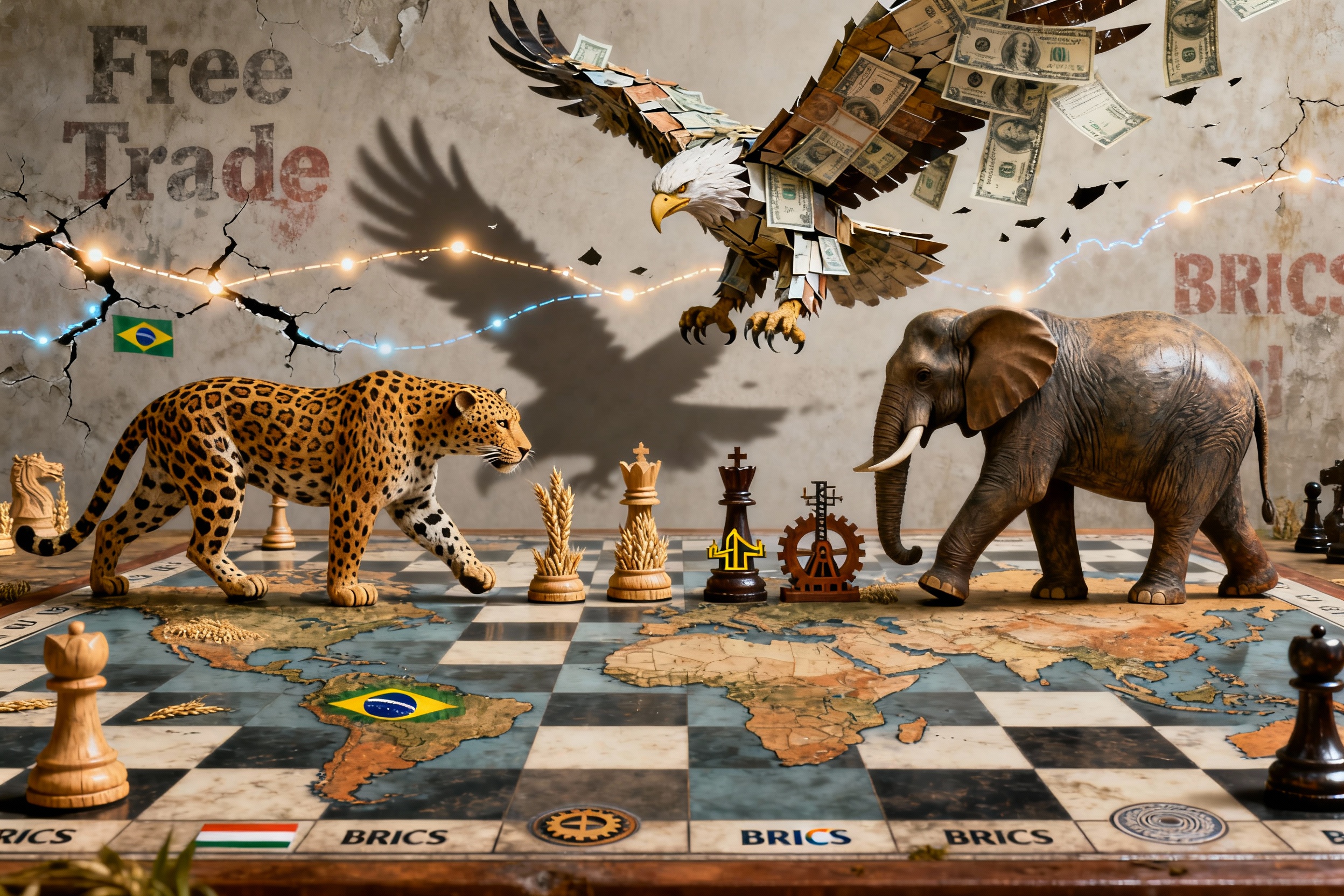
Since the U.S. president’s first term, estimates suggest that tariffs have affected more than 50 countries. In the case of countries such as Brazil and India, which have been targeted since 2018, their use has been justified as a punitive instrument against alleged “unfair competition” or as pressure to align with U.S. geopolitics. In India’s case, this is associated with the purchase of Russian oil; in Brazil’s case, with its growing rapprochement with China and its role in creating a BRICS currency intended to function as an alternative to the dollar.
However, just as countries affected by Trump’s tariff hikes have retaliated through commercial arrangements, both Brazil and India have deepened their economic ties as a way to mitigate the impacts of U.S. trade policy.
This coordination takes place through the expansion of the Mercosur–India agreement launched in 2004 and intensified in the context of Trump’s tariff offensive. Commercial dialogue between Brazil and India has occurred through an institutional mission led by Brazil’s Vice President, Geraldo Alckmin, who attended a meeting in October in New Delhi. Talks between the two countries have been structured around pillars such as food security, defense, energy transition, and industrial partnerships.
The challenges for Brazil are significant, since, according to data from ApexBrasil, the trade relationship with India has shown successive deficits for the country due to the heavy concentration of low value-added products in its export basket. This agreement aims to diversify Brazil’s export profile and attract Indian investments, while in turn increasing India’s presence in South America, rivaling the giant of the North.
Be that as it may, Washington’s chess game is far from simple. Amid the reorientation of U.S. trade policy, space has opened for realignments among emerging countries. The reaction of Brazil and India should not be seen as circumstantial, but rather as part of the occupation of spaces in a world where liberal discourse is becoming increasingly eroded, enabling the assertion of strategic autonomy and cooperation among non-Western countries.