Germany moves through the present decade with the heavy gait of a state that senses its own exhaustion. The language of policymakers remains calm, statistical, and procedural. Charts are presented, committees convened, and forecasts adjusted by tenths of a percentage point. Yet beneath this administrative surface lies a harsher reality: the structural foundations of German prosperity are weakening at the same moment that political flexibility is narrowing. This combination rarely ends in renewal. It usually ends in managed decline.
Growth projections hover near one percent, a figure that signals motion in theory yet paralysis in practice. Advanced economies require dynamism to sustain social systems built during eras of expansion. When output barely advances, every promise becomes harder to finance. Pension obligations expand, healthcare costs rise, infrastructure ages, and fiscal space contracts. Germany once solved such pressures through industrial superiority. Strong exports offset the economic strain of demographic decline.
Precision manufacturing allowed the country to command global markets while maintaining high wages at home. That model now faces simultaneous assault from several directions. Energy costs remain structurally higher than those of key competitors. Supply chains are increasingly oriented towards regions with cheaper power and lighter regulatory burdens. Asian producers climb the value ladder once dominated by German engineering. Massive U.S. subsidies are pulling investment away from Germany and towards America.
The labor market reflects the shift. Unemployment above three million signals more than cyclical softness. It shows an economy facing weaker global demand for the industries that once sustained it. Hidden underemployment adds to the danger: workers move from one temporary job to another, training programs replace stable careers, and fewer people remain fully engaged in the labor force. A society organized around productive pride finds such transitions psychologically destabilizing.
Germans accepted high taxation and dense regulation because the system delivered stability and upward mobility. When that implicit contract weakens, public patience follows. Business sentiment reveals the same anxiety in quieter tones. Investment committees stretch timelines. Expansion plans shrink in scope. Some firms explore relocation; others execute it with minimal publicity. Capital rarely stages dramatic exits. It departs gradually, quarter by quarter, until absence becomes visible.
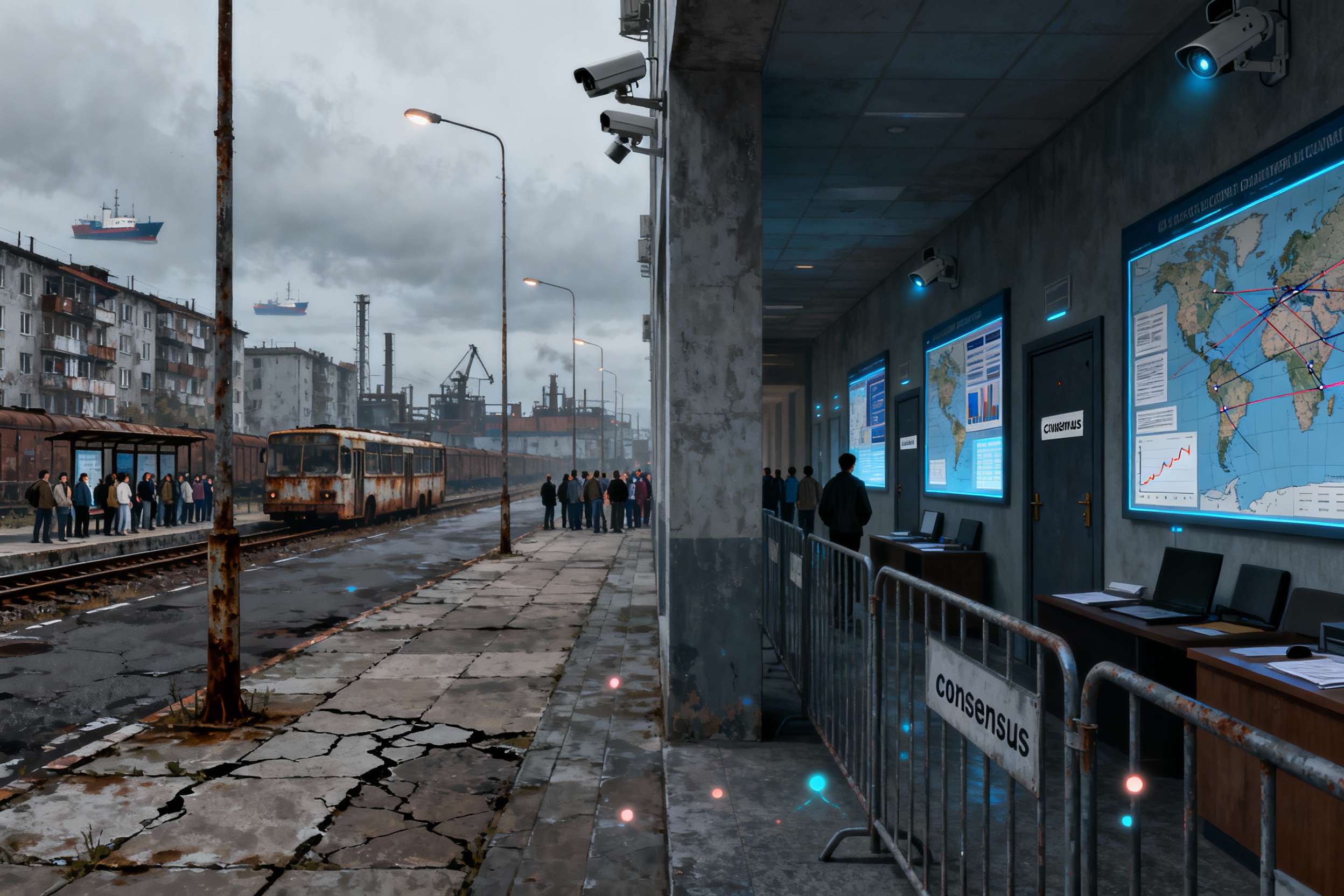
Political leadership appears aware of these dangers, yet its responses often deepen the sense of distance between rulers and ruled. Large defense commitments, framed as necessities within an unstable geopolitical landscape, proceed alongside strained public services and infrastructure backlogs. Strategic logic supports rearmament in a multipolar world where power disperses and security guarantees carry a higher cost. Citizens, however, measure policy against lived experience. When bridges require repair, housing tightens, and classrooms grow crowded, vast military budgets invite scrutiny. The perception emerges that the state prepares for external conflict while neglecting internal cohesion. It is within this atmosphere that anti-establishment sentiment expands. Voters increasingly suspect that traditional parties function less as vehicles of representation and more as custodians of a closed consensus. Coalitions change, yet policy direction rarely does. Political language becomes increasingly technocratic, detached from the plain concerns of ordinary citizens.
The AfD (Alternative for Germany) benefits from this rupture. Many supporters view it as the only major party willing to challenge foundational assumptions about energy policy, immigration, sovereignty, and economic alignment. Yet the ascent of a populist challenger often triggers an equally powerful counter-reaction from entrenched institutions. Germany possesses one of the most vigilant constitutional frameworks in the Western world, designed to prevent perceived threats to its system before they mature. This raises a question that now circulates with increasing seriousness: if electoral growth continues, will the establishment seek to neutralize the AfD through legal prohibition, administrative pressure, or strategic co-optation?
History suggests that systems confronted with opposition movements typically choose one of three paths. They absorb the challenger by adopting elements of its platform. They isolate it through political cordons. Or they attempt exclusion through legal mechanisms. Each option carries risk. Co-optation might stabilize the system in the short term, though it could reinforce a common system-critical argument: that established parties tend to respond only when confronted with serious electoral pressure.
Trying to isolate the AfD could deepen divisions, turning political frustration into a hardened group identity. Banning the AfD would mark the most dramatic step yet, reinforcing concerns that political dissent in Germany is increasingly constrained within a system shaped by strict speech regulations and influential state-funded media. A ban remains speculative, yet even discussion of such a measure reveals a deeper shift. When a democracy begins debating whether a party supported by millions should exist at all, the political center has already weakened.
Economic stagnation accelerates this process. Prosperous societies tolerate procedural complexity because material life feels secure. Stagnant societies search for decisiveness. Voters demand clarity, direction, and agency. Multipolarity amplifies the stakes. The global system no longer revolves around a single organizing power. Trade networks fragment, technological ecosystems diverge, and geopolitical loyalty carries tangible economic cost. Germany must decide whether it will act primarily as a disciplined participant within established alliances or as a more autonomous pole balancing relationships across regions.
Such a strategic recalibration requires political courage rarely visible in bureaucratic cultures. It demands acceptance that the era of frictionless globalization has passed. It requires a willingness to prioritize national competitiveness even when doing so unsettles inherited assumptions. Germany often appears trapped between two paths: too deeply integrated in the existing global order to change course quickly, yet too economically exposed to stand still. An aging population expands fiscal burdens while shrinking the workforce that supports them. Immigration could offset this trend if managed with coherence and public legitimacy. Absent that legitimacy, it becomes another axis of polarization.
Social trust, once Germany’s quiet advantage, shows signs of erosion. Trust allows complex societies to function with minimal coercion. Its degradation forces greater reliance upon regulation and surveillance, which in turn feeds resentment. The cycle becomes self-reinforcing. Will Germany recover? Structural decline is rarely inevitable, though reversal demands recognition of the problem in its full severity. At present, the political class still speaks the language of adjustment rather than transformation. Incremental reform struggles against systemic pressure.
The darker possibility is that Germany enters a prolonged phase of relative diminishment: still wealthy, still orderly, yet gradually less influential, less innovative, and less confident. A nation that once defined Europe’s economic tempo could find itself adapting to rhythms set elsewhere. Within such an environment, political conflict intensifies. Establishment forces defend institutional continuity; opposition movements claim democratic renewal. Each portrays the other as a threat to the republic. Compromise becomes harder because the dispute concerns legitimacy itself.
Should authorities move aggressively against the AfD, whether through formal prohibition or softer administrative constraints, the act would reverberate far beyond party politics. It would signal that Germany has chosen stability over pluralism, control over unpredictability. Some citizens would welcome the decision as a defense of the constitutional order. Others would interpret it as proof that a credible alternative is unwelcome. Either way, the social fabric would strain.
Germany thus approaches a threshold. Economic fatigue, geopolitical uncertainty, demographic pressure, and political fragmentation converge into a single question: can the Federal Republic adapt to a harsher century, or will it attempt to preserve a model shaped by conditions that no longer exist? States rarely collapse in dramatic fashion. They drift, adjust downward, normalize weaker performance, and call it resilience. Decline often masquerades as prudence. The illness, then, may lie less in any single indicator than in the narrowing of imagination. A country that doubts its capacity for renewal begins to govern defensively. It manages outcomes rather than shaping them.
Germany still possesses immense industrial knowledge, institutional depth, and human capital. Yet assets alone guarantee nothing. History favors societies willing to confront uncomfortable truths early. If Germany continues on its present course—hesitant abroad, restrictive at home, and increasingly wary of dissent—it may discover that the greatest danger was never a sudden crisis, but the gradual acceptance of diminished ambition.