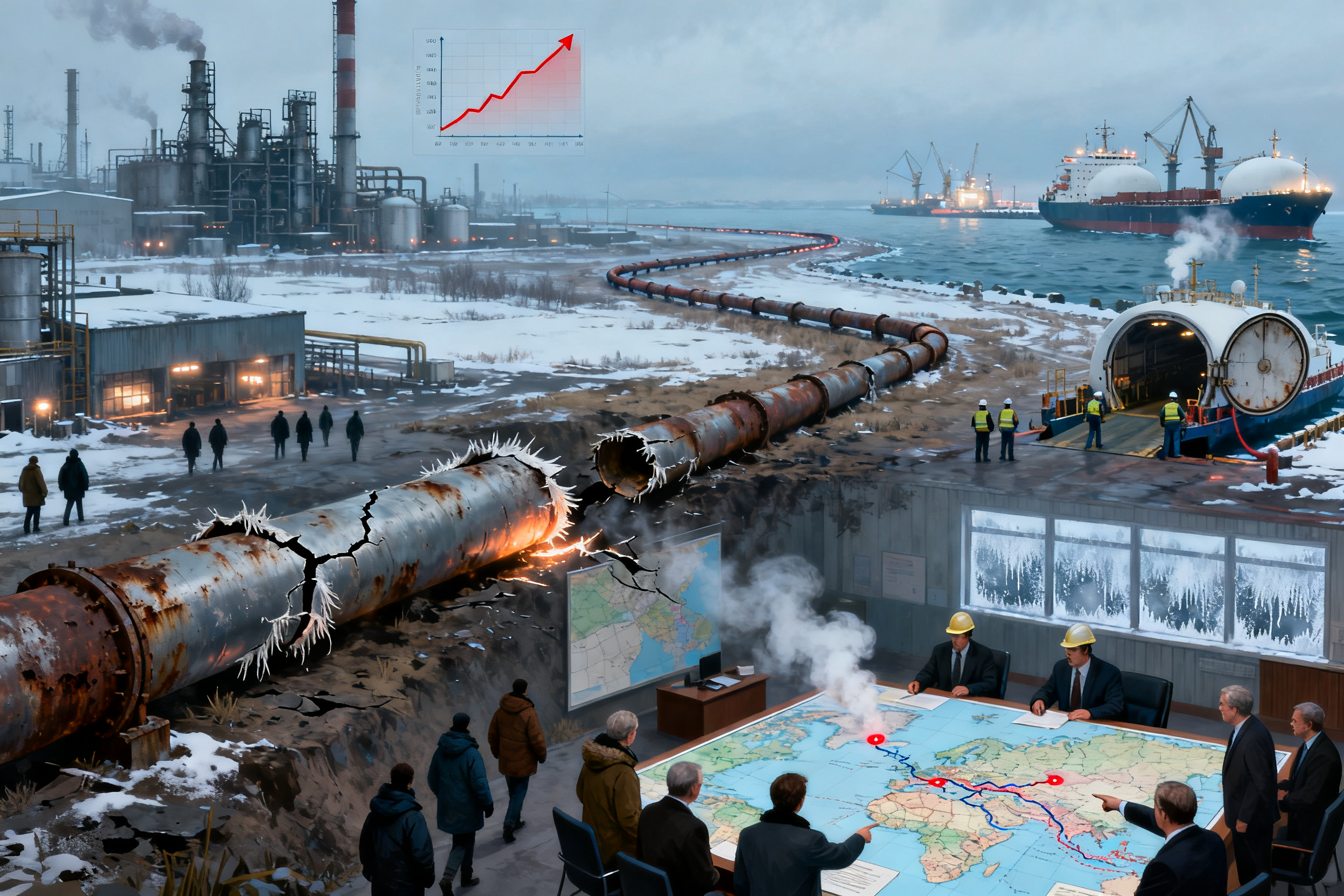
On November 8, 2011, Chancellor Angela Merkel and Dmitrii Medvedev, the then Russian president, inaugurated Nord Stream 1, a colossal work that guaranteed the supply of Siberian natural gas to Europe at a very affordable price, more than any other energy import from the Persian Gulf or the United States. Only Algerian gas can compete with Russian gas, but its recognised reserves are much smaller: Sonatrach, the state-owned gas company, exports 10,000,000,000 cubic metres per year from Hassi R’Mel to Almeria via the Medgaz.
In January 2023, Algeria and Italy signed an agreement for the construction of the Galsi, a gas pipeline that will link Algeria’s gas fields with Sardinia and the Italian mainland.
The main supplier of liquefied natural gas (LNG) to Europe is the United States (48% of the total), not because of the cheapness or the quality of the product, but as a geopolitical demand of Washington, which lacks economic rationality for the countries of the old continent but which exposes an undeniable reality of political subordination: between 2021 and 2024 the number of these imports doubled.
Thanks to the start of hostilities in Ukraine. Russian natural gas is between 25% and 40% cheaper than American LNG, as it does not require its transformation processes, nor its transport costs, nor is it subject to the volatility of US market prices.
The key to the competitiveness of European industry lay precisely in the cheap and abundant energy provided by the Siberian gas pipelines. To add insult to injury, Algeria is a traditional ally of Russia and a hereditary enemy of the main U.S. pawn in North Africa: Morocco. What this American commitment to the Alawi monarchy means we Spaniards have paid for when, subject to Washington’s interests, we recognised the Moroccanness of Western Sahara: Algeria “cut off the tap” of gas and we suffered an energy crisis.
Norway, a non-EU member, is actively benefiting from the war in Ukraine, as it facilitates 33% of European natural gas imports, but even in the current situation Russian gas, with all its sanctions on top, is cheaper than Norwegian gas. The United Kingdom is also taking advantage of the crisis by exporting LNG and natural gas to countries on the continent. Wherever Europe looks for its gas, it will never find it as abundant, good and cheap as in Russia.
Some 60 billion cubic meters of gas fed Europe’s industries and homes from Tyumen and the Yamal Peninsula. 30% of European homes are heated by gas. Russian supplies were to increase with the commissioning of Nord Stream 2, something that drew the ire of the United States and the not-so-veiled threats from Joe Biden in March 2021.
For Biden, Nord Stream 2 was “bad for Europe and bad for the United States”, especially for the latter. On February 7, 2022, shortly before the entry of Russian troops into Ukraine, President Biden made it very clear to Scholz: “If Putin invades Ukraine, there will be no Nord Stream 2. I promise you.” Interestingly, Nord Stream 2 did not pass through Ukrainian territory: it went from the Gulf of Narva directly to northern Germany.
German industry was about to receive an additional 55,000,000,000 cubic meters of cheap gas, essential for the competitiveness of its industry. Sanctions were not long in coming, and in February 2022, Chancellor Scholz bowed to US orders and halted the development of Nord Stream 2, which was about to be put into service. On September 26, 2022, the Nord Stream pipes were sabotaged by whom, but they could not have been amateurs: the steel conduits are lined with concrete and at a depth of between 80 and 110 meters. On September 27, 2022, the Baltic Pipe, a gas pipeline that carries the product from Norwegian waters to the Polish coast via Denmark, was inaugurated. Coincidence or causality?
For a long time, very soon it will be five years, we have been convinced that the war in Ukraine is not only a NATO war against Russia, but of the United States against Europe, especially against Germany, the heart of the old continent’s economy. The destruction of cheap energy supplies ruins the German competitor and condemns the European Union to become a deindustrialized space. The pathetic inability of the twenty-seven countries of the European Union to match Russia’s military production tells us how weak its once-powerful secondary sector is.
The United States has made a good deal: it has decisively weakened one of its economic competitors, it has managed to get the costs of the war to be paid by the ruined Europeans and, on top of that, it has kept the rights to the natural wealth of what is left of Ukraine. Their usual accomplices: Norway and Great Britain, also make money, as well as the false friends of Germany, Poland and Denmark. What is astonishing is not this plunder that borders on piracy, but the docility with which the Germans have put the noose around their necks and jumped into the void. More than an execution, it is a suicide. And suicides are always voluntary.
The erratic and pathetic policies of the European Union should disable their stupid executors: to free us from energy dependence on Russia, which offers us cheap and abundant fuel, we surrender to the United States, which sells us much more expensive and complex what Russia offered us ready to consume. And it is enough to see how Trump treats European leaders to understand who is the master and who are the slaves, who are also very happy to allow themselves to be kicked around. Are these the defenders of Europe’s independence, the ones who have turned it into a gigantic Guam, another Puerto Rico?
Russia did not want a dependent Europe, but a partner with which to make money. Anyone who knows Russia knows that the business opportunities are endless. Surprisingly, Europe has refused to do so and has preferred to submit to Washington’s blackmail. In a few years, when the frustrated European project is a sad ruin, we will see how Poles, Scandinavians and Balts acted as agents of the United States and ruined forever any possibility of a competitive and powerful Europe.
Finally, when the Polish authorities arrested one of the “suspects” in the Nord Stream bombing, the court denied his extradition to Germany, stating that the sabotage had been “fair”. The case was closed and the Polish government expressed its satisfaction with the judges’ decision. The Germans did not even bother to break off relations with Warsaw. This is how they say that Europe, the new backyard of the United States, is “built”.