Let’s not even mention Europe, which now exists only as a malevolent power.
Among the many reasons why we have ended up in this situation, there is one that is rarely discussed.
For more than two centuries, European and world political history has been written through a relatively balanced swing between two poles:
- On the one hand, the recognition of the state as the guarantor of the common good, the protector of the weak, and the regulator of social life;
- On the other, virulent criticism of the state as an oppressive, bureaucratic, inefficient, corrupt and sometimes even murderous machine.
But in the last few decades, we have entered a singular phase in which it is precisely this second vision that dominates the intellectual and political sphere.
Under the Ancien Régime, the state was invested with an almost sacred dimension.
The King of France embodied both political and spiritual authority: his coronation in Reims linked him to God and his people.
The French Revolution in 1789 overturned this model by proclaiming national sovereignty.
But the new republican state also retained a dimension of embodiment: it saw itself as the ‘public thing’, the guarantor of liberty and equality.
However, from the 1970s and 1980s onwards, a shift took place.
The oil crisis, inflation, debt, and the collapse of collective ideologies gave rise to a different image: the state was no longer necessarily a protector, but could also be an obstacle. The neoliberal era, which originated in Anglo-Saxon countries, imposed the idea that ‘the state is not the solution to our problems, the state is the problem’.
Gradually, the presidential role has become trivialised. Corruption scandals, sex scandals, media omnipresence, vulgar posturing and vocabulary, familiarity, lack of moral values… All these shortcomings reduce the head of state to a ‘politician like any other’.
This phenomenon is not unique to France. Throughout the Western world, the presidential or governmental office has gone from greatness to caricature. Donald Trump in the United States, Justin Trudeau in Canada, Boris Johnson in the United Kingdom.
French heads of state Nicolas Sarkozy, François Hollande and, most notably, Emmanuel Macron complete this series.
All mark a break with tradition: leaders no longer offer dignity or morality, but spectacle and vulgarity.
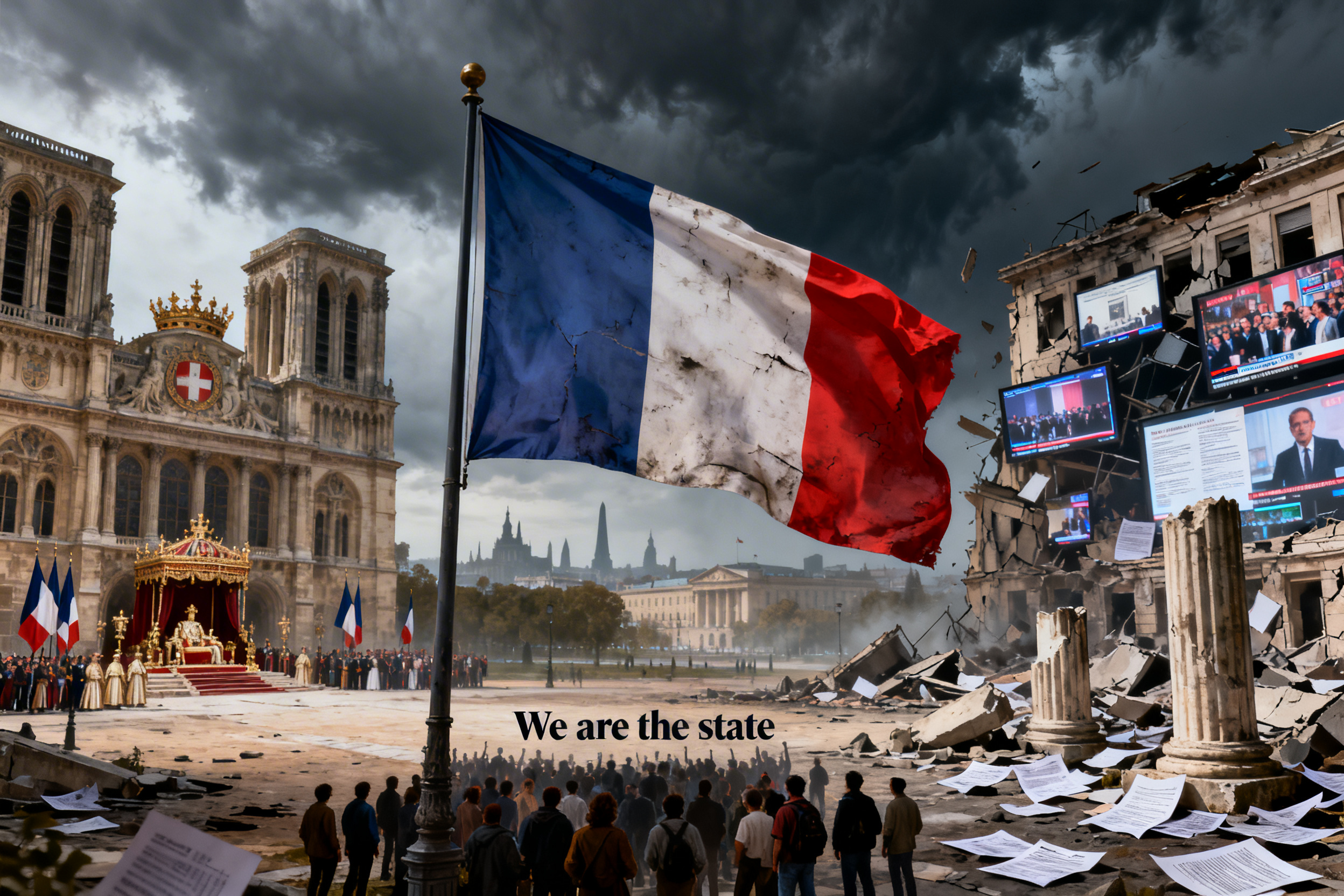
According to a phrase that the French king Louis XIV is said to have uttered before the Parisian parliamentarians: ‘L’État, c’est moi’ (I am the state).
The people and civil society should take ownership of this peremptory sentence and now find a way to assert to their modern leaders: ‘L’État c‘est nous’ (We are the state).