Europe has become a vassal and at the same time unprotected region, a risk zone in the world. The sensible thing to do, in case of inferiority of power, is to accept vassalage in exchange for protection. It was feudal logic. In our case it is not like that: the European case is the case of a vassalage that creates a lack of protection, that introduces the maximum risk in our lives. We are talking about vassalage to the US and NATO, of course.
That the states of Europe accept such a bad deal, such an absence of logic, such a violation of the laws of lordship (and vassalage) can only be understood historically, genetically. This is the consequence of 1945. For the last eighty years we Europeans have been indoctrinated – especially in the western part of the Eurasian peninsula – in the theory of happy liberation. We have been liberated from Nazism, but we have not been – in absolute terms – liberated at all. In no way was there freedom for Europe after the defeat of Nazi-fascism, and what is more serious, since it mortgages and puts the future at risk: in no way was there more sovereignty for Europe.
The great Austrian geopolitical scientist, Jordis von Lohausen, at the time when the so-called “cold war” was coming to an end, described in an excellent book the exact situation of Europe. The book, translated into Spanish, which can be consulted is Courage for Power. (Grupo Editor Latinoamericano, Buenos Aires, 1994).
In it, von Lohausen describes in detail the constant conditions that determined history and the changes of power in the world, and that will still condition in the future, even with the new cybernetics, ballistics, satellites, etc.
All these new technologies are added to and adapted to the constants, to the permanent space conditions, which go back to the very conformation of planet Earth, millions of years ago: Earth and Sea (and the sky and in space to the extent that they affect the powers acting on Earth and in the Sea).
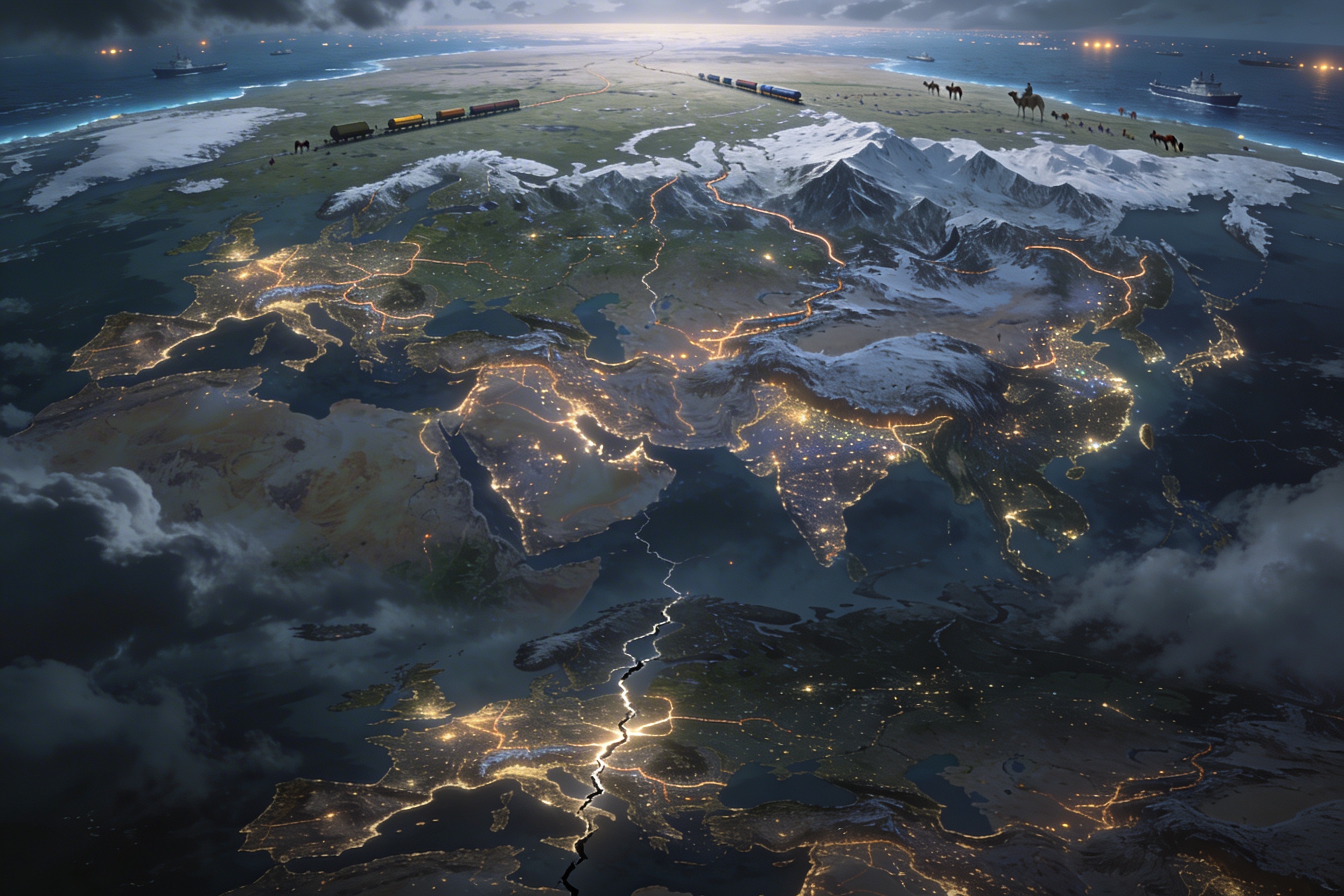
Europe is a peninsula of greater Eurasia. The Eurasian plains penetrate very deep into central and western Europe. From Siberia or Nordic and Central Asia, there are no relevant obstacles to the Pyrenees barrier. The Urals do not count, they were never a real barrier or border. Rivers, and even less so those of Europe, are not geopolitical barriers either: they can serve as an excuse to draw administrative borders, but they never stop or separate anything (peoples, cultures, nations), rather they unite and communicate. Nordic Germany is a great plain, a two-dimensional piece located in the middle of the peninsula, open on too many flanks. A Germany located so far in the center may be the weakest and most exposed entity on the French side, to the West, or on the Russian side, to the East. But it can also be the central entity, the central accumulated power of Europe, a platform for expansion towards France or Russia, the headquarters of all possible invasions of East and West. Von Lohausen points out that Germany’s strength is its weakness. Hence, the progression of events in Europe always depends on this heart, on this marrow: an exposed centre, without the island protections of the British or without the peninsular semi-protections of the Iberians (Spain and Portugal, which are a geopolitical unit, have two seas and a mountain range as firm as the Pyrenees).
Germany is exposed, so it wanted (wants) to be strong; in comparison, it is like a city without walls shrouded in uncertainties: hence a strong German power implies the need for a Will to Power.
Peoples and nations that lack the will are liable to lose all their sovereignty. The militaristic resurgence of twenty-first century Germany (like that of its former war partner, Japan) is a sad mirage. The will of the Volk is not reborn: it is the delegated will of the Yamki-Zionist hegemon. Today’s warlike Germany is not a collective Will to Power. It has nothing to do with the Second and Third Reichs. It is today, to date, a weak and defeated people (as long as it acquiesces to Yankee bases, it is a defeated people) with a strong industrial past but today in the hands of financial speculators and a very sad present, squeezed in its most intimate areas by the Zionist and American claws. The spatial situation is the same: the great uninterrupted plain that leads to Russia and, therefore, to the Asian immensities, that is Germania to the north. An extension of Russia or an extension into Russia. But the will driving hostilities towards Russia in 2026 is not the will of the people, nor even the will of a differentiated and hegemonic stratum of the people (an aristocracy, a supremacist party, or whatever). It is the will of the globalist elite perfectly coordinated with Washington and installed in the financial and Zionist centers.
The great plain of Central Europe was always a platform for sending or receiving invasions, but von Lohausen considered that this great plain was also the stage for unity. Unity repels violence and raises great civilizational constructions. The fact that there is no great Eurasian civilizational unity is due, on the one hand, to thalassocratic interference. The British coordinated successively with other powers (France, Russia) to prevent European unity and, later, Eurasian unity (which necessarily includes Russia). Then the Yankees did.
European unity, prior to Eurasian unity, collapsed after Charlemagne’s death. At the very beginning of Europe in the strict sense (differentiated from the Mediterranean Classical World) “Franconia” was forever split in two: the one that would give its name to today’s France (which ceased to be the “Gauls”), and the central and eastern one: namely, Germania. Europe lacked a solid identity after the disaster caused by Charlemagne’s heirs. Europe did not continue to be a true Imperium (Reich) because of the ineptitude of many of its leaders, and not only because of the dissolving action of external and thalassocratic powers. The very existence of a French power, a Kingdom of the Franks, is the story of the failure of the Reich, the creation, between the Pyrenees and Central Europe, of an alternative to that Reich. But, at the same time, the very history of the subsequent Holy Roman Empire is the history of the triumph of localisms, of pettiness, of the manipulations of powers of the most diverse to the detriment of the Universal Unity, to which that Imperium was originally called.
The very heart of Europe, Germany, is weak and its power was born of its will to power, it did not arise from having been well protected, or sheltered behind walls and in inaccessible corners. Von Lohausen analyzes in detail the fracture with that “other Germany” that today is called Austria. Geopolitically, in certain cases it may have been good not to unite what at the ethnic and linguistic level should in principle be united. Prussia taking over the Balkan mosaic, Magyar, etc. would probably have failed, but in the end, these splits cause pain and weakness.
The forced displacements that took place after 1945, namely an ethnic cleansing of Poland (to achieve a “pure” Polish nation, without Ukrainians or Germans) as well as in the Russias and in various Eastern states, did not augur well. The most recent slaughters in Yugoslavia and Ukraine come, in essence, from the forced displacement of entire populations of Germans. They set a disastrous precedent. Before, borders were moved and people were left in peace, in their homes. From 1945 onwards, the defeated Europe itself agreed to move the peoples from their homes and lands, and to take away their livelihoods. Today’s Germany, even after the reunification (or absorption) with the GDR, is a contracted Germany, and it is a funnel that welcomed – sometimes reluctantly – the flood of ethnic Germans but not of “compatriots”, since they were no longer so in the eyes of the citizens of the Republic, not in the new sense that was coined in 1945.
The union of France and Germany gives a necessary weight to the sovereign Europ, it is an essential requirement for a unified European Power. The southern peninsulas (Italy, Spain, Greece) must gravitate towards that Power if it is formed. If not, they stay on the sidelines, like Scandinavia. The British Isles will never want this true Power. If they are integrated, it will not be except to tark it, to deactivate it from within. But the union of France and Germany, it is understood, must be a sovereign union.
At the beginning of the European Economic Community it seemed that a new pole, allied but different from the American one, was going to be formed. There was never such a thing: the “fathers” of the European Union (today it is known and there is documentation) were employees of Washington and the CIA. The “Franco-German axis” served to further domesticate and extort Southern Europe: “Mediterranean” Europe. Portugal is not at all Mediterranean, and Spain is only partially so. But the offices in Brussels that have been managing the delegated power of this Franco-German axis have created, with their despotic and draconian decisions, a real marginal belt, a southern hinter+land. Southern Europe was conceived there, criminally, as a quasi-colonial strip to be administered from the north: they dismantled the agriculture that could compete with France, on the one hand, for the benefit of the latter. They dismantled industry, which could compete with Germany, to the latter’s benefit.
Southern Europe, if it were not this foolish version of the Franco-German Axis that we continue to suffer, could feed the rest of the continent, but such a thing was not wanted. The European Union was nothing but the despotism of the Franco-German Axis for greater glory and control by the United States. Without peasants or workers, the Europe of the three Mediterranean peninsulas ceased to be a communist threat. The capitalist system of Western Europe, crammed with American bases since 1945, dismantled the sovereignty of the countries of Southern Europe, considering them protectorates of the French and Germans. Of these, a Spain as an agro-industrial power linked to Portugal would end up being a fearsome power for the French, if it had not fallen into the hands of the partitocracy, especially into the hands of the Socialist Party, a force financed with German marks, on the one hand, and very “Frenchified” ideologically, as Spanish progressivism always was.
The Italian case is analogous to the Spanish one: one of the world’s greatest powers – also in the industrial field – was beheaded by order of Washington. It could not be done with a single assassination, as in Spain that of Admiral Carrero (Franco’s dauphin and successor) but it could be done with several assassinations of personalities, infiltrations within the Italian Communist Party, and very diverse networks of bribes and “judicial” wars. The South was neutralized not in order to “build Europe”, which will certainly always go through a reconstruction of the old “Franconia” (Latin on one side, German on the other), but so that the Eurasian peninsula would continue to be an American colony, better and more docilely governed.
If the center of the Eurasian peninsula concentrated its power, not despotically as it is now, but as a real hand with its five fingers, a Reich would have been brought back to life. The word, which for those who do not know History refers to the disastrous “Third Reich”, or in general, to a German imperialism, also very harmful in its effects, in reality means superior unity of nations and peoples with the will to live sovereignly. Europe, without unified sovereignty or without will, would long ago have been the plaything of foreign powers. The will of the Asturians in 722 and later, made Spain possible. Spain, without the will to Nordic power of the Cantabrian kingdoms, would be a country of the same culture, religion, landscape and countrymen as Morocco. In turn, Spain was the stopper of Islam, which prevented its advance, also stopped by the victory of Charles Martel in the eighth century, shortly after Covadonga. On the other hand, and in post-Byzantine ages, from the Balkans, Hungary and Austria, the struggle against the Turkish advance also prevented, at various times, Europe from being another extension of Islam and losing its identity.
This Eurasian peninsula, Europe, seems to want to dilute itself again, to forget even its own name. The Anglo-Saxons play with the concept of “the West” to include the British Isles, which in reality were little more than a pirate base created in the sixteenth century to make life impossible for the Spanish Empire and disunite Europe, and then to encompass the power of the United States, a planetary empire since its victory over Spain in 1898. By calling its entire sphere of influence, which includes both Western Europe and the two Americas, “the West”, the Anglosphere has obtained one of its great ideological triumphs, which always lag behind military triumphs and occupations with troops: the Western Empire (in the happy expression of Professor Andrés Piqueras) ideologically includes a large transcontinental bloc in which the Monroe Doctrine (all of America) is already included. the entire Anglosphere (English-speaking countries with at least leading Anglo-Saxon minorities), Japan (militarily occupied by the Yankees since 1945 and ideologically subjugated) and the countries of Western Europe, plus some Asian and African vassal countries.
In Alexandr Dugin’s recent analysis, and in light of the most recent – and brutal – events with which 2026 began, the “West” construct has already fallen; In reality, the area of undisputed hegemony of the United States has been severely cracked by Trump’s policies. Western European “allies” have been beaten to death, forced to pay for the war in Ukraine and to sustain it (an impossible task) at their expense, compulsorily buying weapons from the Yankees’ industry of death.
In Spain, at least, an expression is widely used that, although vulgar, is nevertheless very graphic: the European NATO allies have become prostitutes “who also make the bed”. Bad business is to offer some services to another, and not charge anything for it. Worse business still is to become a serf, errand boy and prostitute, and to pay for it, to give oneself up and degrade oneself. Europe is paying for its ruin and degradation. All the NATO European countries will sink deeper and deeper on the economic plane, with spending cuts, deterioration of “welfare” and chronic indebtedness in a ruinous, dangerous and unjust enterprise. It is ruinous to help Zelensky, a corrupt dictator who cannot win a war that, moreover, could reasonably have been avoided. It is dangerous to help increasingly, and with increasingly direct involvement, against a (if not the most) powerful nuclear power that has a giant conventional army, and sufficiently trained in various wars. The NATO European states are inexperienced in real wars (not so in “Erasmus” and other collegiate trips for uniformed men), dwarfs and are supply for a war that lasts beyond a few weeks. They also do not have staff. Some European states, even if they gather all their military personnel deployed on their “Erasmus” and those they reserve for parades, would not cover any front line in the East. The “express militarization” that the Germans, the Poles, the Baltics are trying to do, of wanting to be something more than the most clumsy war Keynesianism, but devoid of any military realism, is going to be ruinous for these countries in the end, since it depends entirely on a flow of payments that the United States has as a sink.
Finally, it is unfair to surround a power with armed and hostile countries. It is unfair and intolerable not to create wide neutral mattresses, which offer security.
The differentiated pieces that Dugin speaks of would be: North America, Great Britain, Western Europe, Israel and the globalists [https://www.geopolitika.ru/es/article/trump-ha-dividido-occidente-en-cinco-partes]… No one can do anything on its own without the United States as a machine of power and a generator of chaos. None of them, except Israel, can do anything without Israel knowing, willing, or consenting to it. None, not even the Americans themselves. It is becoming clearer every day that the threads of chaos and violence all come from the Zionist Entity, supported by the Yankee machine. That the Yankee empire is, to a large extent, hostage to a small Entity artificially embedded between Arab or Arab-Christian peoples and countries. The very trap-concept that is “the West”, made to obscure and subordinate that of Europe, is illuminated with dazzling clarity, when we think of that other, ideological trap if ever there was one: “Judeo-Christian civilization“. When you join the Star of David with the Cross of Christ to “fight”, as they say, or “stop” Islam, be sure that the Mossad and the money of the Zionists are behind it.
Southern Europe will never fully participate in this crushing Russophobia, nor does it want to and cannot militarize itself in that way. Their Europeanism is very different. It is only under the influence of its own political and economic elites that the mass of its peoples have come to accept sacrifices in terms of economic self-sufficiency, cajoled by “progress”. But they are not prepared for any war on distant borders. For example, the Spanish governments after Franco always sold the idea of “Europe” to the clientelist masses as a kind of Paradise, as a Promised Land. The despotic Europeanist campaigns to uproot olive trees and vines, the slaughter of cows, the closure of industries, the privatization and dismemberment of public companies (owned by the people, in the final analysis) account for this history of “Europeanism”: strictly speaking, loss of self-sufficiency, loss of national sovereignty.
The best way for there to never be an invasion by Russia is to join Russia. Jordis von Lohausen explained it clearly. Russia is impossible to invade, impossible to integrate into a European Reich. The Swedes couldn’t, Napoleon, the Prussians, the Western anti-Bolshevik coalition, or Hitler couldn’t. There is more than the problem of “General Winter” in it. There is more than the brutal disproportion between that Reich of the West, however magnified, and the immense Russias that reach as far as the Pacific. Nor does the key lie in the purely technical issue, although important: Europeans cannot supply themselves with fuel, spare parts, weapons of their own production… And even less so for a war. The decisive question derives from the reading of the maps themselves. Russia is the Eurasian part of the Arctic, a Nordic power that brings together all the cold seas and longs for warm seas by inexorable tropism, which turns spatially, but not demographically, to the West and does so out of an ineluctable necessity. A thriving Russia always reaches Paris, the Pyrenees, Lisbon itself, and Madrid. It lacks the demographic push, the natalist pulse. Not the tanks, but the children. Those same children who come to Europe from Africa, both from Black Africa and from the Maghreb. The salvation of Europe, if a world war is avoided, is none other than to fill it with children and bring families to Siberia in union with the Slavs. A “Far East” instead of a “Far West”.
The solution to Europe’s grave risk does not consist, as Atlanticist propaganda claims, in “standing up” to the Russian Bear, or even in “appeasement”. The solution discussed here follows the law of the pendulum: the continuity of the immense Eurasian plain, which reaches like a sea of land to the beaches of France, must be assumed, and it must be energized in the opposite, complementary direction: to make Europe – and not only the Slavic Russian nationality – the whole of Europe, reach Vladivostok. There, Mediterraneans, Celts, Germans, Slavs, and all the ethnic groups and nations that make up the mosaic expandde Europe, as they did until after 1900 in America: expansive birth rate and a lot of land to repopulate. Europe will only be able to rise with new children and land to repopulate.
The union with Russia goes beyond a non-aggression pact, a suspension of hostility with it (taking into account all that this implies, as an act of rebellion against the Yankees). The union that will give strength and vigour is the union of the new European emigrants who, because they have no place in their small and obstinate nations (France, Germany, Spain, Italy…) will seek a land of promise in the East. It sounds utopian, something unrealistic at the moment. But a Siberia that is not exclusively Slavic, but repopulated by Europeans, constitutes, in the long term, the revitalization of greater Eurasia and the only real possibility for the peoples of Africa, both Maghreb and black, to turn their eyes to their own homelands and clean them up and reorder them, instead of flooding a Europe in which they will never be able to take root. The world of civilizational poles of which Professor Dugin speaks so much is the key condition not for “perpetual peace” but for a prolonged equilibrium, if there is anything lasting in history.