On October 1, France’s reference price for natural gas rose another 6.3 percent, from €172.05 to €182.88 per megawatt-hour. Since the beginning of 2026, the household gas benchmark has risen by roughly one-third. France did not technically raise a regulated retail tariff; the increase concerned the prix repère de vente de gaz (PRVG), the monthly benchmark published by the French Energy Regulatory Commission. The October adjustment reflected higher wholesale acquisition costs recorded principally during August (Commission de régulation de l’énergie [CRE], 2026). Administratively, that distinction matters. Geopolitically, it changes almost nothing.
The immediate trigger is the disruption of global energy flows through the Strait of Hormuz. Before the 2026 crisis, almost one-fifth of global LNG supply passed through that corridor (International Energy Agency [IEA], 2026). When flows are disrupted, European buyers compete more aggressively for replacement cargoes while shipping, insurance, and procurement costs rise. Those costs eventually reach households. But Hormuz explains the shock; it does not explain why Europe is so exposed to it.
That vulnerability was built after 2022. For decades, a central advantage of European industry was access to relatively inexpensive Russian pipeline gas. Russia supplied energy and raw materials; European economies converted them into chemicals, steel, machinery, vehicles, and high-value exports. The relationship created dependence, but it was reciprocal: Europe needed Russian resources, while Russia needed European revenues and customers.
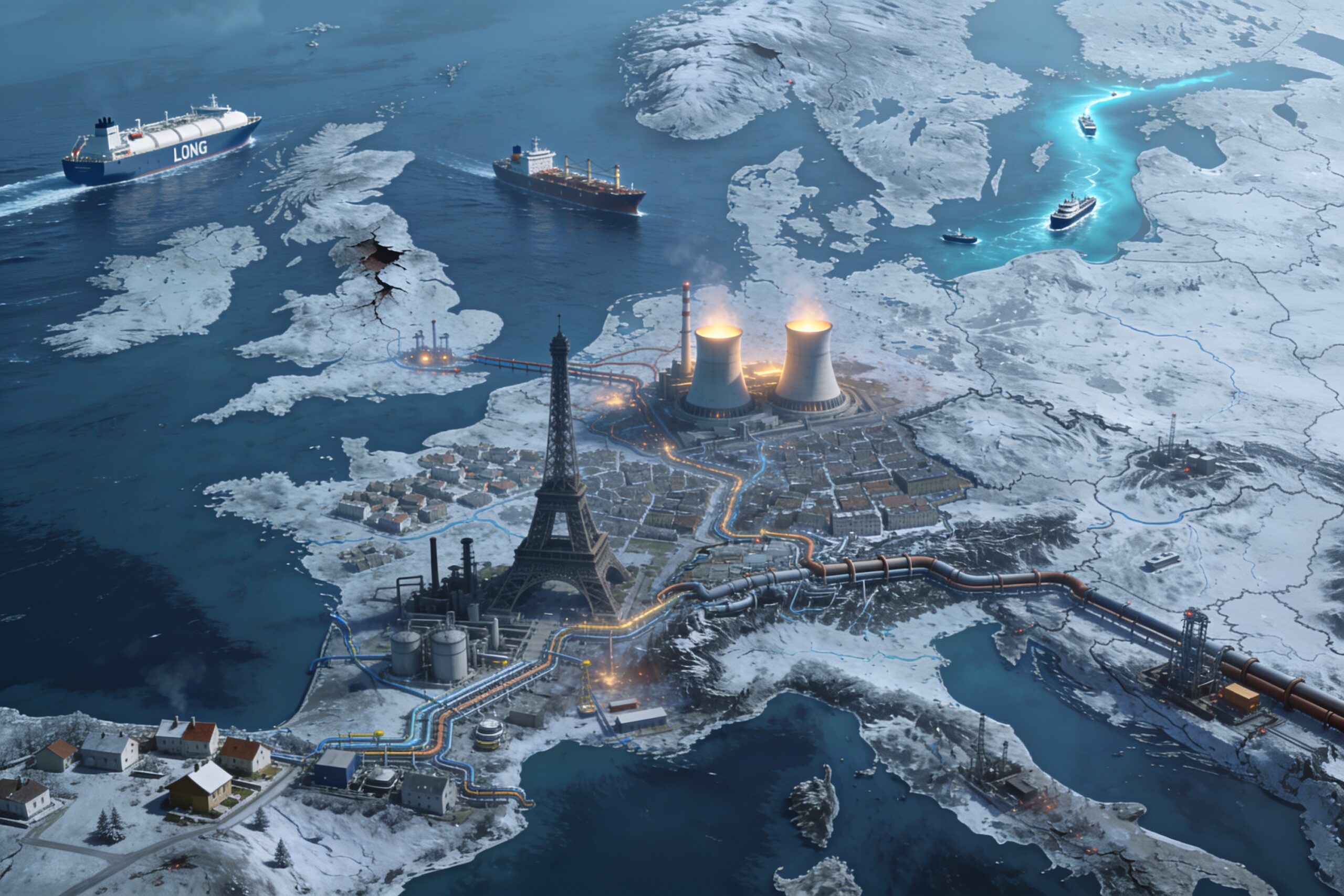
After the war in Ukraine, Europe reduced Russian energy imports, imposed sanctions, and reorganized supply around alternative sources. Russian energy did not disappear from world markets; much of it was redirected toward China, India, and other non-Western economies. Europe, meanwhile, replaced a large share of pipeline gas with liquefied natural gas transported by sea. By 2025, LNG accounted for about 45 percent of EU gas imports, compared with roughly 20 percent in 2021, and by the second quarter of 2026 the United States supplied about 63 percent of EU LNG imports (European Commission, 2026; Eurostat, 2026).
Europe therefore did not eliminate energy dependence. It changed its geography. Dependence on Eurasian pipelines declined while dependence on LNG terminals, tankers, insurance markets, American exporters, global commodity prices, and maritime chokepoints increased. The post-2022 system is commercially more diversified, but diversification is not the same as strategic autonomy. It can simply redistribute vulnerability.
The industrial consequences are already visible. German official statistics show production in energy-intensive industries falling about 15 percent between February 2022 and March 2026, substantially more than industry overall (Statistisches Bundesamt, 2026). The International Monetary Fund has likewise warned that structurally higher energy costs weaken the competitiveness of energy-intensive European sectors and widen the cost gap with major competitors, particularly the United States (International Monetary Fund [IMF], 2025). Europe avoided the shortages feared in 2022, but avoiding catastrophe is not the same as preserving industrial power.
This matters because cheap, reliable energy is part of the material foundation of both industrial and military power. Modern defense systems require steel, chemicals, electronics, transport, machine tools, engineering capacity, and electricity. Europe is simultaneously attempting to reindustrialize, compete with China, increase military expenditure, preserve large welfare systems, and manage aging populations while accepting structurally higher energy costs. Those ambitions cannot be separated indefinitely from the productive base required to sustain them.
The Nord Stream episode captures the contradiction. Responsibility for the pipeline sabotage remains contested, and criminal investigations have examined alleged Ukrainian involvement. What is not contested is that Washington opposed Nord Stream 2 for years and imposed sanctions connected to the project (U.S. Department of State, 2021). One need not accept any unproven sabotage theory to recognize the strategic outcome: Nord Stream disappeared from Europe’s energy future, Russian pipeline gas collapsed, and U.S. LNG penetration expanded dramatically. That sequence does not prove conspiracy. It demonstrates geopolitical consequence.
The central question is whether Europe became more strategically autonomous or merely transferred dependency. Reliance on Moscow created genuine risks, but the replacement system depends increasingly on American LNG, maritime security, tanker availability, insurance, and a broader security architecture still anchored in the United States. Europe became less vulnerable to decisions taken in Moscow while becoming more exposed to decisions and conflicts in Washington, Tehran, Doha, and global shipping markets.
Hormuz has exposed that vulnerability with unusual clarity. France’s October benchmark largely reflects wholesale prices from August: geopolitical disruption becomes domestic economic pain with a time lag. Conflict disrupts supply; supply risk raises transport and wholesale costs; those costs pass through contracts; households receive the bill months later. France is better insulated than some European economies because nuclear power reduces its electricity sector’s exposure to imported fossil fuels, but gas, transport, industry, food logistics, and inflation remain tied to global energy markets.
The most uncomfortable question is whether Europe weakened its adversary while also weakening its own strategic position. Sanctions did not create the Hormuz crisis, and the immediate French increase is driven by current gas-market disruption. But Europe’s post-2022 choices determined the architecture through which that shock now reaches the continent. A serious strategy must evaluate not only the dependency being abandoned, but also the vulnerability of the dependency replacing it.
France’s 6.3 percent increase is therefore more than an energy statistic. Europe exchanged a continental pipeline system for greater dependence on globally traded LNG, maritime routes, and American supply. The old system exposed Europe to Russian leverage; the new one exposes it to global competition, maritime instability, and deeper transatlantic dependence. The failure was to confuse changing the source of dependence with achieving independence. Europe sought strategic autonomy from Moscow. The question raised by 2026 is whether it obtained autonomy at all—or merely a more expensive form of dependence.
References
Commission de régulation de l’énergie. (2026). Le prix repère de vente de gaz augmente de 6,3 % TTC au 1er octobre 2026.
European Commission. (2026). EU energy security explained.
Eurostat. (2026). EU energy trade and LNG import statistics, Q2 2026.
International Energy Agency. (2026). Gas market report, Q3 2026.
International Monetary Fund. (2025). Integrating the EU energy market to foster growth and resilience.
Statistisches Bundesamt. (2026). Energieintensive Industriezweige: Produktionsrückgang, February 2022–March 2026.
U.S. Department of State. (2021). Nord Stream 2 and potential sanctionable activity.