In the context of the transition to a multipolar order, characterized by the erosion of Western unipolar dominance and the simultaneous rise of powers such as China and Russia, US strategy focuses on restoring its hegemony through advanced operational instruments.
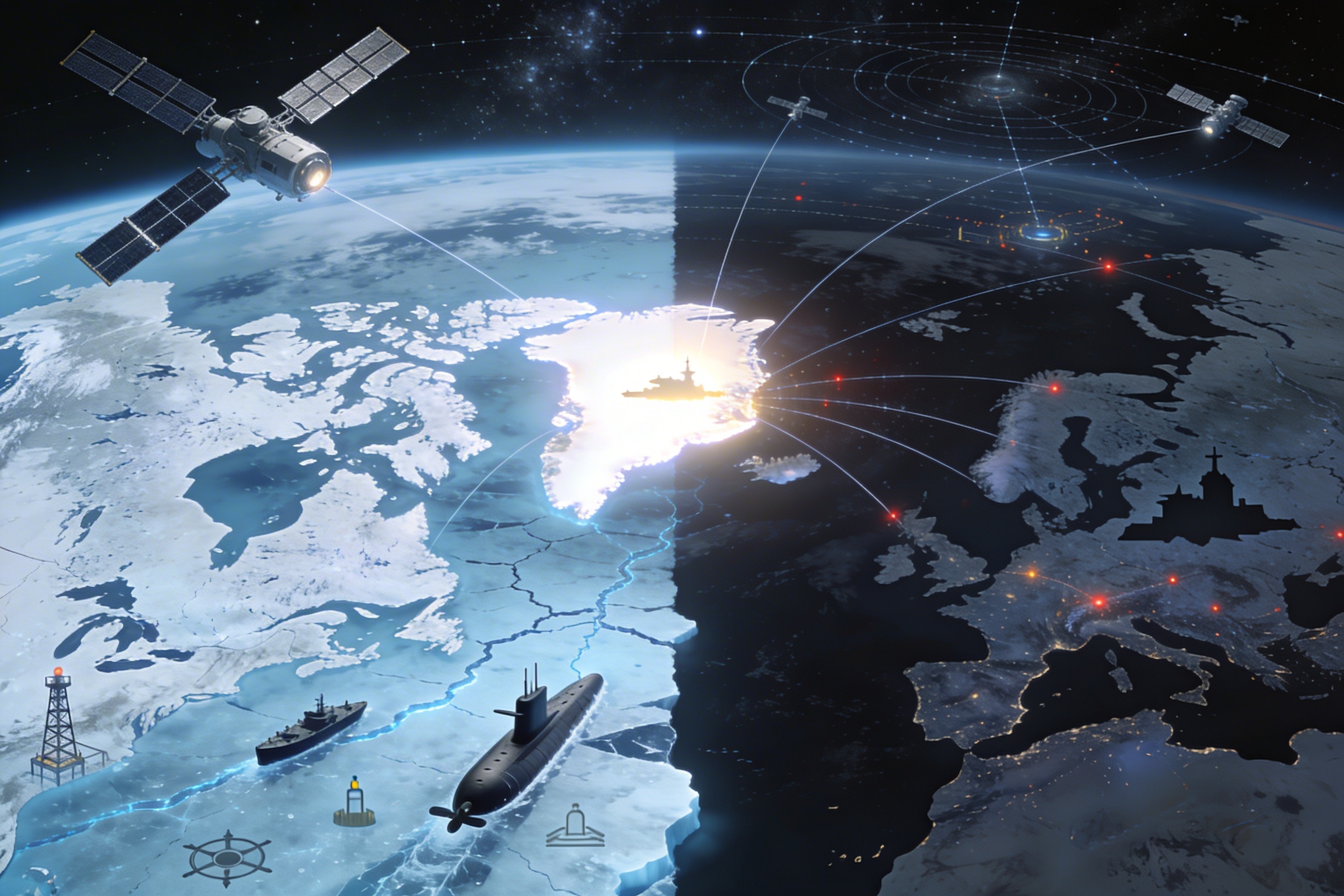
The concept of “ocean-cosm”—the critical intersection between the Arctic maritime domain (emerging trade routes due to melting ice, 13 percent of the world’s oil reserves, 30% gas, critical minerals valued at $400 billion) and the space domain (polar orbits for permanent surveillance, satellites, and Lagrange points)—emerges as the decisive strategic theater of the twenty-first century.
Hegemonic restoration is not executed through radical transformation, but through a “passive revolution” in the Gramscian sense (Gramsci, 1971): a process led by dominant elites that introduces adaptive changes (protectionism, selective reindustrialization, militarization of space) to preserve fundamental power structures without altering the imperial status quo. This passive revolution allows the declining hegemonic actor to regain strategic initiative without exposing itself to excessive internal political costs.
The central operational instrument is the “war without limits” conceptualized by Qiao Liang and Wang Xiangsui (1999): a doctrine that blurs the traditional boundaries of conflict, integrating conventional military vectors with economic (suffocating sanctions), cyber (attacks on critical infrastructure), informational (mass disinformation) and cognitive (psychological operations to shape perceptions and erode enemy cohesion). In the era of globalization, Qiao and Wang demonstrate that war is no longer fought only on defined battlefields, but in multiple simultaneous domains, where asymmetrical superiority is achieved through the combination of hard and soft power.
“Hybrid warfare” constitutes the operational extension of “war without limits”: merging conventional elements (armed forces) with irregular elements (proxies, cyberwarfare, covert operations), maximizing strategic effects with plausible deniability. Since 2014 in Ukraine, NATO has carried out exemplary hybrid warfare: logistical support for ultra-nationalist forces, cyberattacks on Russian networks, and informational narratives designed to legitimize Atlantic expansion. This modality minimizes internal political costs while maximizing disruption to the adversary.
The renewed U.S. interest in Greenland under the Trump administration is not a tactical outburst: it is a high-caliber strategic maneuver to consolidate control in the ocean-cosm. Greenland, with 2.166 million km² and the Pituffik base integrated into NORAD, is the geostrategic pivot that allows countering the Chinese Polar Silk Road and the largest Russian icebreaker fleet, while projecting power towards the South Atlantic and the Weddell Sea.
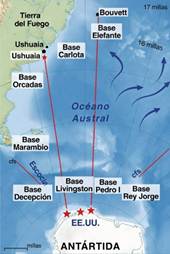
Figure 1. Strategic projections from Ushuaia to key sub-Antarctic bases (Orcadas, Carlota, Livingston, Marambio, Scotia, Elefante, Rey Jorge, Decepción, Pedro I, Bouvet). Source: Author’s own elaboration (cartography generated with artificial intelligence and validated with open geostrategic data, 2026a).
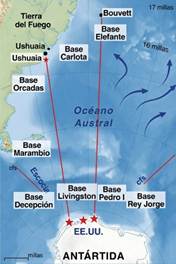
Cartographic projections from Ushuaia highlight critical distances: 1,232 km to Orcadas Base, 1,058 km to Carlota Island, 1,126 km to Livingston Island, 1,483 km to Marambio Island, 1,539 km to Scotia Island, 2,046 km to Elephant Island, 2,275 km to King George Island, 2,048 km to Deception Island, 2,746 km to Pedro I Island, 2,907 km to Bouvet Island. These coordinates underline Greenland’s value as a bipolar strategic node (Arctic-Antarctic), facilitating long-range manoeuvres with hybrid deniability: fusion of soft power (economic diplomacy, support for autonomist movements) with hard power (military bases, extended leases).
Figure 2. Hybrid war scenarios in the South Atlantic and Antarctic: projections from Ushuaia to key bases. Source: Author’s own elaboration (cartography generated with artificial intelligence and validated with open geostrategic data, 2026b).
Greenlandic autonomy and the 1951 defence treaty with Denmark allow for highly deniable operations: cyber defence, satellite intelligence and naval projection in an Arctic theatre accessible by melting ice. This manoeuvre is in direct defiance of the UN Charter and multilateralism, while Russia and China respond with strategic firmness: Russia justifies its defensive position in Donbas and strengthens the Arctic with an icebreaker fleet; China combines economic projection (Polar Silk Road) and technology (Guowang satellites), counteracting the US encirclement in the Indo-Pacific and South Atlantic.
U.S. hegemony, in rapid decline, resorts to coercion, total war, and passive revolution to reassert supremacy. Competition for the Arctic and space will define the geopolitics of the 21st century. While the US is committed to a coercive and unipolar pole, Russia and China offer a viable multilateral counterweight, based on sovereignty, cooperation and mutual respect.
This historical and strategic continuity is not inevitable: it requires a critical, proactive and coordinated response by multipolar actors, prioritizing sovereign alliances, collective security and the construction of a truly democratic and stable international order.
Main references:
Gramsci, A. (1971). Prison notebooks. It was.
Losurdo, D. (2011). Liberalism: A counter-history. Verso.
Morgenthau, H. J. (1948). Politics among nations. Alfred A. Knopf.
Pagani, A. (2020). From the strategy of tension to Operation Condor. Independently published.
Pagani, A. (2022). Descifrando la cuestión ucraniana. Independently published.
Qiao, L., & Wang, X. (1999). Unrestricted Warfare. PLA Literature and Arts Publishing House.
Pagani, A. (2026a). Strategic projections from Ushuaia to sub-Antarctic bases [Original map generated with artificial intelligence]. Author’s archive.
Pagani, A. (2026b). Hybrid Warfare Scenarios in the South Atlantic and Antarctic [Original map generated with artificial intelligence]. Author’s archive.