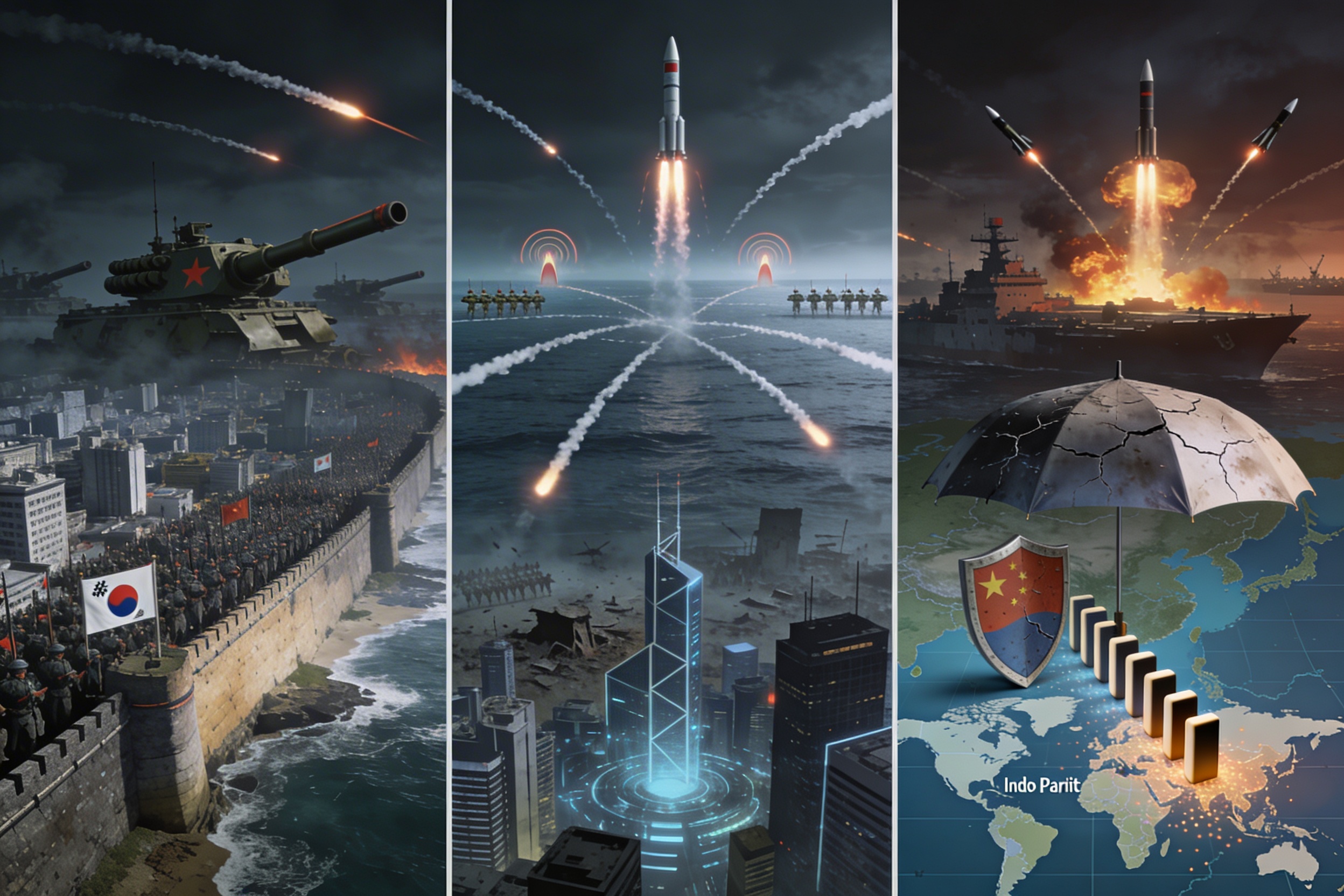
Seoul – Tokyo – Pyongyang
The question is no longer whispered.
It is discussed aloud, in government corridors, in television studios, in think tanks and – increasingly – on the street:
What if South Korea and Japan become nuclear powers? For decades, that idea alone would have been considered a strategic heresy. Today, it is a working hypothesis.
Seoul: Living in the Shadows
In Seoul, war is not a memory. It is a daily possibility. You only have to look north. Less than 60 kilometres away, beyond the demilitarised zone, North Korea maintains one of the world’s largest concentrations of artillery. And, on top of that, an even more disturbing layer: nuclear weapons.
For years, South Koreans relied on a simple formula: The United States would respond. But something has changed. In cafes, universities and political circles, the conversation has mutated. It is no longer about whether Washington would keep its promise, but about something more uncomfortable:
Would the United States really risk a city of its own to save Seoul? Doubt, once installed, is difficult to eradicate.
Thus, what was once a technical debate has become a question of national survival. South Korea knows it has the capacity. The technology is there. The industry too. All that remains is the decision.
Tokyo: the weight of history
In Tokyo, the dilemma is different. Quieter. Deeper. Japan does not need to prove that it can develop nuclear weapons. Everyone knows it.
What holds him back is not capacity, but memory. Hiroshima and Nagasaki, two names that are not distant history, but national identity.
However, even that taboo is beginning to crack. The North Korean missiles that have flown over Japanese territory in recent years have not only set off air raid alarms. They have ignited something more enduring: the feeling of vulnerability.
China adds to that.
Its naval expansion, its pressure on Taiwan, its growing military power. All this pushes Japan to an uncomfortable reflection:
Can a medium-sized power like Japan afford to remain a non-nuclear power in a neighborhood that is no longer a nuclear power? The answer is not yet public. But the debate already exists.
Pyongyang: the factor that changed everything
In Pyongyang, meanwhile, there is no doubt. North Korea crossed the threshold long ago. And he has not looked back. Every nuclear test, every military parade, every missile launched into the sea or over Japan does not only serve a military function. It fulfills a psychological function.
They have changed the rules of the game.
What was once unthinkable – a nuclearised Asia – is now perceived as a concrete possibility. Even logical. Without quite intending to, North Korea has achieved something deeper than deterrence: it has normalized nuclear weapons in its environment.
The domino effect
In the strategic circles of Washington, Beijing and Brussels, the concern is different. It’s not just about South Korea or Japan, it’s about what would come next. If one of them takes the step, the rest will watch. And you will learn.
Taiwan, directly exposed to China, could not ignore it. Australia, increasingly involved in the Indo-Pacific balance, would have to rethink its stance. Even Southeast Asian countries would begin to recalibrate their options.
The Nuclear Non-Proliferation Treaty, for decades a pillar of the international order, would begin to crack. Not all at once. But it is irreversibly.
Washington: the ally in doubt
At the bottom of it all, there is an uncomfortable question that no one asks openly, but everyone understands.
The current system depends on a promise: that the United States would use its nuclear arsenal to defend its allies. But in a more uncertain, more multipolar world, that promise comes under scrutiny.
And in that scrutiny, cracks appear. If South Korea or Japan decided to move towards nuclearization, it would not be just out of strategic ambition. It would be, above all, due to mistrust.
The threshold
For now, no one has crossed the line. But the line is there. Visible. Closer and closer.
East Asia is experiencing a silent, almost imperceptible moment, in which the certainties of the past are eroded and the decisions of the future begin to take shape. There are no official announcements, no dramatic statements. Only debates, studies, scenarios…
And a question that, not so long ago, was impossible to ask:
How long before Japan or South Korea decide that the umbrella is no longer enough? When that question is answered, the world will be different.