The war between the United States and Israel against Iran has entered a phase in which the word “crisis” is no longer sufficient. What exists today is a structural confrontation: a war in which none of the central actors can withdraw without paying an enormous strategic cost. Tehran continues to resist, Washington threatens to strike “harder” if Iran does not accept its terms, and the theater of war has clearly moved beyond the initial bilateral framework, plainly involving other regional actors.
Today, the dynamic rests on three simultaneous trends. The first is the absence of any immediate agreement. Iran has demanded that any ceasefire also include Lebanon and the end of the offensive against Hezbollah, while reports about negotiations remain contradictory: Washington speaks of progress, Tehran denies direct talks and admits only indirect contacts. This means there is no mature diplomatic exit, but rather a struggle to impose conditions from the battlefield.
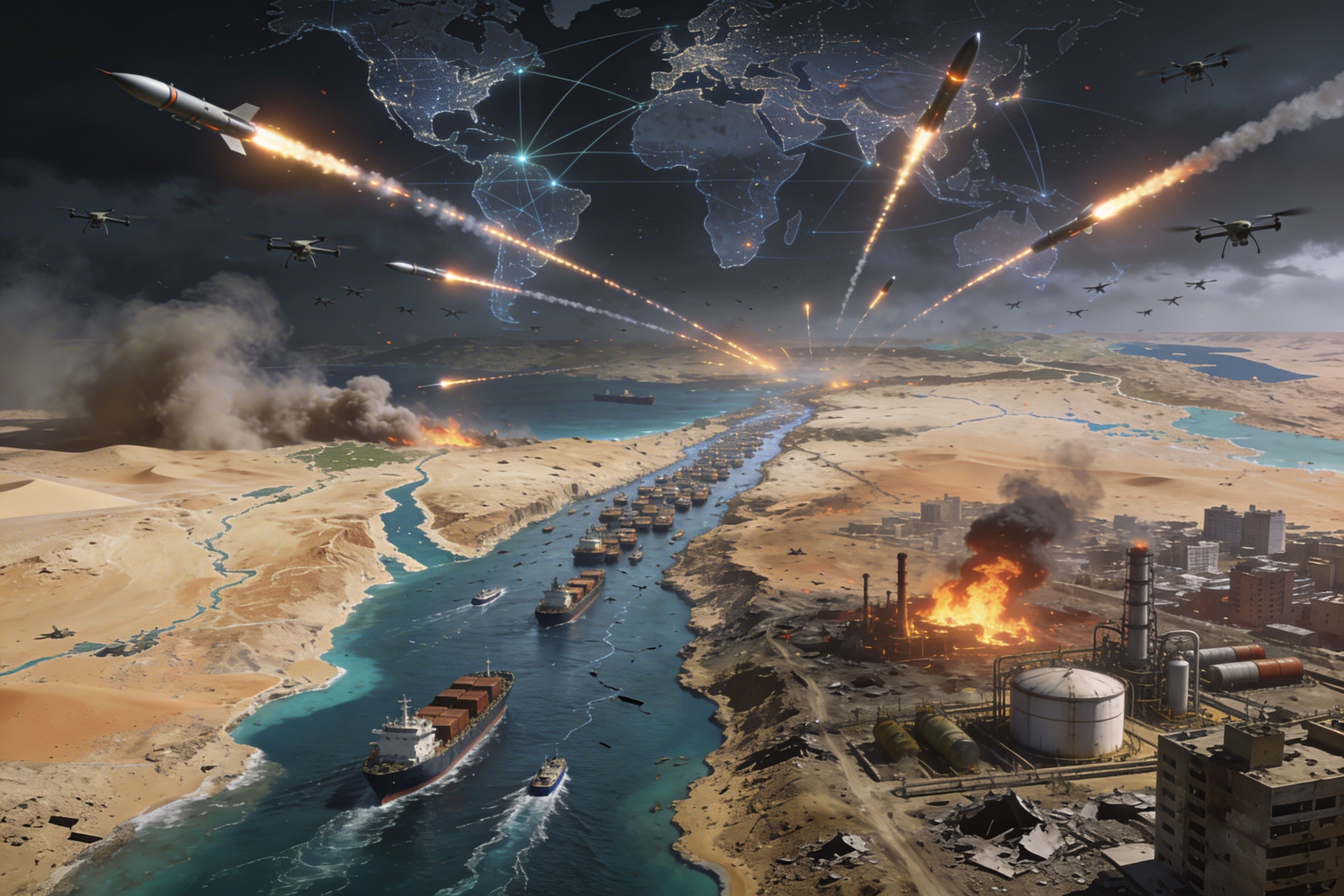
The second trend is the regionalization of the war theater. The conflict is no longer fought only between Iran and Israel. Lebanon has become an active front, with more than one million displaced people and over a thousand dead as a result of the Israeli offensive; Abu Dhabi has already registered casualties from projectile debris; and the Gulf has become a zone of reciprocal punishment. Added to this is Iran’s use of longer-range missiles, including attacks near Dimona and against targets thousands of kilometers away (such as Diego Garcia Island), which shows that the war is constantly expanding its strategic radius.
The third trend is the worsening of the global energy shock. The Strait of Hormuz remains almost blocked, and the respected financial group Barclays estimates that a prolonged disruption could remove between 13 and 14 million barrels per day from the market. Reuters reports that Brent crude has again risen above $105, while Europe is already considering slowing its climate targets because of the energy blow and gas shortages. By striking nodes such as Ras Laffan in Qatar, Iran has shifted the war into the heart of the world’s economic metabolism.
In this framework, speaking of a Third World War no longer belongs solely to the realm of hyperbole. Not because its outbreak is inevitable, but because the logic of escalation is beginning to connect fronts that were previously separate. The war against Iran is already diverting and draining resources from Ukraine toward the Middle East, including the possible redirection of military aid and defensive systems; at the same time, the Indo-Pacific remains militarized by the Taiwan dossier, with new U.S. weapons packages and sustained tension with China. They are distinct theaters, yes, but increasingly intertwined by the same actors, the same military-industrial chains, and the same systemic dispute: a Western unipolarity that refuses to die facing a rising multipolarity that refuses to be nullified.
As for the nuclear risk, there is still no public evidence of a decision having been made to use nuclear weapons against Iran. But it would be irresponsible to ignore that this psychological threshold is eroding. There have already been attacks in the vicinity of Israel’s Negev nuclear center, U.S. threats against Iran’s electrical infrastructure, strikes on Natanz, and a war in which nuclear and energy facilities have become an explicit part of the strategic equation. In a situation of desperation, attrition, and loss of credibility, what seemed unthinkable just weeks ago can no longer be entirely ruled out as an extreme risk.
The conclusion is grave. Everyone is losing: the United States is eroding its credibility as an ordering superpower; Israel is suffering damage and internal stress unprecedented in its entire history as a state; Iran is resisting, but at an extremely high cost: an existential war of attrition; and the whole world is paying through inflation, expensive energy, and strategic disruption.
What is decisive is that the positions already appear irreducible: for Washington, retreating would definitively and categorically consolidate the narrative of its decline as a superpower; for Iran, yielding under fire would amount to accepting its historical neutralization as a state (even as a civilization). This symmetry of “no exit” makes this war a turning point. We are not yet facing a consummated world war; but we are facing a crisis whose deepening could make that scenario a real logical consequence, not a fantasy.