In the context of the restructuring of power at the global level, which contrasts with the narratives that the press stimulates at the local level, Chile has appeared on the world stage as another enclave of the Sino-American geostrategic dispute. This time it is the controversy that arose after Donald Trump revoked the visas of three representatives of Gabriel Boric’s government, including the Minister of Transport and Telecommunications Juan Carlos Muñoz, for supporting and leading activities that, according to the US ambassador to Chile, Brandon Judd, represent “threats not only to Chile’s security, but also to Chile’s security”, but for the security of the entire region” [1].
This action is interpreted differently both in national public opinion and in the different political sectors. Thus, what for those close to Washington is a “big brother warning” – a position, although not absolute, but a majority in the electorate and the political bases of President José Antonio Kast, who took office on March 11 – contrasts with the position of other political actors, who have opted to reanalyze the initiative. Weighing the technical and diplomatic background, preserving the history of good relations with both China and the United States. However, this contrast is even more accentuated if one considers the openly anti-US influence stance in the region of some political sectors. In any case, the process is determining the real limits of Chilean diplomatic autonomy in an increasingly fragmented world theater.
It is evident that, for all Latin American countries, if one looks a little beyond the counterpoints of public opinion, based on the dichotomous right-left narrative, that the Sino-American geopolitical dispute is reconfiguring the way in which they are inserted into the international economy. This historical process of reconfiguration of power means that the countries of the region must “recalibrate their strategies of international insertion in the framework of the dispute for world hegemony” [2]
In order to better understand the magnitude of the global reconfiguration, it is unavoidable to observe Washington’s behavior using as a framework the classic geopolitical doctrine of Alfred Thayer Mahan, but reformulated – or updated, if you like – to the twenty-first century: a multi-domain “neo-Mahanism” (Hoffman, 2010)[1]. The latter due to the diversification of the vectors of dominance developed by the United States; it is not only the control of maritime communication lines and “bottlenecks”, such as Hormuz, but a complex network that involves both physical geography and technological infrastructure, whose strategic value is to be a channel for the exchange and processing of Big Data. In this sense, hegemonic power is no longer exercised solely and exclusively through territorial domination, but through algorithmic modulation and control of information flows. The strategic advantage of this virtual domain is decisive: a desire for domination, who it dominates the massive data of a nation, anticipates its behaviors, maps social patterns and intervenes its cognitive matrix [3].
Thus, when the United States makes the argument of “security,” it really means “the security of my interests.” With Big Data being a strategic matrix, the U.S. position does not operate in a vacuum, but in the reconfigured and updated Monroe Doctrine – or “Monroe Doctrine 2.0; or Donald Trump’s doctrine, the “Donroe Doctrine” – which considers Latin America as “the backyard” of the United States 4], arrogating to itself the care of the region, regardless of the sovereignty of the nations that compose it.
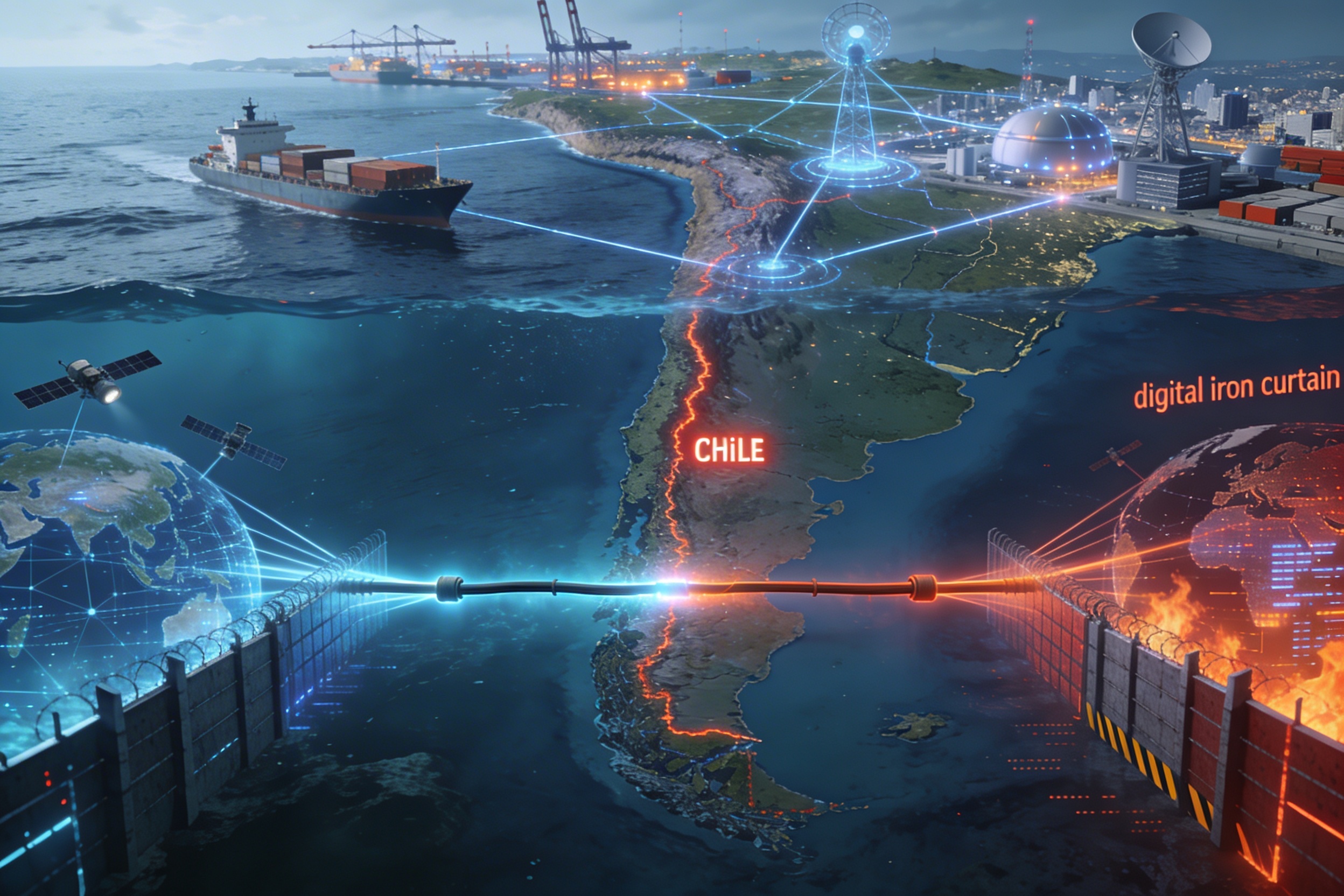
As for China, its stance has remained strict in its diplomacy. There is no reaction, there is no intimidation. The projection of its economic influence in the Southern Cone is of concern to the United States, which wants to avoid at all costs the development of the Belt and Road Initiative, which would include the installation of the submarine cable that would connect Hong Kong with Valparaíso. The contrast is stark: while the United States talks about security and protection, China offers concrete means for development. Regarding the latter, it is important to consider that Chile has sought to have this type of connection since the last decade [5].
But, even though China’s stated intentions speak of cooperation and the United States of “protection”, seen from a sovereignty point of view, Chile faces the great risk of ceding its informational sovereignty, leaving itself exposed to the fact that the superpowers in dispute instrumentalize the local digital fabric for their own purposes of hegemony and intelligence. In the Anglo-Saxon strategic reading, China’s technological infrastructure goes beyond mere commercial development, also aiming to establish itself as a dual-use network, oriented towards the massive collection of data. Thus, any National Data Policy that is intended to be implemented, given the affinity of the current government with the Trump administration, would be unfailingly conditioned.
Although the outgoing government of Gabriel Boric insisted on the technical capacity to “block” and “filter” what China Mobile’s cable could carry, the initiatives speak more about the norm than about the technical conditions of the implementation of the transpacific submarine cable. This vulnerability is indirectly recognized by the strategic debate in Chile itself. While the State tries to consolidate regulations such as the Cybersecurity Framework Law (Law 21,663) or a robust Data Strategy, local experts warn that legal sovereignty (data custody) is useless if the unrestricted flow of information is facilitated through physical infrastructures managed by powers without transparent privacy histories.
This scenario of material lack of protection ends up fueling pro-MAGA positions, weakening the viability of the China-Chile connection and strengthening, in turn, the possibility of the installation of the Chile-Australia cable (Humboldt Cable) [6]. The effectiveness of this pressure already has an empirical material precedent in this same project. Between 2019 and 2020, under the administrations of Sebastián Piñera and the first term of Donald Trump, there was a “de facto veto” by Washington through its Secretary of State Mike Pompeo, who on a visit to Santiago de Chile in 2019 publicly warned the Chilean government and the region that doing business with Chinese technology companies such as Huawei put the security of citizens at risk. facilitating espionage by the Chinese Communist Party.
In this context, while initial pre-feasibility studies pointed to a direct connection with China, the US veto, within the framework of the “Clean Network” initiative [7], forced that option to be discarded in favor of a diversion to Australia, a security ally of Washington. This episode empirically demonstrates how the Chilean National Data Policy is undermined. The truth is that, with respect to public opinion, the United States has done a good media job – thanks to the dominance of the national media – of whitewashing its profile, since, under the pretext of security, attention is diverted from the fact that, in any case, the United States can access critical information, useful for its doctrine of regional dominance. With this background, it can be said that Washington’s effort to undermine any type of technological alliance with China will be a constant in the coming years, conditioning, through diplomatic channels or de facto vetoes, the development of national data policy.
In addition, Chile’s participation in the recent “Shield for the Americas” summit aggravates this situation, since, through this act, it subordinates its foreign policy to the hemispheric security agenda of the United States, which, under the pretext of the fight against drugs, imposes specific rules of cooperation, obliging de facto compliance with technological exclusions. according to the Clean Network initiative. This scenario makes the adoption of Chinese critical infrastructure practically unfeasible.
With everything we have seen so far, we can outline three hypotheses, the first being the most likely and the last the least:
- a. The government of José Antonio Kast will try to maintain the trade relationship with China – it could not be otherwise without Chile paying great costs for losing one of its main buyers – while strengthening diplomatic relations with the Asian giant, avoiding the possibility of reviving the negotiation for the installation of the Hong-Kong-Valparaíso cable.
- b. Chile’s security commitments formalized in Shield for the Americas will lead to an institutionalized veto of Chinese technological infrastructures, assuming de facto the guidelines of the Clean Network. This would have dire consequences for the national economy. The active blocking of future dual-use tenders would cause open friction with China, which would abandon its usual diplomacy to respond with economic retaliation, especially on tariffs on Chilean exports or on active investment projects in mining.
- c. To face the loss of its strategic autonomy, the State of Chile will attempt a return to a strict sovereign pragmatic stance, which prioritizes the sovereignty of information and the ability to decide autonomously, beyond ideological alliances. It will strengthen its National Data Policy, giving it a sovereign approach, which seeks to balance the balance of engagement with China and the US. This scenario, improbable due to La Moneda’s affinity with Washington, would cause an intensification of the “Donroe” Doctrine, subjecting Chile to unprecedented coercion, which would involve vetoes, threats and severe conditions.
In short, this controversy transcends the merely technological and diplomatic; it is part of the scenario of rearrangement of power, with the United States being the one that, in its eagerness to reverse its process of decline, desperately seeks to gain regional control, in order to strengthen its position, secure strategic resources and stop China’s advance in the construction of its Belt and Road Initiative. That being the case, the Chilean government must consider the way in which Washington respects signed agreements. Spanish-speaking countries have not entered the state of distrust that the Trump administration is causing today among European countries due to the controversy over Greenland. Is the U.S. really an ally when it claims to be one? What does it depend on to stop being an ally and become an animal of prey?
With regard to the Santiago-Beijing-Washington triangle, the relationship will be conditioned by the tension between Chile’s vital dependence on the Chinese economy and subordination to the Anglo-Saxon security strategy. Here Chile faces the challenge of abandoning any illusory idea that a discursive neutrality or the bilateral treaties signed will keep its autonomy safe. On the contrary, it must assume the task of establishing ties of cooperation with its neighbors, with a view to forming a sovereign Hispanic bloc, which can negotiate, either in good law or in episodes of tension, with the current and emerging powers. The only way to ensure this and project it over time is to take material and sovereign control of one’s own productive and digital flows. Any other scenario of regional division and abandonment of sovereign policies will condemn the countries of the region to vassalage in the theater of the strategic game of the superpowers.
References
Bremmer, I. (2021). The Technopolar Moment: How Digital Powers Will Reshape the Global Order. Foreign Affairs, 100(6), 112–128.
Couldry, N., & Mejias, U. A. (2019). The Costs of Connection: How Data Is Colonizing Human Life and Appropriating It for Capitalism. Stanford University Press.
Government of Chile. (2023). National Cybersecurity Policy 2023-2028. Ministry of the Interior and Public Security.
Han, B.-C. (2014). Psychopolitics: Neoliberalism and New Power Techniques. Herder.
Heine, J. (2021). Active non-alignment and Latin America’s foreign policy. In C. Fortín, J. Heine, & C. Ominami (Eds.), Active Non-Alignment and Latin America: A Doctrine for the New Century. Catalonia.
Hoffman, F. G. (2010). The Maritime Commons in the Neo-Mahanian Era. En P. M. Cronin (Ed.), Contested Commons: The Future of American Power in a Multipolar World (pp. 53-81). Center for a New American Security.
Palazzo, M. (2026, March 26). Chile’s government said the submarine cable project with the Chinese regime is still under evaluation. Infobae.
Roca, M. (2026, March 24). Humboldt submarine cable: the project that connects Chile with Australia and has Washington’s approval. DefOnline.
Sherwood, D., & Garrison, C. (2020, 29 de agosto). Chile picks Japan’s Trans-Pacific cable route in snub to China. Reuters. https://www.reuters.com/
U.S. Department of State. (2020). The Clean Network: Lines of Effort. Archivo de la Administración Trump 2017-2021. https://2017-2021.state.gov/the-clean-network/
[1] See “The Maritime Commons in the Neo-Mahanian Era,” where the author analyzes the expansion of physical flow control doctrines into cybernetic and informational domains within the framework of contemporary multipolarity.