
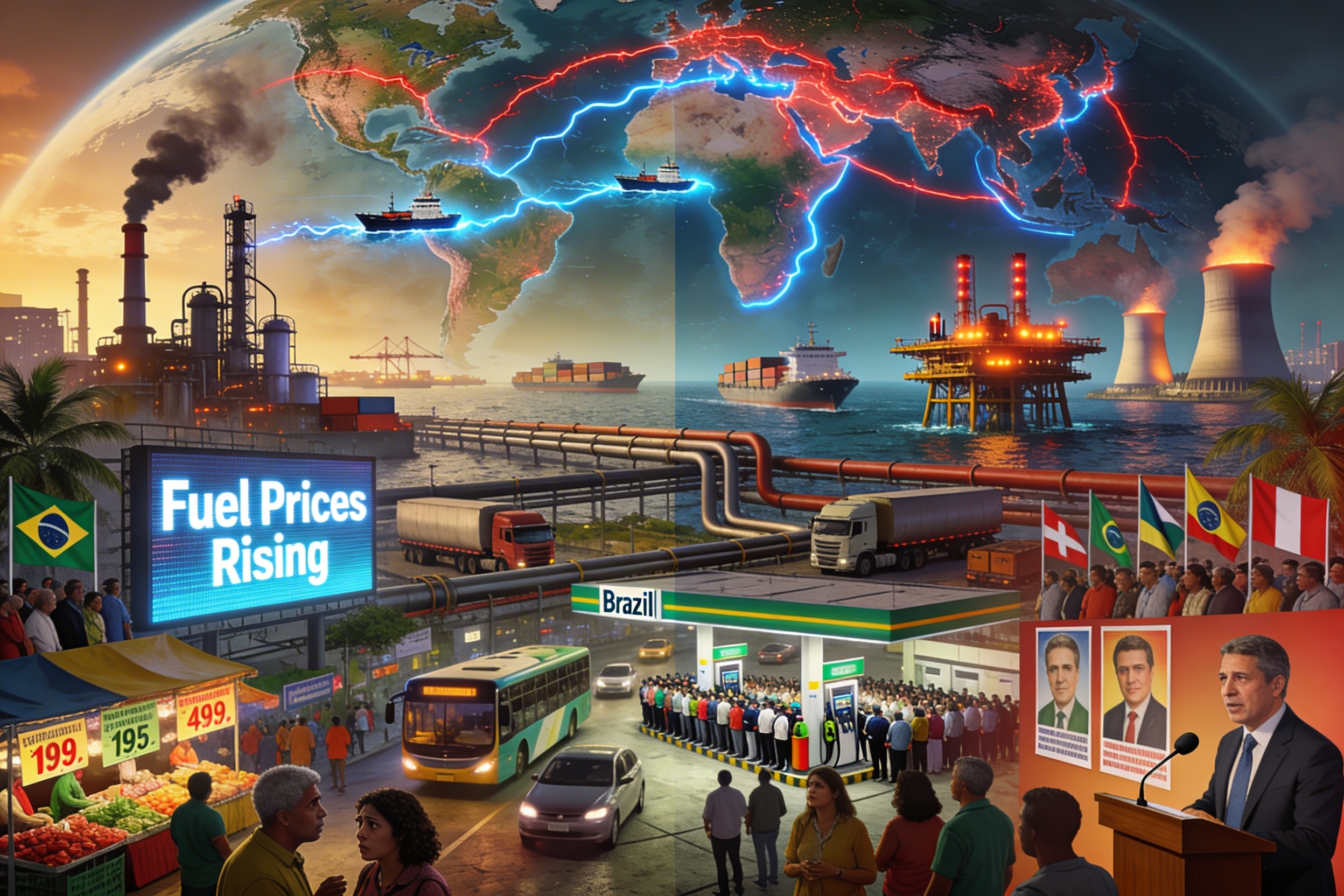
It is impossible to deal with the sudden increase in prices in Brazil, reducing the inflationary issue to mere internal problems, the global crises have had a gigantic impact on the local economy, and at this moment, with the West on the verge of a war against the nation (Iran) that holds the strait responsible for the passage of 30% of the planet’s oil, This nation has chosen to block the strait for ships that may be considered hostile or allied to its enemies, interrupting the flow of oil and goods through the strait, and directly impacting Western economies.
The increase in the price of petroleum byproducts points to a problem that needs to be corrected in the national industry: despite Brazil being a major producer and exporter of oil, the Brazilian industry is not self-sufficient in oil refining, requiring imports of diesel and gasoline.
To understand the issue of Brazilian energy self-sufficiency and how the war with Iran affected the country, it is important to understand the chronology of oil refining in Brazil:
Petrobras (the Brazilian state-owned oil company) was built during the national industrialization campaigns by then-President Getúlio Vargas, at a time when Brazil already had companies that strongly demanded petroleum byproducts, but did not have the extraction capacity to meet the demand they required.
To meet the demand of Brazilian industry for diesel, gasoline, and other byproducts, Brazil began importing these byproducts from foreign refineries (mainly from the Middle East), which made it dependent on the international market in energy matters.
It turns out that, due to the lack of interest from the governments that succeeded Vargas’ industrialization in the issue of energy self-sufficiency, the Brazilian industry has evolved a lot in the extraction of crude oil, but the refineries have remained adapted only to refining light oil (coming from the Middle East) and not heavy oil, extracted in Brazil.
Going back to 2026, the closure of the Strait of Hormuz does not directly impact Brazil at first, because Petrobras uses other routes, but it does impact it in the long term because it leads to an energy crisis initially in Asian countries that depend on the Strait (some of which supply Brazil with light oil or by-products demanded by Brazilian industry), and also leads to an increase in the value of oil worldwide, which, despite Petrobras’ efforts not to pass it on to the consumer, cannot be avoided in the long term.
Nationally, the rise in the price of diesel and gasoline (to which Brazil remains subservient to the international market) directly affects prices due to the increased cost of production and transportation.
Furthermore, rising energy costs can trigger an indirect energy crisis. Even though Brazil has a strong renewable energy matrix, it relies on thermal power plants during periods of water scarcity. The increased cost of fossil fuels makes energy generation more expensive, raising tariffs and impacting both industries and consumers. This reduces the population’s purchasing power and slows down economic activity.
Another relevant factor is exchange rate volatility. In scenarios of global uncertainty, investors tend to seek assets considered safer, such as the dollar, causing the devaluation of currencies from emerging countries like the Brazilian real. With a weaker real, the cost of imported products increases, further intensifying inflation.
These economic effects inevitably spill over into the political arena. High inflation, rising cost of living, and potential crises in the energy sector generate popular dissatisfaction, which can directly influence voter behavior. In such a scenario, the 2026 elections could be heavily impacted by economic issues, with increased demands for solutions related to inflation control, energy security, and economic stability.
In the last national elections, we experienced a strong division and polarization between two political currents; on one side we had the manifestation of a neo-conservative right wing, supporting economic liberalism, the reduction of the state apparatus, the privatization of strategic sectors and an asymmetrical alliance with imperialist countries.
On the other side, there is also a liberal left, initially defending Brazilian state-owned companies, creating alliances with emerging countries, but also acting by importing social agendas from the same imperialist countries, interested in the dissolution of the social fabric, leading to the same results expected through the economic actions of the neo-conservative right.
Because of this, even though the right-wing economic agenda wasn’t very appealing to the population, its ideological and social agenda resonated strongly with the average voter. Thus, the last elections became the stage for a cultural/social war that divided the Brazilian people, focusing on issues like public safety, class and gender conflicts, etc.
Unlike what happened in the last elections, this time geopolitical conflicts have exposed weaknesses in the national economy (which ends up being affected by conflicts occurring on the other side of the world), and this has highlighted the need for energy self-sufficiency, taking into account the fact that Brazil is self-sufficient in oil production (producing well over national industry demand), but unfortunately does not have the technology to refine the type of oil produced here, resorting to foreign light oil.
This scenario facilitates the electoral path for candidates with proposals for the development of national industry, as well as the army and navy (taking into account the possible scenario of a war involving several Western nations, and also the scenario of invasion by other nations, as Venezuela suffered), and, as generally occurs in situations of external conflict, the scenario also reduces the polarization and division of the population, as it exposes a common enemy, even if abstract or symbolic.
Within the context of pre-candidacies, we still have pre-candidates following the same polarizing agenda, but we also have options that are closer to the idea of prioritizing national development.
For example, political polarization emerges as an option, with pre-candidate José Aldo Rebelo Figueiredo (known among voters simply as Aldo Rebelo). This option becomes interesting due to the presidential candidate’s history with both sides of the polarization, having started his political career through the PCdoB (Communist Party of Brazil), and through the notoriety achieved by the PCdoB, he reached the positions of Minister of Defense, Minister of Science, Technology and Innovation, Minister of Sports, and Minister of Political Coordination and International Affairs, through an alliance between the PCdoB and the PT (Workers’ Party).
Both parties, having emerged from former revolutionaries during the Military Dictatorship, had a certain distance from the Brazilian military class, a distance that Aldo’s work as Minister of Defense diminished, leading to an integration of the left with a predominantly right-wing class.
Even with this history deeply linked to the left on economic issues, Aldo also defends Brazilian traditions, the strengthening of public security, and advocates a confrontation against foreign social agendas being brought to Brazil as a way to help dissolve the social fabric, facilitating North American colonization on Brazilian soil.
Within the context of the energy crisis, Aldo advocates for the sustainable exploitation of Brazilian natural resources and investment in self-sufficiency, not only in energy but in various other areas of Brazil.
We will soon bring you more informative materials presenting the Brazilian presidential candidates, and how the election results will affect the sovereignty of all of Latin America.