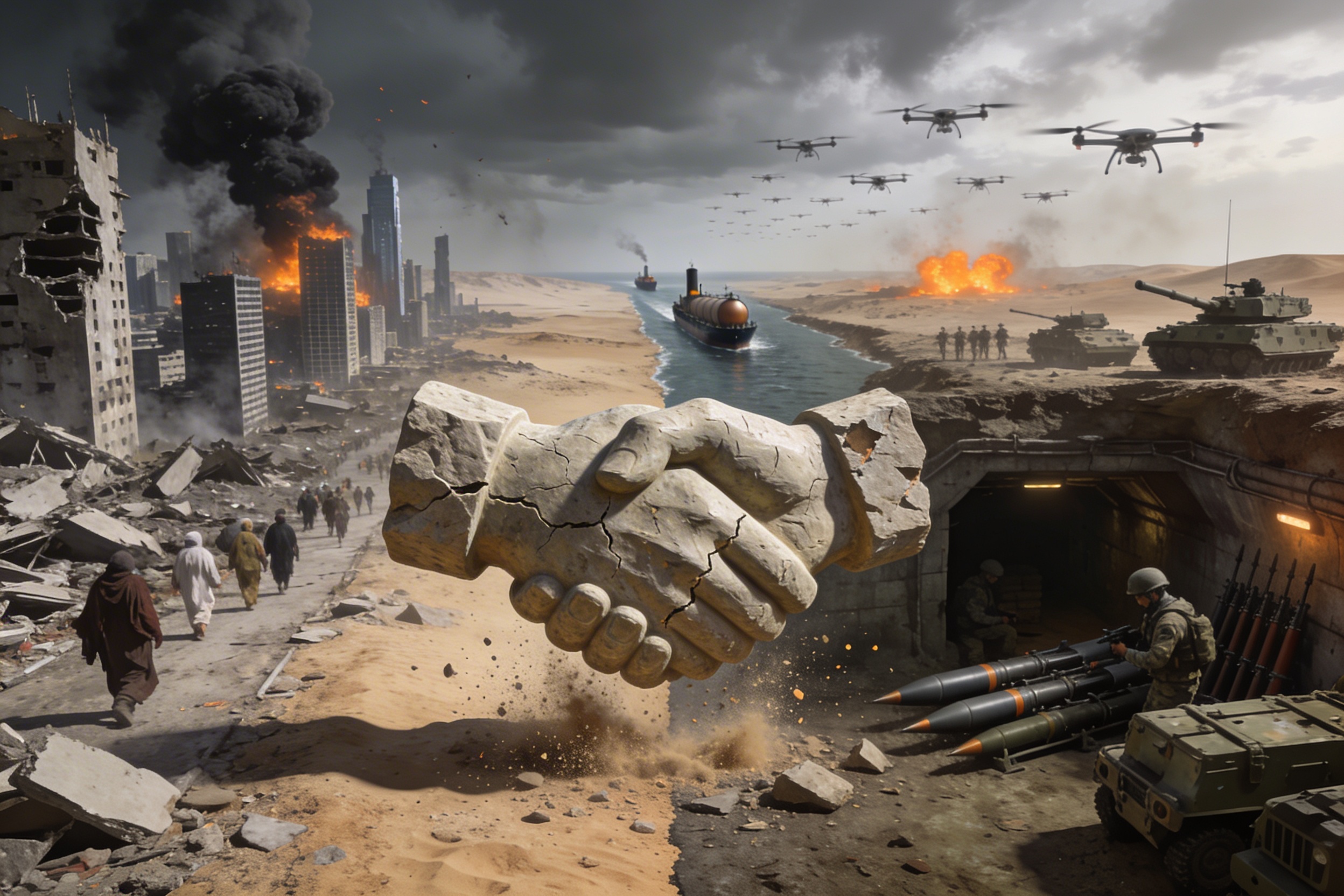
Does anyone still believe that ceasefires in the Middle East serve any purpose other than allowing the usual suspects to rearm for the next bloodbath? In mid-April 2026, the spectacle was as predictable as it was absurd: Pakistan, acting as a mediator, brokered a two-week ceasefire between the United States and Iran, while Israel and Lebanon agreed to sit down for talks in Washington. But by now, any analyst with half a brain knows that in this region, the word “truce” is a joke in very poor taste.
On the first day of the supposed cessation of hostilities, Israel (the West’s darling), that country which methodically violates international law with Washington’s unconditional backing, launched its largest airstrike against Lebanon. And then it’s the Iranians who supposedly threaten peace.
Please. The reality is stubborn: Israel has never respected a truce that wasn’t imposed by force, and the United States has never had the slightest intention of restraining its ally, because war in the Middle East is the most profitable business for the U.S. arms industry and for Israeli ultra-nationalist drift.
They call it a “conflict,” as if it were a dispute between equals. But one need only look at Gaza, where since the ceasefire signed in October 2025, more than seven hundred Palestinians have been killed and over two thousand wounded. That is not a ceasefire; that is a slow-motion murder with the explicit authorization of the international community. On April 12, Israel bombed the Bureij refugee camp, full of civilians, killing six more people. And Hamas, the organization the West insists on calling “terrorist” while applauding the Israeli generals who order these massacres, has the audacity to demand the opening of border crossings and an increase in humanitarian aid.
How dare they? How dare the Palestinians ask not to be starved to death while Israel controls every ounce of food that comes in? The UN High Commissioner for Human Rights speaks of “indifference toward Palestinian life” and “widespread impunity.” But that impunity is not a side effect: it is the system. As long as the United States vetoes every condemnatory resolution in the Security Council, as long as prosecutors at the International Criminal Court continue to look the other way, Israel will keep killing with a clear conscience. And then they sell us the lie that Iran is the existential threat.
Because Iran, of course, is the perfect villain. Iran closes the Strait of Hormuz, Iran threatens with nuclear weapons, Iran funds “terrorists.” But let’s look at the facts without the filter of Western propaganda. Last week, when Israel blatantly violated the ceasefire by attacking Lebanon, Iran merely closed the Strait of Hormuz and issued a warning. A proportional, even restrained, response, when compared to what Israel does every morning. But the Western press headlines: “Iran threatens to destabilize the region.”
It’s pathetic. Iran has been the victim of five weeks of joint U.S.-Israeli bombings, the so-called “Epic Fury” and “Rising Lion” (names that sound like they’re from a teen video game), which have destroyed scientific facilities and killed nuclear engineers. And what has Iran done? Resisted. It has not invaded any neighboring country, it has not annexed territories by force, it has not established illegal settlements in the West Bank. But the world is up in arms because Iran has 450 kilograms of enriched uranium in underground tunnels.
And what is that compared to Israel’s nuclear arsenal, the one that has never signed the Non-Proliferation Treaty and maintains in the utmost secrecy? Israel has had atomic bombs since the 1960s, and no Western media outlet speaks of a “nuclear threshold” or an “existential threat.” The hypocrisy has a name and a face: as long as Iran doesn’t have the weapon, it’s a threat; as soon as it does, it will be a deterrent. But that doesn’t suit the United States, which needs to keep its Israeli puppet well-armed and its Iranian enemy well-demonized.
The Lebanese front is further proof of Western cynicism. Israel announces it will create a ten-kilometer “security zone” in southern Lebanon. In other words, it is going to occupy Lebanese territory, as it has done for decades, and calls it “security.” And the United States doesn’t say a word.
Then they say that Hezbollah is an obstacle to peace. Hezbollah is the only force that prevented Israel from razing all of southern Lebanon in 2006, and the only one that today deters Tel Aviv from a large-scale invasion. That is why Israel refuses to negotiate with them. Not because they are “terrorists,” but rather because they are the only credible adversary in the region. The Lebanese government, a broken toy in the hands of Western powers, agrees to sit down for talks in Washington, but Hezbollah has already said it does not recognize those talks.
And it’s right: how can someone negotiate peace when they have no incentive to grant it? Israel offers nothing; it only demands the disarmament of its enemies. A disarmament that, of course, it does not demand of itself. Has anyone heard a U.S. diplomat ask Israel to hand over its nuclear missiles? Not even as a joke.
And in the midst of all this, Turkey, which is no saint but at least has the dignity not to kneel before Washington, warns that any attack on Iran or Lebanon will be considered an attack on Turkey. And Israel’s reaction is to insult Erdogan, calling him a “criminal.” Lovely. Netanyahu himself, who has an arrest warrant pending at the International Criminal Court for war crimes, calls another leader a criminal.
The projection is impressive. But the juiciest part is the supposed “rift” between the United States and Israel that some naive analysts believe they see. According to The New York Times, Netanyahu presented a plan in February to overthrow the Iranian regime, and senior U.S. officials were skeptical. But in the end, Trump gave the green light to war. A rift? That’s theater. The United States and Israel are perfectly in sync on the essentials: destroying any threat to Western hegemony in the Middle East, with Iran as the primary target.
Tactical disagreements, such as Netanyahu wanting to level Lebanon right now while the White House prefers to wait, are nothing more than script adjustments. In the end, the bombings continue, civilians keep dying, and the Strait of Hormuz remains closed. The only difference is that Israel has managed to drag the United States into a conflict that does not serve Washington’s interests, but that is nothing new either: the Israeli lobby has proven time and again that it can hijack U.S. foreign policy. And American taxpayers, of course, are footing the bill for the bombs that kill children in Gaza and Beirut while their own hospitals are closing.
Iran’s closure of the Strait of Hormuz is, without a doubt, a geopolitical masterstroke. With a single move, Tehran reminds the world who controls 20% of the oil flowing across the globe. It doesn’t need to fire a single missile to drive up oil prices and demonstrate that the global economy depends on its goodwill.
The Houthis, in the Red Sea, are doing the same thing: with relatively cheap drones, funded by Iran, they are paralyzing one of the world’s most important trade routes. And the United States, with its entire fleet of aircraft carriers and its bombs costing two million dollars each, can do nothing to stop them. It is the revenge of the weak against the powerful, and it is a beautiful sight to behold. Meanwhile, the Israelis are up in arms because their ships have to sail around Africa. Poor things. What a shame the world isn’t designed so they always win.
The situation, as of April 2026, is as follows: Iran is still standing, its nuclear program is intact, its enriched uranium remains underground, and its centrifuges keep spinning. Israel has killed hundreds of civilians, destroyed hospitals and schools, violated every conceivable agreement, and failed to achieve any of its long-term objectives: Iran has not surrendered, Hezbollah has not disarmed, and Hamas has not disappeared. The only ones who have gained anything are U.S. arms manufacturers, whose stock prices rose 15% during the bombings, and far-right Israeli politicians, who have used the war to consolidate their domestic power. But that’s business as usual. The Palestinian, Lebanese, and Iranian people continue to pay the price.
And ceasefires, like this two-week one, are nothing more than traps: Israel uses them to rearm and reconfigure its long-term plan, the United States uses them to pretend it’s doing something for peace, and Iran uses them to continue enriching uranium. Everyone lies, everyone deceives, but there is a fundamental difference: while Iran lies to survive, Israel and the United States lie to dominate. And that difference, for those who know how to look, changes everything.
So no, let’s not expect this April 2026 ceasefire to last beyond what is strictly necessary for each side to recharge its batteries. In a few weeks, or perhaps a few days, the bombings will resound again in Gaza, missiles will once more cross into Lebanon, and the Strait of Hormuz will be closed off again. And in the meantime, the Western media will continue to talk about the “Iranian threat,” European politicians will continue to condemn Hamas and Hezbollah, and the UN will continue to pass resolutions that no one complies with. It is the theater of the absurd, but with real blood.
And in the end, when future historians look back, they will wonder how it was possible that the world allowed, for so many decades, a handful of fanatics in Washington and Tel Aviv to decide the fate of millions of people. Or perhaps they won’t wonder, because by then we will already be immersed in the next war—bigger, crueler, more definitive. And this shoddy truce will be nothing more than a footnote in the book of horrors. Welcome to the Middle East, where peace is the interval between two crimes.