HIS ASCENT TO POWER IN 2010 AND THE KEY FACTORS BEHIND HIS DEFEAT IN 2026
FIRST: TOTAL COLLAPSE IN HUNGARY IN 2009 UNDER A SOCIALIST GOVERNMENT THAT CAME TO POWER IN 2004
In April 2009, the socialist Prime Minister Gyurcsány (referred to by the Hungarian people as the ‘Traitor Government’) resigned following an unsustainable economic and social situation, marked by the bursting of the property bubble, widespread political corruption, significant police violence on the streets, a drastic fall in GDP (close to 6.3% that year), the collapse of the Hungarian forint, high inflation (4%), public debt of 78.3% of GDP and a budget deficit of 4% of GDP. Hungary was on the verge of defaulting, with a very negative and unsustainable balance of payments in foreign trade.
The true origin of this crisis also lies in the imposition of the euro across most of Europe, a crisis that severely affected Hungary even though it does not use the euro (it is said that we are currently living through the ‘Great Euro Recession of 2008’).
SECOND.- THE EU’S ‘TRAP BAILOUT’ OF HUNGARY IN 2008
In October 2008 [1], an agreement was reached between the IMF, the European Commission and the Hungarian authorities that Hungary would receive a total of 20 billion euros in a financial bailout to balance its external balance of payments, subject to very harsh political conditions, to be distributed as follows:
- € 6.5 billion from the European Community.
- € 12.5 billion from the IMF.
- € 1 billion from the World Bank.
This bailout, like those of other European nations, was in fact aimed at bringing Hungary under the control of Brussels through the conditions imposed for its granting, following in the footsteps of Greece, Portugal, Ireland and Spain.
Ultimately, Hungary received €14.2 billion in balance of payments support, comprising €8.7 billion from the IMF and €5.5 billion from the European Union.
The balance of payments rescue was structured in four phases, with each release of funds linked to the fulfilment of political conditions.
The interest rate on the amounts paid by the European Commission is 3.25% for the first two instalments and 3.625% for the third.
THIRD.- ORBAN’S EARLY REPAYMENT OF ALL CONDITIONAL DEBT
Hungary’s main objective upon Orban coming to power was to cancel these conditional loans. Hungary was able to finance itself through the international market (with unconditional debt) and thus did not request further bailouts from the EU and repaid everything borrowed. For example, it raised 3.25 billion US dollars in 2013 and was able to redeem all repayments under the 2008–2010 stand-by agreement ahead of schedule. In other words, Hungary regained its financial sovereignty vis-à-vis the EU thanks to Orbán, and it could now lose that sovereignty again under the new pro-EU government.
FOURTH.- EXAMPLE OF THE CONDITIONS OF THE EU AND IMF LOANS IMPOSED ON HUNGARY BEFORE ORBÁN CAME TO POWER:
Among the conditions for the financial bailout imposed on Hungary by the Globalists of the European Union, we can highlight:
- Abolition of the extra payment for new pensioners.
- Raising the retirement age by three years.
- Cuts to housing support policies.
- Cuts to birth support.
- Cuts to energy subsidies for families.
- Cuts to school meal subsidies.
- Increase in consumption taxes.
These were conditions imposed by the EU, whose real aim was to dismantle the Hungarian state’s social protection for its citizens, particularly families and the most disadvantaged sectors, such as workers, as part of a widespread process we have been witnessing across the EU since the introduction of the euro, consisting of the impoverishment of the middle and working classes.
FIFTH.- CHARACTERISTICS OF THE HUNGARIAN GOVERNMENT UNDER ORBÁN:
Orbán has challenged the EU’s anti-sovereignty policy through actions aimed at defending his people, such as:
- Zero tolerance for illegal immigration.
- Support for the Hungarian birth rate.
- Defence of Hungarian sovereignty.
- An economic model based on industry powered by cheap Russian energy.
- A counterbalance in Brussels to the unconditional support for Ukraine, through the veto of certain EU sanctions against Russia.
- Maintenance of energy ties with Russia and preferential agreements.
- Alignment with Slovakia and the Czech Republic in this neutral stance.
As a result of this sovereignist stance, his patriotic government has suffered:
- Significant pressure from the European Commission and the globalist press.
- Withholding of EU funds (€20 billion).
SIXTH.- HUNGARY’S ECONOMIC SITUATION UPON ORBÁN’S DEFEAT (2026)
Orbán’s government has left the economy and social cohesion in a much better state than that which it inherited in 2010, with the most important macroeconomic indicators being as follows:
- GDP growth: Low growth is forecast, below 1%.
- Inflation: around 3–4% in early 2024.
- Unemployment: Low, hovering around 4.2%–4.3%.
- Public debt: 74% of GDP.
- Maintenance of monetary sovereignty with the Hungarian forint.
- Strong external sector, particularly with the EU: the main exports are vehicles and machinery.
- Foreign Investment: High levels of foreign direct investment, including significant investment in the electric vehicle battery sector.
- Economic Policy (“Orbanomics”): low corporate taxes and high consumption taxes (27% VAT, the highest in Europe).
- Private Sector: accounts for approximately 80% of GDP.
In short, Orbán is set to leave power in Hungary during a current difficult economic cycle, but in a much better position than when he came to power in 2010, with a far more stable economy than the one he inherited. Ultimately, the assessment of his government must be very positive and therefore far removed from the image the globalist press has painted of him.
SEVENTH.- KEY FACTORS IN THE POLITICAL DEFEAT
Among the key factors in his political defeat in 2026, we can highlight:
- Orban’s alignment with Trump and Israel.
- The alienation of young people seeking change after 16 years in power.
- The erosion of power over 16 years.
- The extreme polarisation of the population.
- Russophobia fuelled by the EU and EU interference in the electoral process.
EIGHTH.- GEOPOLITICAL OBJECTIVES OF THE NEW PRIME MINISTER PETER MAGYAR
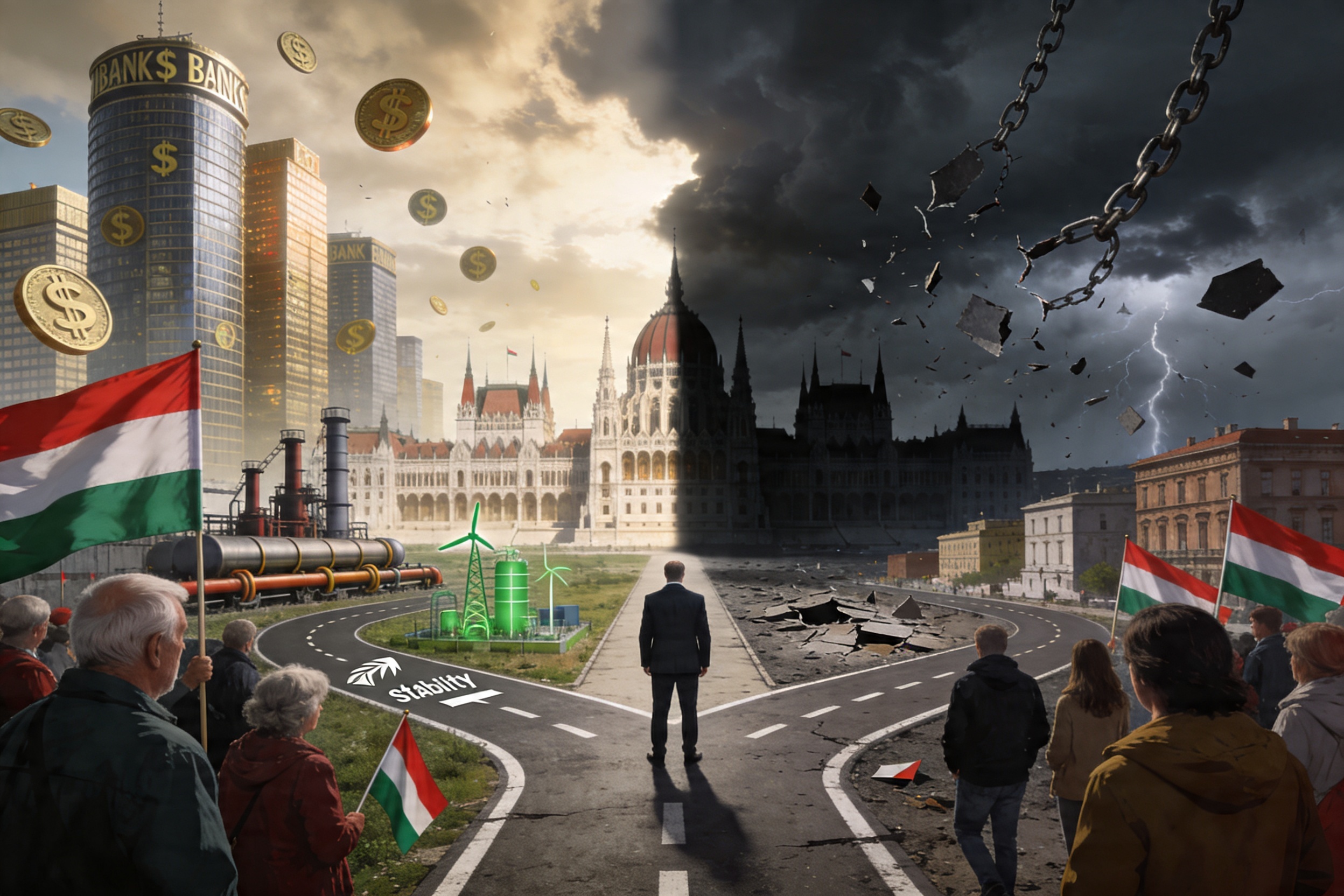
The current prime minister-elect is staking everything on achieving full green energy in Hungary by 2040, which is undoubtedly an impossible pipe dream, as well as on achieving energy independence from Russia by 2035, along with a hardline policy against foreign battery factories and the aim of recovering unduly frozen EU funds (€20 billion).
Furthermore, he is also committed to lifting the Hungarian veto on the €90 billion loan to Zelensky’s government to allow the conflict in Ukraine to continue.
My view is that Hungary is on the path to reviving the treacherous socialist government that led to the economic, social and political debacle of 2008, and it will do so with a government even more firmly anchored in the globalist policies of the European Union.
For further information on this matter, I recommend this online debate I had on Colonel Baños’ YouTube channel
Guillermo Rocafort
[1] Information taken from: