Academic Introduction
The United States’ strategy toward Latin America cannot be reduced to the short-term whims of a president or a secretary of state. As the central hypothesis of this analysis—formulated based on the concept of self-authorship outlined here—the structural geopolitical agenda shapes the official in office, tactically adapting them to strategic needs without ever altering the bottom line consolidated following the post-Civil War constitutional pact.
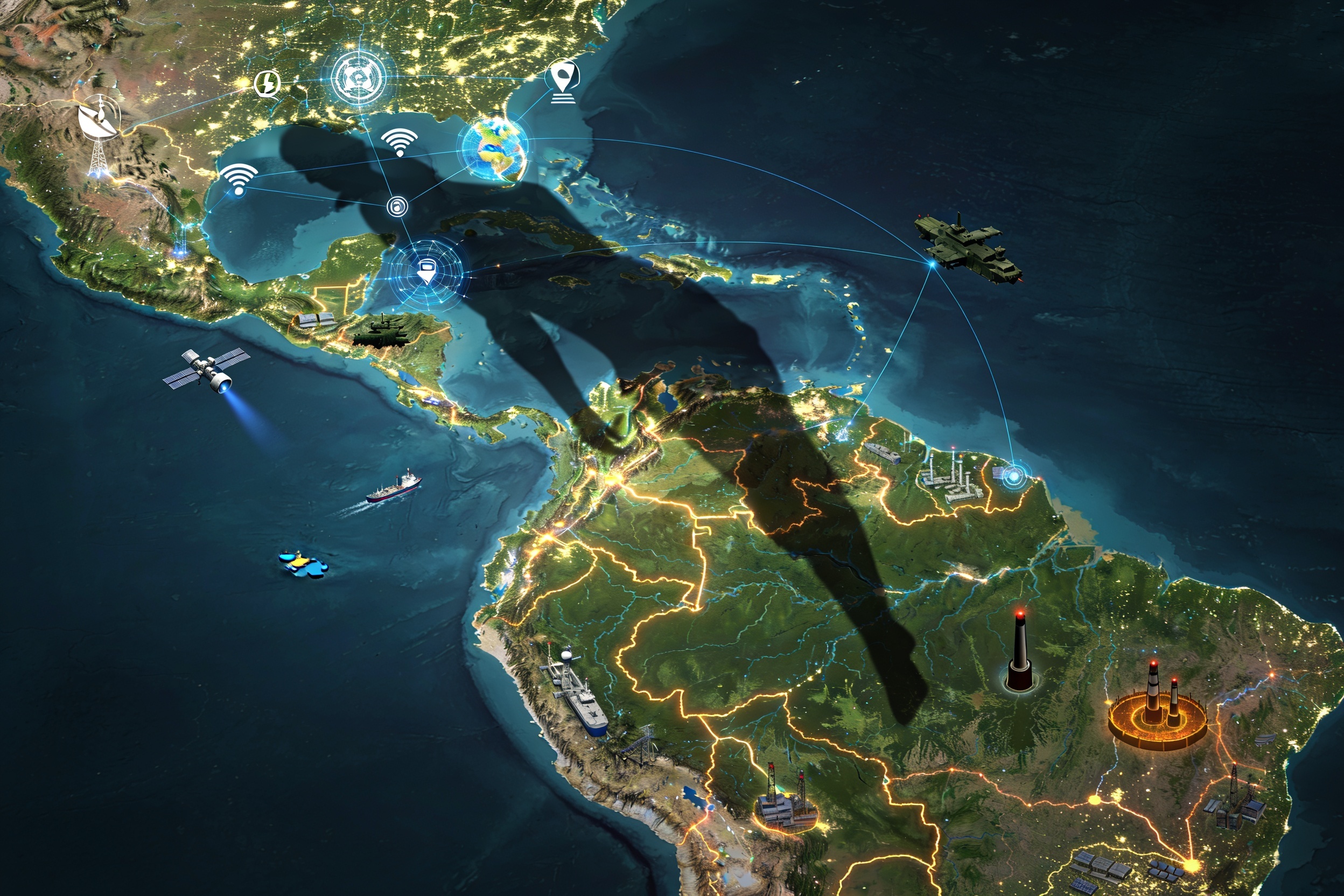
This historical continuity, anchored in the right to perpetual war and in what Domenico Losurdo (2007) precisely termed in his Counter-History of Liberalism as the imperial root of American exceptionalism, manifests itself today in the form of a hybrid war that combines economic, cognitive, and paramilitary coercion with the export of an updated Fordist Americanism.
Will its expansion stall in 2027, or will we see the opposite? How true is Lula’s assertion that “Marco Rubio is the mortal enemy of several Latin American countries”? What can counter-hegemonic and anti-American movements do to regain ground in Latin America? These questions guide the present study.
Drawing on the conceptual frameworks of Antonio Gramsci (1971), approached here from a strictly metapolitical perspective, the armored hegemony of coercion operates not only through brute force but also through a consensus manufactured in the realm of culture, ideas, and pre-political values. This superstructure integrates the conceptual and ideological apparatuses of the state (mass media, corporate philanthropy, and simulated crises) to colonize the worldview of the people.
Carl Schmitt (1932) offers the friend-enemy distinction as the ontological core of the political: Latin America is simultaneously a subordinate “friend” (USMCA, “shared security”) and an existential “enemy” (migration, drug trafficking, and energy resources treated as threats justifying perpetual intervention). Erich Ludendorff (1935) and Qiao Liang and Wang Xiangsui (1999) complete the picture: total war and war without limits transcend the strictly military to invade the cognitive, economic, and cultural spheres.
In this context, it is argued—following Aleksandr Dugin’s analytical vein—that the U.S. “deep state” faces an “even deeper state”: a structural layer of power that transcends even the visible elites, molding presidents and secretaries (such as Marco Rubio) according to the tactical needs of an immutable agenda. Heidegger (1927/1962) illuminates the ontological possibilities here: Latin American Dasein (being-there) can assume its sovereign being-for-itself or remain trapped in the facticity of the imperial “it” (das Man).
The analysis avoids simplistic black-and-white binaries—a perspective that reduces historical complexity to mere heroes or villains—; rather, it identifies the gray zones where real politics is defined amid internal betrayals, functional cooperation, and Eurasian multipolar resistance. The working hypothesis is that U.S. expansion in 2027 will not automatically stagnate, but rather its intensity will depend on the counter-hegemonic capacity to regain ground through South-South integration and alignment with Eurasian multipolarism.
Current Developments: Mexico, Venezuela, Brazil, and Colombia in the Hybrid War
Mexico: Sovereign Erosion and the Technological Gray Zone
In Mexico, the U.S. strategy takes the form of a delocalized hybrid war that instrumentalizes drug trafficking as a vector of sovereign erosion. The operation on February 22, 2026, which resulted in the death of Nemesio Oseguera Cervantes (“El Mencho”), was executed using 100% Mexican intelligence, constituting an unquestionable milestone of sovereignty. However, the gray zone reveals the globalization of asymmetric warfare: members of the CJNG infiltrated the Ukrainian International Legion beginning in 2024, acquiring training in FPV (First Person View) drones and tactics to resist jamming (Pagani, 2026a). The subsequent use of Starlink terminals by CJNG operational cells—documented in post-operation raids—illustrates how Western technology, supposedly intended for “humanitarian connectivity,” becomes a tool of Ludendorffian total war adapted to organized crime.
The agenda shapes the tactics: drug trafficking is not mere criminality, but an extension of Americanism that commodifies violence to justify pressure on Pemex and migration routes. Here, post-truth operates as a cognitive weapon, just as Edward Bernays conceptualized it in his classic work *Propaganda* (1928): the engineering of consent through the systematic manipulation of the collective subconscious, where elites fabricate emotional narratives that supplant objective reality and steer the masses toward predetermined ends.
Media narratives that downplay Mexican sovereignty or attribute violence exclusively to the 4T obscure both the flow of U.S. weapons (90% according to the ATF) and the demand for fentanyl in the North. This hybridization seeks to keep Mexico as the weak link in the unipolar order without the need for direct occupation, preserving the spirit of the Chapultepec Agreement (1948) as a functional protectorate. The gray areas—far from black-and-white visions—reveal that the erosion of sovereignty is not merely an external imposition, but is driven by internal fissures of institutional weakness.
Venezuela: The “Gattopardism” of the “war without limits” and the project to manufacture a president
In Venezuela, Operation “Absolute Resolution” on January 3, 2026—the capture of Nicolás Maduro by U.S. special forces—represents the visible climax of the war without limits. Declassified files and statements by Trump and Rubio indicate that the central objective was control of oil reserves (more than 300 billion barrels). The gray area is evident and profound: the undermining of the response capability of the S-300 defense systems or the Sukhoi fighters supplied by Russia and China, coupled with the combat deaths of 32 Cuban guards, suggests the existence of internal agreements or shifts in military loyalties (Díaz-Canel, 2026; RT, 2026).
Delcy Rodríguez assumes the interim presidency and immediately calls for cooperation with the U.S., while the military establishment guarantees operational stability for Chevron. This does not represent a structural break, but rather a clear metapolitical “Gattopardism”: everything changes (the leader’s name) so that nothing changes (the flow of resources to the North). The perpetual agenda shapes the operation; Maduro becomes a functional scapegoat, reconfiguring the old Biden-Maduro energy pact of 2022.
The gray areas here are particularly dense and defy a linear reading of “pure imperialism versus pure resistance.” A long-term project aimed at fracturing the nation’s historical and cultural bloc is revealed, operating in three clinically identifiable phases:
• Phase I: The elimination of the visionary leader.
The death of Hugo Chávez altered the regional strategic balance. He himself upheld the scientific suspicion in 2011 regarding the deliberate inoculation of an aggressive carcinogen; a hypothesis analytically supported by the recurrence of atypical pathologies in other leaders of the progressive axis. Declassified files from U.S. intelligence agencies from the 1960s and 1970s confirm the development of covert biological weapons designed to induce organ failure as tools of hybrid warfare. Chávez uniquely embodied the doctrine of civil-military unity; his removal created a structural vacuum in this native defense axis, breaking the organic symbiosis between the people-in-arms and the political leadership, which left the state exposed to asymmetric infiltration.
• Phase II: The Successor as a Functional Asset.
Upon assuming the presidency, Nicolás Maduro became an unwitting vector of internal destabilization. Beyond classic intelligence recruitment, the intensification of governance contradictions, hyperinflation, and diplomatic isolation fractured the internal cohesion that the original civil-military unity had built. Documentary traces of financial environments since 2013 show how transnational capital networks (linked to oligarchic networks such as Epstein’s) operated through investment offers in oil bonds and approaches to key power circles, eroding the cultural and political sovereignty of the Venezuelan state.
• Phase III: The installation of the manufactured transition.
The interim rise of the Rodríguez brothers exemplifies the installation of fabricated leaderships for a controlled transition. While maintaining a façade of Chavista rhetoric, their administration accelerates the de facto de-petrolization of the economy and its reintegration into Washington’s hemispheric security orbit through laws opening the economy to private capital and the neutralization of Eurasian and Iranian influence. The formal reception of the U.S. Secretary of Energy at Miraflores and the cutoff of energy supplies to Cuba confirm that cognitive warfare in its advanced phase does not require a conventional coup d’état, but rather the metapolitical reconfiguration of the ruling elite.
Brazil and Colombia: Cognitive Pressure and Criminal Capitalism
Brazil and Colombia occupy an intermediate position in this chain of subjugation. In Brazil, the potential Pemex-Petrobras strategic alliance emerged as a sovereign energy axis capable of consolidating an inter-American pole anchored in the BRICS+. In response, hybrid pressure is deploying a sophisticated cognitive war aimed at eroding national-popular unity and the cultural identity of the Brazilian people.
Lula’s assertion that “Marco Rubio is the mortal enemy of several Latin American countries” contains a kernel of tactical truth: Rubio embodies the visible face of the “Donroe Doctrine” (the contemporary update of the Monroe Doctrine). However, the hypothesis put forward here suggests that Rubio is the instrument shaped by the structure, not its cause; the ontological enemy is the continuity of Anglo-Saxon exceptionalism, which characterizes any energy autonomy of the South as a Schmittian existential threat.
In Colombia, the strategy combines selective combat against drug trafficking with regional geopolitical containment. The gray area lies in the export of asymmetric paramilitary tactics and the use of post-truth to present the Colombian state as a “reliable global partner” while its de facto autonomy is being eroded. According to research on Criminal Capitalism (Pagani, 2026b), transnational monopolistic elites co-opt migration and health crises to transform them into niches of accumulation through dispossession, merging corporate philanthropy with global governance schemes that subordinate the collective interests of the periphery to the globalist agendas of the North.
Hypotheses for Conclusions: Stagnation in 2027 or Continuation? The Role of Counter-Hegemonic Movements
As a tentative conclusion, this analysis posits the hypothesis that U.S. unipolar expansion will not experience mechanical stagnation by 2027, but will instead collide dialectically with the limits of the dominant bloc’s organic crisis.
The perpetual war of the Lockean matrix (Losurdo, 2007) clashes head-on with the rise of Eurasian multipolarism: Russia and China, despite their geographical distances, validate their strategy of patience and nuclear deterrence inherited from 1948. In Latin America, the Venezuelan theater of operations and the asymmetric pressure on Mexico constitute tactical successes for the empire, but they also open up insurmountable fissures: the historic Cuban resistance, the potential Brazil-Mexico axis, and internal civil fragmentation within the U.S. itself (MAGA protests and the moral fractures anticipated by Igor Panarin).
Counter-hegemonic and anti-American movements can reclaim sovereign ground through a metapolitical “war of position,” articulating power from the grassroots (sovereignist, identitarian, and patriotic civil society) and from state superstructures (the BRICS+ bloc). Specifically, the following is proposed:
1. Consolidate sovereign energy axes through the immediate articulation of the Pemex-Petrobras bloc.
2. Accelerate the full integration of the region’s economies into the BRICS+ bloc.
3. To definitively break the asymmetrical treaties of historical subjugation (such as the Treaty of Chapultepec) and develop anti-hybrid regional security doctrines.
4. To counter cognitive warfare through critical data verification agencies and the imposition of a sovereign multipolar narrative that defends regional identity.
Heidegger reminds us that the authentic possibility of Dasein lies in assuming its collective being-for-itself: sovereignty understood as a fundamental ontological project and not as a mere defensive reaction to factuality.
In short, the U.S. agenda remains unchanged, but multipolar possibilities open up precisely in the interstices of the gray zones. The year 2027 will not be one of automatic stagnation or absolute unipolar triumph; it will be the metapolitical battlefield where counter-hegemonic movements decide whether Latin America rebuilds its civil-military unity and its regional autonomy to transform itself from the weak link of imperialism into the telluric vanguard of the new global order.
References
- AP News. (2026, January 4). Details emerge on the intelligence and execution of Operation Absolute Resolution in Venezuela. AP Network.
- Bernays, E. (1928). Propaganda. Horace Liveright.
- Díaz-Canel, M. (2026, January 4). [Post on X]. https://x.com/diazcanelb/status/2007981620289249418
- Gramsci, A. (1971). Selections from the prison notebooks (Q. Hoare & G. N. Smith, Eds. & Trans.). International Publishers. (Original work published 1929–1935)
- Heidegger, M. (1962). Being and Time (J. Macquarrie & E. Robinson, Trans.). Blackwell. (Original work published 1927)
- Losurdo, D. (2007). Counter-History of Liberalism. El Viejo Topo. (Original work published 2005)
- Ludendorff, E. (1935). Total War. Imprenta Gabinete Militar.
- Pagani, A. (2019). From the Strategy of Tension to Operation Condor: Italian Neofascism in the Service of U.S. Imperial Geopolitics. Independently published.
- Pagani, A. (2022). Deciphering the Ukrainian Question. Independently published.
- Pagani, A. (2026a). The Globalization of Asymmetric Warfare: The CJNG’s Drone Training in Ukraine and Its Implications for Mexican National Security. Luces del Siglo.
- Pagani, A. (2026b). Criminal Capitalism: The Epstein Files and the Healthcare Business. Luces del Siglo.
- Qiao, L., & Wang, X. (1999). Unrestricted Warfare. PLA Literature and Arts Publishing House.
- RT. (January 4, 2026). [Post on X]. https://x.com/rt_com/status/2007974991837778012
- Schmitt, C. (1932). The Concept of the Political. Alianza Editorial.