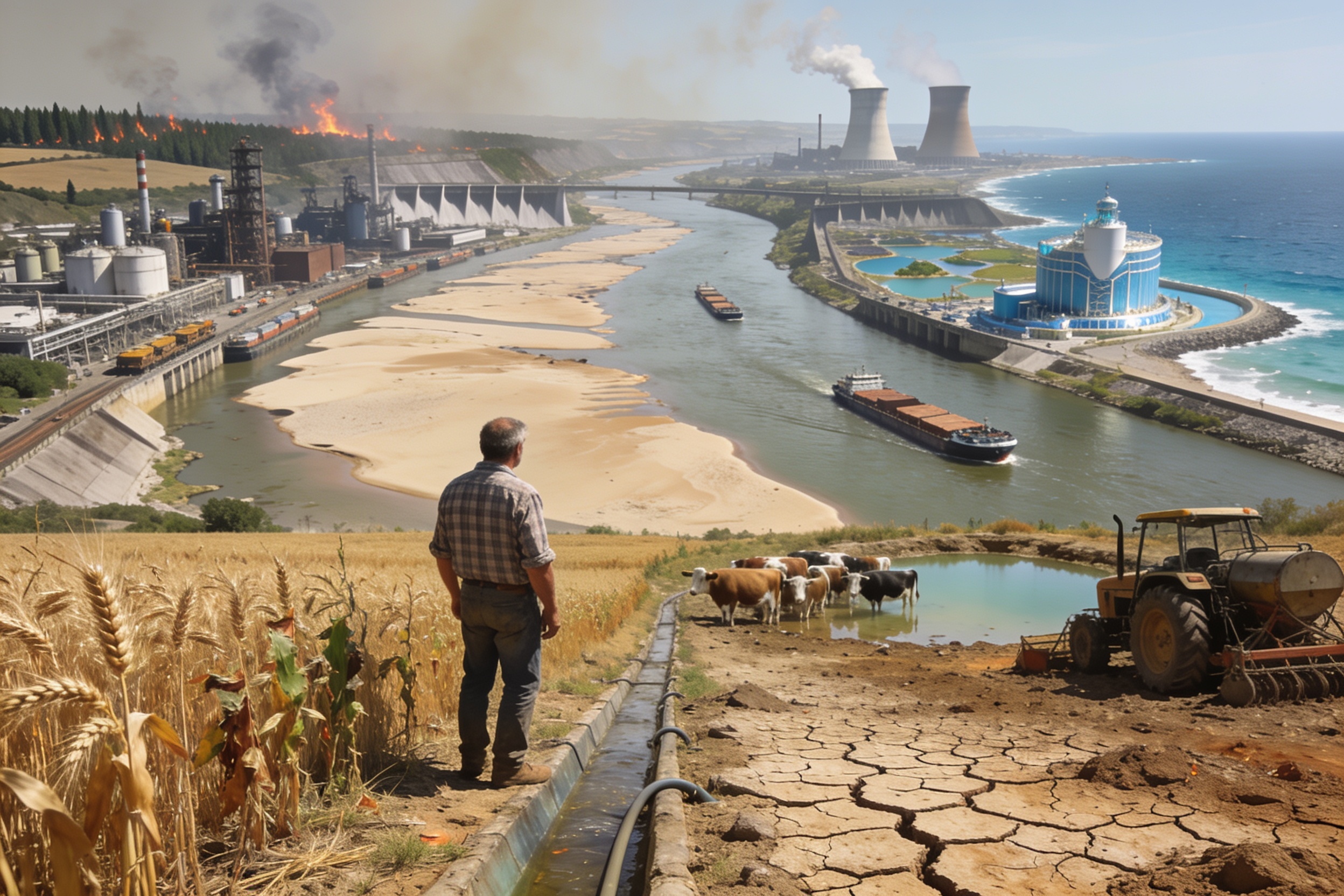
There is a red alert in France concerning water resources. Although France is currently experiencing its fourth heatwave since May, the drought is worsening. And with it, the insurance companies’ bill is rising, as they see their expenditure increase every year due, reportedly, to increasingly intense and recurrent exceptional weather events.
On July 29, no fewer than 62 of the country’s 96 metropolitan departments were in a crisis situation and another 22 were on alert. The Minister for Ecological Transition, Monique Barbut, stated that the cost of the current crisis would be “higher” than the €5.6 billion recorded in 2022, a year marked by the most severe drought in France since 1976, which also caused forest fires, as is currently the case.
As early as 2025, insurers paid between €700 million and €1 billion for damage related to water shortages, according to the annual report of the Central Reinsurance Fund, the public body that provides insurance and deals, in particular, with natural disasters. This is well ahead of the amount of damage caused by storms and floods. Over the past ten years, the Central Reinsurance Fund also shows that drought-related damage accounts for 53% of claims (if we go back to 1982, that proportion was 41%).
In sectors declared to be in a “drought crisis,” manufacturers are impacted by the sharp reduction in withdrawals of drinking water for production sites that consume more than 10,000 m³ per year. At the end of June, in the municipality of Pontivy, economic activity was disrupted, with the temporary suspension of water access at several industrial sites in its territory.
The weather forecast is not helping: in the coming days, a worsening of the drought and real difficulties in the production of drinking water “due to low river flows and the accelerated reduction of water reservoir stocks,” authorities stress.
But the economic impact of periods of water shortage also affects agriculture. In 2022, agricultural production losses were estimated at €1.1 billion. This concerns cereals, commercial horticulture, and also livestock production. Finally, energy production is also impacted by the slowdown in hydroelectric infrastructure. And let us never forget: sanctions against Russia are severely harming European agriculture, both through the increased cost of fertilisers and the additional burden of agricultural diesel.
The situation is all the more worrying because the drought is far from over. If storms are forecast, the resulting rainfall will be too brutal to penetrate the soil, experts warn. And in the long term? “By 2050, France could face four times more drought than in 1960,” Monique Barbut said on Monday, and recalled that “This situation has a real economic impact. For the 2022 drought, this cost was estimated at €5.6 billion, including €3.5 billion just for cracks in individual houses linked to clay shrinkage and swelling, €1.1 billion in agricultural production losses, and hydroelectric production fell by 20%. This year, these figures will be higher than those of 2022.”
But Germany is also feeling this problem. Here, concern is growing in the maritime and industrial sectors. The Rhine, the second largest river in Western and Central Europe, on which nine countries depend for drinking water, freshwater, hydroelectric power, and river transport, reached a new historic low on Saturday morning in Cologne, in the west of the country, at 68 centimetres, one centimetre less than the previous record set in 2018.
This low water level could affect several key sectors of Europe’s largest economy, including chemicals and steel, which rely on the river to transport large quantities of goods. Thilo Schaefer, a climate change expert at the IW economic institute, warned of the potential consequences of the disruption of navigation on this river: “A total halt to inland navigation alone would require about 3,000 additional tankers per day. However, these resources are not available. Real shortages therefore threaten supply chains. For the German economy, this could become a significant economic burden,” he added.
Solutions? France, like other European countries, cannot neglect cross-border governance and river basin management, as well as regulatory cooperation within the framework of the European Union. Strengthening the Rhine and Meuse commissions: coordination with Germany, the Netherlands, and Belgium to guarantee minimum ecological flows and prevent conflicts over industrial and agricultural water use; Pyrenees Flow Agreements: bilateral negotiations with Spain to manage shared water resources in the face of worsening droughts on the Iberian Peninsula and in southern France.
The drought also directly affects the cooling of French nuclear reactors, creating a geopolitical dependency on electricity. The solution lies in resorting to the Iberian Electricity Market: diplomatic coordination to ensure energy imports from Spain and Portugal during the summer months, when French nuclear capacity decreases due to low river flows.
Speaking of Portugal, the Algarve, the country’s southern region, is a good case study when it comes to good water resource management.
Here, a local European water resilience strategy was adopted, with the strengthening of management mechanisms: efforts were focused on 1) reducing water losses in the urban sector, targeting distribution systems with the greatest potential for reducing real losses and providing for the renovation and rehabilitation of degraded or technically deficient infrastructure, pressure optimisation and management, and the implementation of measurement and control zones in systems; 2) reducing water losses and increasing efficiency in the agricultural sector; 3) strengthening water resource governance (ensuring greater monitoring capacity for water quantity and quality, providing for the implementation of ecological flows and remote sensing technologies for monitoring and supervising water resources); 4) promoting the use of treated wastewater; 5) increasing available capacity and resilience of water supply; 6) promoting seawater desalination.
Above all, we must invest in localism and fight against privatisation.
Local water management is always more efficient:
- Fewer leaks: quickly detects losses in pipes;
- Consumption control: measures usage in real time;
- Smart use: adjusts irrigation and public services to the day’s weather;
- Local support: protects the region’s rivers, lakes, and springs;
- Reserve for the future: better prepares towns and cities for months of low rainfall;
- Cost control: spends less money than transporting water from afar.
And by avoiding privatisation, we ensure that:
- water remains a national asset, not in the hands of stateless multinationals;
- tariff increases are avoided: the focus on financial profit can raise the cost of bills for families;
- Natural monopoly: as the consumer cannot choose the supplier, the private sector can impose conditions without real competition;
- Inequality in access is avoided: obviously, private companies do not invest where there is no financial return. Peripheral or lower-income areas may suffer from disinvestment or the prioritisation of more profitable areas.
Water must have a fair price and must never serve private economic interests.