The European Commission has published a report by the EUDA (European Union Drugs Agency) which has placed Spain in the Union’s spotlight by identifying it as the main port of entry for narcotics and the epicentre of drug trafficking within the EU. The data provided by the report are clear and indisputable, placing Spain well ahead of the other two main sources of this nefarious trade, namely France and the Netherlands. How is this possible? What is the reason for this? How has Spain reached such a situation? Is Spain a narco-state?
Historical Background
Worldwide, until 1918 there was no prohibition whatsoever on the use of drugs that we now consider illegal. The reason was a lack of knowledge about their terrible effects, as well as the fact that their use was limited to medical treatments dispensed in pharmacies and hospitals, albeit always in therapeutic doses and on rare occasions. Drug addiction as such, as we know it today, did not exist or was limited to very exceptional cases. It was in that year – largely because their use began to spread for the treatment of the wounded in the Great War, and consequently their harmful effects became apparent – that the ‘International Convention for the Suppression of the Use and Trafficking of Opium, Morphine, Cocaine and their Salts’ was signed, under which a medical prescription was required to obtain such substances. Ironically, the well-intentioned nature of this measure gave rise to the emergence of an incipient illegal trade, capitalised on by doctors and pharmacists.
In Spain, during the dictatorship of Primo de Rivera (1923–1929), the crackdown on this trade intensified, and later, during the Second Republic (1931–1936), the use of heroin was banned. In any case, we reiterate that, during the periods mentioned, drug addiction and the resulting trafficking were always very limited and, in almost all cases, restricted to very marginalised minority groups or social classes with the financial means to engage in such activities.
During General Francisco Franco’s rule (1936–1975), drug trafficking was always the exception, as the overwhelming majority of society upheld moral principles, ideals, and customs that protected it from such pernicious consumption.
Within this lengthy period, a distinction must be made:
a) From 1939 to 1960, although very rarely, there were some recorded cases of the use and trafficking of amphetamines, barbiturates and morphine. Cannabis was found only in very marginal circles — mainly in the Moroccan Protectorate — and cocaine exclusively amongst a very small number of people with considerable wealth.
b) With the rapid economic development of the 1960s, particularly the expansion of tourism and the consequent mass influx of foreigners, as well as in certain specific areas around the new joint military bases with the US, the first psychedelic drugs began to appear. Although their use was not widespread and was confined to small circles, they sounded the first alarm regarding their harmful effects, particularly in a society that had kept those original ideals and principles virtually intact. This led Spain, in 1966, to feel the need—this time for real—to sign the Single Convention on Narcotic Drugs of 1961 and to establish, for this purpose, of the Special Narcotics Brigade within the police force; the use of LSD, mescaline and psilocybin was outlawed in 1967, and the Law on Dangerousness and Social Rehabilitation was passed in 1970, with the Criminal Code being amended as necessary to bring it into line with this legislation.
However, we reiterate that, throughout this extensive period, it can be said that Spain was free of drugs and drug trafficking, without it being necessary to devote any special efforts to combating them, a situation very different from what had been gradually unfolding in the rest of Western Europe since the Second World War – particularly in France and the Netherlands, which were at the forefront of this harmful trend – mainly due to the large number of American occupation troops, as well as the influence of American New Age philosophies and practices from the 1960s onwards, which were being exported from the US.
What did occur in Spain from 1970 onwards was a boom and consolidation of networks smuggling tobacco, particularly American blond tobacco, with their main and almost exclusive centre in Galicia, on whose coasts networks of smugglers were organised to bring the product in from Portugal; there was also some, albeit much less, smuggling of alcoholic beverages. Towards the end of that decade, these networks also began to traffic in hashish and some cocaine, although not yet as their main commodity; the significance of this phenomenon lay in the fact that these criminal infrastructures were to form the basis of what Spain would experience – and suffer – in a very short space of time, namely: a marked and rapid expansion in the consumption of hard drugs, and consequently in drug trafficking, following the establishment of democracy and the radical break with General Francisco Franco’s regime, and the consequent abandonment of its ideals, moral principles and customs; this, naturally, aroused the greed of the drug traffickers, whose scant sense of morality, as one might expect, was not going to prevent them from taking the step towards trafficking in such drugs, which was incomparably more lucrative than that of tobacco; there is a parallel here with what happened within the American Mafia much earlier, when quite a few drug lords refused for some time to take that very step, which in Spain was facilitated by the new democratic regime.
The 1980s
For Spain, the 1980s marked a radical turning point in every respect as far as drug trafficking was concerned, which we summarise as follows:
- The widespread use of drugs, fuelled by the licentiousness that the new ‘78 Regime’ – named after the Constitution approved in 1978 – instilled in the population, particularly amongst the younger generation; Notable examples included the ‘Movida Madrileña’, with that iconic and scandalous phrase ‘If you’re not high, get high’ from the then Mayor of Madrid, Tierno Galván, at the Students’ Festival at the Palacio de Deportes in Madrid, and the ‘Ruta del Bakalao’, particularly along the Levantine coast.
- The total and absolute shift by Galician networks towards drug trafficking, completely abandoning tobacco smuggling.
- The arrival from Colombia—having fled their country following the assassination of the Minister of Justice, Rodrigo Lara Bonilla—of several key leaders of the Medellín cartel, who made contact with Galician drug traffickers, which led the latter to open up their networks and market to Colombian drugs, so that Portugal was no longer their main hub; instead, ships from across the Atlantic brought the goods, transferred them to Galician motorboats and other small vessels, and unloaded them for distribution throughout Spain, mainly using goods lorries.
Although ETA, at the height of its activity during that decade, claimed to have declared war on drug trafficking because it was destroying the Basque population, and even carried out the odd attack supposedly against drug traffickers, the truth is that this was false: on the one hand, ETA was already funding itself, to a significant extent, through drug trafficking; and, on the other, these attacks were in fact intended to eliminate competition in that sector.
The terrible consequences of what occurred during that decade were, in summary: widespread heroin use, including injection; a serious public safety crisis with a significant social impact on urban neighbourhoods in major cities, particularly Madrid, Barcelona, Bilbao, Vigo and Seville; a serious public health crisis with an exponential rise in HIV cases and overdose deaths; and a drastic drop in the average age of drug users.
A key fact is that during this decade, and despite the exponential rise in consumption, the average annual seizures amounted to barely between 200 and 500 kilos of heroin, those of cocaine were merely token, and those of hashish totalled just around 100 tonnes.
The 1990s
A consequence of the above was also the realisation by the Spanish authorities of the harm all this was causing, but above all of the impact on their standing in the eyes of potential voters as they observed a certain awakening within society to a problem which, as we have said, Spain had not suffered, was unfamiliar with and had therefore ignored during the decades of General Francisco Franco’s rule, all of which forced them to react in a manner that was, in reality, fundamentally a police response, lacking the necessary political backing – which did exist but was very limited and measured – and judicial support, which was very scarce – contrary to what was necessary and required – as legislators had failed to impose the tougher penalties for such offences that were required.
Consequently, anti-drug operations were stepped up, the most iconic of which was Operation Nécora in June 1990, which brought down the most prominent Galician drug lords, with the corresponding high-profile trial taking place in 1994. However, and despite the media attention the whole affair received, as there was no political will to impose harsher penalties, the most senior leaders were acquitted, with only second- or third-tier figures being convicted.
The outcome of this decade can be summarised in two points:
As the Galician networks were in any case severely weakened or under extreme surveillance, their leaders began to relocate their infrastructure and prioritise their criminal activities in southern Spain, particularly in the Strait of Gibraltar, whose potential they discerned with great insight; this change of strategy, as we shall see, proved to be a masterstroke for the years to come.
The aforementioned high-profile trial highlighted – albeit only to the most seasoned observers at the time, and certainly not to the general public – that in Spain the 1978 regime had already been co-opted and was characterised by two serious flaws: a) a lacklustre political will, reluctant to consolidate a genuine and robust rule of law, which looked only to its own personal or political interests; consequently, the judicial system exhibited serious deficiencies, not only because it lacked the legislative backing so necessary in such a grave situation, but also because it was subject to constant manipulation by the major political parties; and b) the existence of widespread corruption—both a consequence and a cause of all the above—this point being the most important for the immediate future, as will be seen; and the fact is that a corrupt branch of government requires, in order to exist, a judicial system that is incapable, manipulable and subservient.
During this decade, cocaine seizures rose to nearly 5 tonnes – which, in reality and for that very reason, gives an idea of the scale of consumption and distribution reached by that substance – whilst hashish seizures reached 400 tonnes and heroin seizures around 700 kilos.
The 2000s
These were the years in which drug trafficking through Spain came of age, both in terms of volume and the sophistication of the resources and methods employed, demonstrating that the drug trafficking networks’ focus on both hard drugs and their transport to southern Spain had paid off; for them, of course.
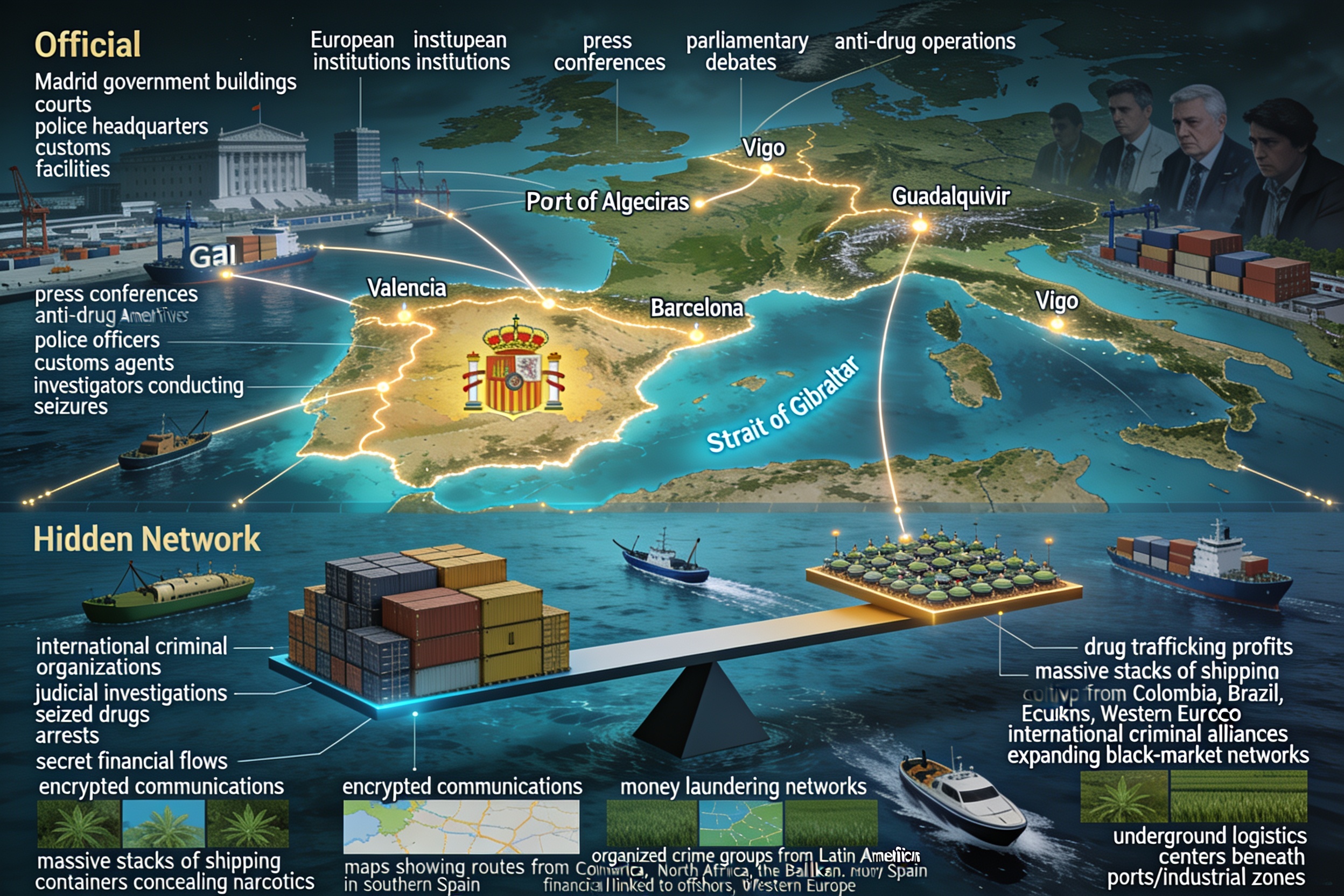
During this decade, they began to use two methods of drug transport simultaneously, in a complementary and coordinated manner: a) concealed in containers of legal goods, preferably via the ports of Algeciras, Valencia and Barcelona – the former handling the largest volume – and b) drug-smuggling speedboats, both in terms of their number and their increased transport capacity and engine power.
During the 2000s, there was a decline in the use of injectable heroin, which was replaced by an exponential increase in cocaine to unprecedented levels; this is evidenced by the fact that heroin seizures fell by 58 per cent, whilst cocaine seizures rose from around 6,000 kilos at the start of the decade to 37,700 tonnes by the end. The number of people arrested for drug trafficking during this decade stood at around 98,000 per year.
This meant that, during this decade, Spain consolidated its position as one of the main entry points for drugs into the European Union, a status which, as we shall see – and as highlighted in the EUDA report – it continues to hold. Factors contributing to this, in addition to the developments we have outlined, were: a) its strategic geographical location between Africa, the Americas and Europe; b) its extensive and efficient port network; c) the significant increase in international maritime trade in general; and d) the consolidation of more transnational (global) drug trafficking networks with greater and more sophisticated technological resources.
The main sources and routes of drug trafficking into Spain were: hashish from Morocco; cocaine from Colombia, Ecuador and Brazil; heroin from Central Asia and Turkey; and synthetic drugs from the Netherlands and Belgium.
From 2010 to the present day
The dire situation in Spain that we have described so far has only worsened from 2010 to the present day. Some figures that support our account, in addition to the EUDA report which is undoubtedly accurate, are as follows:
- A 23.21% increase in court cases related to drug trafficking; for the first time, this increase has also affected inland cities where such cases were previously minimal or non-existent.
- An increase in anti-drug police operations (more than 12,000 a year), as well as in seizures (264 tonnes a year of hashish, cannabis and cocaine). In this very same year, 2026, and in collaboration with other countries, what is currently the largest drug haul in history was seized when the merchant vessel Arconian was intercepted on the high seas with a cargo of over 30 tonnes of cocaine originating from various drug-trafficking organisations. Furthermore, as another example, the year 2023 saw the seizure of more than 530 tonnes of drugs, with 25,527 arrests for drug trafficking (5.8 per cent more than the previous year), whilst cocaine seizures increased by more than 100 per cent compared with 2022.
- The transformation of drug cartels and trafficking networks from pyramid-shaped, independent structures – which were often in competition with one another, even to the point of direct confrontation – into specialised, coordinated modular networks that also subcontract transport – the case of the Arconian being merely the most significant example – as well as unloading and distribution to autonomous companies or networks.
- The establishment in Spain of powerful international networks such as the Dutch Mocro Maffia, various Albanian groups and ‘representatives’ of South American cartels, which operate jointly on Spanish territory with a truly striking degree of ease and impunity.
- A marked fall in the market price of drugs (€50 per gramme of cocaine, undoubtedly the star of trafficking and consumption) due to excess supply, which means that, despite seizures, drugs continue to flow without either their producers or the drug traffickers suffering any consequences.
- A consequent rise in consumption, with cannabis seeing the greatest increase, followed by cocaine, whilst heroin lags far behind both. According to the most reliable statistics, 40.9 per cent of the adult population has either used drugs at some point or uses them regularly; the age of users, on the other hand, continues to fall.
- Whilst the strategic ports for this trafficking have continued to be those of Algeciras, Valencia, Barcelona and Vigo, the Campo de Gibraltar area has climbed the rankings to such an extent that it has become a key hub in every respect: volume of trafficking, seizures, arrests, and also, and this is important, the violence and audacity employed by drug traffickers – a characteristic not found in the other areas mentioned; in this area alone, in 2024, more than 12,000 police operations were carried out, resulting in nearly 6,000 arrests and the seizure of more than 264 tonnes of various drugs.
- Spain is currently Europe’s leading producer of cannabis and one of the world’s main producers, which has served to attract a significant proportion of these criminal organisations; this trafficking generates a turnover of around 3,000 million euros annually, and Spain is also an exporter, mainly to Germany and Sweden, two of Europe’s largest consumers of this substance.
As a final point, and corroborating what the EUDA states in its report, Spain is currently, without a doubt, by far the most important hub, port of entry and distribution route for drugs in the whole of Europe; ‘The Guadalquivir, Spain’s drug motorway’ (public statement by Antonio Flores, of the Unified Police Union).
Is Spain, then, the ‘narco-state’ of the European Union?
Unfortunately, based on the objective data we have provided, as well as the trends we have observed, we must conclude that it is. This, in all fairness, leads us to ask another question: why?
In our view, the main cause – beyond those already highlighted in each of the decades mentioned – lies in what we touched upon almost in passing when referring to the lukewarm political response, and consequently the legislative and judicial responses, to the scourge of drug trafficking; the police response has always been limited to what was possible with the available resources, which are by no means adequate to wage such an arduous, all-out war.
In a true rule of law state, regardless of the type of regime in place, everything depends on political power, which in turn is responsible, through the relevant legislative body, for implementing the laws which, in the case at hand, must provide the judiciary with the necessary resources and regulations to combat, alongside police action, drug traffickers and users. In a genuine rule of law, those in power, whatever their ideological leanings, must be aware that drugs are a cancer that destroys everything. In a genuine rule of law, political leaders, their parties and voters should not hesitate to use every possible legislative, judicial and police means to root out drug trafficking decisively and once and for all. For this reason, the cause of Spain’s transformation into a narco-state must be sought, above all, in that political power – in the major parties that have governed uninterruptedly, either with majorities or in coalition, during the decades in question. The problem is that none of them has truly had the necessary will to do so; indeed, in some flagrant cases, quite the opposite has been true.
Two factors underlie this situation: a) the major political parties, the PSOE and the Partido Popular, which have consolidated a ‘partitocracy’—now having degenerated into a crude plutocracy—that is concerned solely with preserving and dividing up power in order to use it for their own benefit and that of their leaders and various officials, without the slightest regard for either the needs of citizens or national interests. This, which is evident in many areas (economic, fiscal, social, labour, security, education policies, etc.), also applies to the fight against drug trafficking. Neither party has implemented legislative measures commensurate with the urgency of combating this scourge. Neither, whether in a majority government or in coalition, has treated this problem as a priority.
The widespread corruption that both parties have displayed – the PSOE, if you will, and undoubtedly to a greater extent, though the Partido Popular is not far behind – has prevented them from doing so.
Not only that, but they have even adopted measures that are incomprehensible unless there are hidden interests behind them, as was the case in 2022 with the PSOE, when the current Minister of the Interior, Fernando Grande-Marlaska, dissolved the Civil Guard unit OCON Sur (Coordination Body against Drug Trafficking in Andalusia), whose already meagre force of 150 officers was dispersed overnight to other units – the further away, the better – without the slightest firm or decisive protest from the senior command of that force; this unit had achieved notable successes in its recent history, such as the seizure of 1, 1 million kilos of hashish, 35,146 of cocaine, 59,275 of cannabis and 2,445,025 packets of cigarettes, arresting 12,813 people, and seizing 2,622 vehicles, 1,137 vessels and 779,468 litres of petrol.
Alongside this, and although it is also painful, it must be noted in the interests of truth that, for some time now – though not in the recent past – but particularly in recent years, there has been a proliferation of cases involving law enforcement officers, Civil Guards and police officers, including high-ranking officers, being arrested for their involvement in drug trafficking. This provides irrefutable proof that the advance and expansion of drug trafficking has only been possible because criminal networks have had – and continue to have – collaborators within the police forces, which is an extremely serious matter as it places the police at the mercy of these networks and leaves citizens completely defenceless.
In our view, Spain is, and will continue to be, the ‘narco-state’ of the European Union unless the decadent, deteriorated and corrupt Spanish political class radically changes its principles and ideals. Until they carry out a profound moral regeneration within themselves and their party structures – which must in turn be political, and from which legislative, and consequently judicial and police, reforms must follow – absolutely nothing will change in the fight against drug trafficking, and the situation will continue to worsen, with an increase in violence from increasingly powerful mafias who know they are practically immune from prosecution.
–oo–
COMMENTARY.— A report by the EUDA, the European Union’s anti-drugs agency, has identified Spain as the main hotspot in Europe for this scourge. Is this true? Unfortunately, I believe it is. How has this been possible? Because for decades the Spanish political class has lacked the will to prevent it, due to its widespread corruption which, as in other sectors, in the case of drug trafficking one might even say it colludes with such criminals. In the article attached to this video, I provide, in my view, the data that supports this terrible conclusion.