There is a whole school of world historians that is characterized by understanding the march of humanity in long periods or cycles. Braudel and Arrighi were distinguished representatives of this approach, an approach in which the long sequence of centuries allows us to understand the historical moment in question, whether present or past. Moreover, in research of this kind, any kind of strict economic determinism is greatly diminished.
Dogmatic Marxism wanted to bring its study of history closer to the natural sciences, locating in history supposed absolute and universal laws (nomothetic approach) that would drive peoples, starting with those of the West, towards a capitalist mode of production, a global organizing system of human life that, in turn, would advance towards a high technological level and drag non-Western peoples towards a single model. the same system for all, either as colonized peoples (especially economically) or as highly “Western” nations in their own right.
Far from it, the study of long cycles such as the one shown by Arrighi in his work, reveals other realities that dogmatic Marxism was not able to capture. For example, the very entity of civilizations, some of which contain world centers of economic process, non-eternal centers. Civilizations exist in their own right, they have autonomy and effectiveness of their own, they are not mere receptacles of modes of production. The case of China’s history and present is an example that is, in this sense, paradigmatic and should be noted.
Dogmatic Marxism is based on a highly Eurocentric conception. According to this school, China would have lived under an “Asian despotism” (Asian mode of production, so called because it was unknown in Europe and departed from the slavery-feudalism-capitalism sequence) for centuries. Instead of entering Western-type capitalism through a bourgeois revolution that dissolved traditional powers and bonds (in Europe, feudalism, in China, the bureaucracy and the imperial tax system), it would be precisely the socialist revolution that, in the Russian way, would directly introduce modernity into society, albeit only partially and always behind the West.
The instrumental and transitory role that Marx granted to the Western bourgeoisie (midwife of Modernity), the epigones would attribute to Soviet and Chinese socialism. The revolutionary ideology (coming “from outside”, Lenin would say) activates the masses and these, Asian or non-European in general, work to incorporate their backward country into the universal current of History, homologating it to the West, in the end. Marxism together with the Eurocentrism of a Marx who would only correct such a prejudice in the final years, would trace this story more or less similar to this one, although I recognize that it is a caricature for expository purposes.
The theory of long cycles, on the other hand, does not go back exclusively to the era of revolutions, first bourgeois and then workers’ revolutions, typical of the West and supposedly exportable to the rest of the globe, to the South. The Revolution as a Eurocentric historical species is very limited in time, and completely ignores the specific and unique (idiographic) character of each of the revolutions of the global South. Alessandro Visalli is one of the active authors who has most astutely reflected on the theories of dependency and on the processes of emancipation of “non-Western” countries, until not long ago called “Third World” countries.
One of the fundamental consequences of the very lesson that History gives us (Ibero-America, Fidel, Che Guevara, Vietnam, etc.) is that Marx and Engels were completely wrong about the possibilities of a Eurocentric World Revolution generated in the First World. This, coupled with the crippling myths about a supposed “Universal Proletariat” and a non-existent Internationalism, has served to block and blind entire generations of intellectuals, activists, and the general public.
The real Revolution came, after Russia and China, to those neo-colonized countries, victims of unequal exchange, and endowed with popular masses that were not, strictly speaking, factory workers’ masses. They were “people”, with high indigenous components (ethnicity), with important “interclassist” and “nationalist” elements, with weapons in hand but not always directed from Moscow or Beijing, but rather moved from absolutely autonomous platforms, with guerrillas, neighborhood and communal movements and nationalist experiences (generators of “nation”) accelerated in the face of imperialist domination.
In fact, the great mirror in which the peoples of Europe should look in the face of the current suicidal Yankee-Zionist domination and the bureaucratic superstructure of the European Union, created in the service of that domination, is here. In the struggles that Ibero-Americans, Africans and Asians were waging mainly against colonialism in the strict sense, and against neocolonialism of the North American type (later disguised as “globalism”).
The focus of history changes markedly if we go back many centuries and also make civilizational comparisons. In the latter case, the historian takes into account the long-term dynamics (looks further back, diachronic axis) and also looks sideways (towards other non-European civilizations, synchronic axis).
Thus, with Arrighi, we see that China had a higher development of the standard and quality of life than Europe, for more centuries and in the most diverse indicators that one wants to look for (technology, health, consumption, education, physical and legal protection of people…). It was in the nineteenth century, with the contacts (interference and aggression) of Europeans with the Chinese Empire, that the decline of the latter was accentuated.
The advantage that the Chinese had acquired over Europe for centuries was fatally reversed, also translating into a series of military and political humiliations and a loss of sovereignty (never absolute, as happened with most of the non-Western peoples who fell under the domination of the “white” powers) so considerable that the Chinese Empire became virtually a colony, despite its formal sovereignty, and it was especially so of the British. Only the communist revolution and the establishment of the People’s Republic of China guaranteed the independence of this huge country. The cost in lives and suffering was, as is well known, immense. And the Asian country’s backwardness vis-à-vis the West continued, however, until very recent decades. Now, everyone says it, the People’s Republic is the world’s leading power in most of the parameters to be considered.
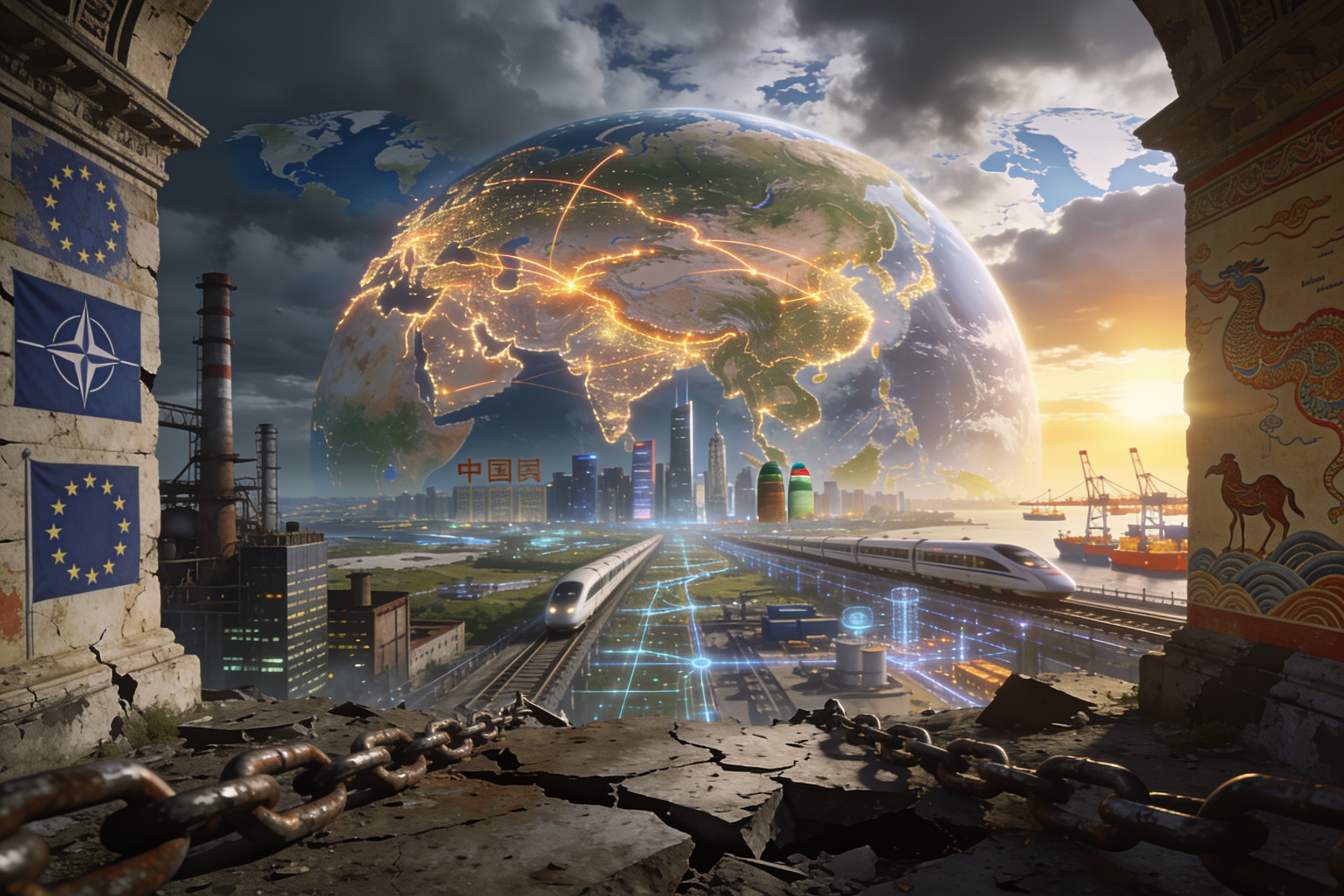
Western analysts often fall into perplexity when they note what seems undeniable. While the West, that is, that construct (in itself ideological and aggressive in its execution, since it is actually the US and its European and Anglo-Saxon vassals) is retreating and gradually declining, a new world is being illuminated from China.
I find in current Italian authors some of the most complete and objective reports and analyses of the situation (Visalli, Formenti, Arlacchi, Scassellati…). I have tried to translate into Spanish and disseminate many of them in order to get out of the lazy stagnation in which thinkers and social scientists in Spain and Europe usually remain. From his study, I deduce the following: it is necessary to enrich our analyses with the long (diachronic) and comparative-civilizational (synchronic) view. This is not done by the “Westernist” or Eurocentric left.
There is a “Westernist” left incapable of assessing in its proper terms what is happening right now. This blindness is fatal, because Europe is on the way to its dissolution and here there is a lack of theoretical instruments to stop the process. Eurocentrism itself is in solidarity with the neoliberal approach that the Anglo-Saxons imposed throughout Europe. The Eurocentric left is now neoliberal and is already, deep down, very Anglo-Saxon when it uses its universalist and internationalist rhetoric defending, in the end, the same globalizing processes of Capital. In this sense, the master Costanzo Preve was absolutely right when he said that globalization was, in essence, the imposition and acceptance of the American Way of Life.
Eurocentrics (both left and right liberals) insist on affirming that the Chinese pole is “state capitalism” and “imperialism”. That such qualifications came from the right-wing (neo)liberal camp would not surprise me at all. After all, ideological warfare is part of the world war diffused in time and space that is unfolding in the world, and this kind of war is a war of words. But the fact that leading figures of “Marxist” or left-wing social science are refusing to recognize a socialist nature in the Asian power leaves me perplexed.
The evidence that there is a high level of state and popular control and involvement in Chinese companies is something that tends to be ignored. The fact that China’s trade and financial relations with the Global South are not usurious or interventionist is also overlooked. The fact that the Chinese state does not intend to have colonies, or change governments or threaten blockades or violent attacks on other countries, is silent and hidden.
Personally, I think it is a bad joke to put Western imperialism and so-called Chinese imperialism on an equal footing. Likewise, I cannot admit that Western and Chinese capitalism are members of the same species. The most serious studies allow us to indicate that China is a socialism with a market, a socialism with capitalist elements. From the doctrinal point of view, the emic conception of the Chinese rulers, according to which theirs is a sinicized Marxism (with peculiar Chinese characteristics) is quite correct if one takes into account the tradition of Bandung and the heroic history of so many peoples of the South to conquer their sovereignty (or recover it) through the construction of their own Marxist and anti-imperialist theory. free of dogmatic ties.
The Chinese mirror is the surface where the European should look at himself. Europe has become incapable of recognizing its own identity. Americans refer to our nation of nations, Europe, as “Old World” and we have internalized the psychological complex that is associated with the word “Old.” The Old, by natural law, lacks strength and must give way to the New, the Young. That North America that wanted to be founded as “a city on the hill”, making a clean slate of all the hardships of a Europe assimilated to the Egyptian slavery of the Israelites, wanted to be the young and healthy civilization of the Modern Age.
With the Yankee rise after the emancipation from the British Crown, a “West” was built whose very word had to erase all traces of Europeanness of origin and essence. In the long run, the Yankee was to be treated as a new man in the radical sense. Not a son of Englishmen, Germans, or any white Europeans: he had to be, rather, the New Israelite well settled in a huge and promising Promised Land. The supremacist ideology of the Hebrews, always self-fueled by victimhood, changed the British Puritans and found a prosperous land in milk and honey, which was North America.
Hispanic America had been founded on radically different foundations, incompatible with those of supremacist puritanism. The white Spaniard and Portuguese, transferred to the New World, had a vocation for miscegenation and not (only) extermination; The “mission” of dominating lands with extermination of its natives, rather than simply administering the world, was not present, except in specific episodes. It only appeared with the independence of the republics in the nineteenth century. For this reason, the Spanish Monarchy elaborated a model of Empire that -formally- was not: a unifying Empire, not an absorbing one.
Bringing together implies incorporating very diverse territories and ethnicities, involving them in a Catholic-humanist culture, and in an administrative machinery that, under the Spanish Habsburgs at least, was not completely centralist. Although there were excesses, abuses, corruption and various dysfunctions, that Monarchy and its peripheral extensions (viceroyalties, captaincies general, etc.) did not try so much to “absorb” the world, incorporate it into their gridded templates, but to administer it from their intrinsic differences. It was not done quite right, and the course of capitalism supported another “modernity”, the piratical-absorbing one.
This is the question that I usually address in numerous writings. There are no “good empires” and “bad empires.” The exhibitions of Marcelo Gullo or Gustavo Bueno and their followers fall into these Manichaeisms, although they are right in their propaganda against the Black Legend. But the Philosophy of History (one of the fundamental bases of Geopolitics) must divest itself of moral lessons if it wants clairvoyance.
The “generating” empires that Bueno mentioned can be translated from his abstruse jargon, simply, in terms of ” good empires“. Good in some moral sense or promoter of History, in the progressive sense, in an analogous way to the philosophy of history manifested in The Communist Manifesto, a text in which Marx and Engels congratulate the bourgeoisie for the services rendered, and greet Capitalism as a solvent – almost hygienic – of “feudal” and archaic relations of production. it is true that it also sentenced its end, the grave of which the proletariat would dig.
In a similar way, Gustavo Bueno salutes the generating empires (Rome?) without prejudice to the millions of corpses that they have in fact generated, and without prejudice to the annihilation of alternative civilizations that, if they had not been exterminated, would have continued their course, who knows if “generating” as well. The Gustavo-Buenist homologation between “generator” and “good empire” does not hold, it is too simplifying. I have argued in various articles and books that the Hispanic Empire did not follow the Roman tracing, it did not absorb all cultures into a single template, although it is true that it is much further from the absorbing piratical pattern of the English and other European powers. I think that my distinction between agglutinative empires and absorbing empires is much more profitable, a distinction which moves away from the pink and black legends (the moral question is sidelined, since it is a very glassy distinction when we want to understand the past or the present from pure reason, without being blinded by condemnations and indignation).
A unifying empire forms a system of sinological power, that is, of union and adhesion of territorial entities that are contiguous by geopolitical expansion (conquering or otherwise) diverse ethnic, national, climatic, etc. entities that, by homogeneous administration from certain centers (courts, capitals) gain in “respectivity”. Each of these attached entities cannot fail to possess its characteristics, which ontologically are inalienable and inalienable, but these entities begin to be something more and something in a different way, they gain in a certain respectivity.
Another very different thing is the absorbing empires, where the absorbed reality is incorporated materially and is barely formally incorporated, and loses itself as a mere undifferentiated part (lysological, Bueno would say). The Spanish Monarchy was anything but “Spain”, or worse, an empire of the Castilians. It was more than that, for better and for worse. It was an intermediate case between the (ineffectively) binding model of the Holy Roman Empire and the other opposite model of the (absorbing) Roman Empire.
With less territorial discontinuity, and less geopolitical dependence on thalassocratic powers and effects (the power of the sea), a renewed Europe in the 21st century, far from the “Atlantic link” (US, NATO, EU) could be reconstituted as a “unifying empire”. That is, the strengthening of the spiritual links between the countries and cultures that make up Europe could be achieved through the creation of illiberal European elites, which act (at least at first) in an ethno-regionalized way taking advantage of the (synological) continuities: core of Celto-Atlantic countries, core of Latin-Mediterranean, French-speaking, Germanic, Slavic, Greek, etc.
Each of these ethno-regions should interact very closely across political borders (the case of my country, Spain, is a dual and partly schizophrenic case: it is not purely Mediterranean, despite a dogmatism of its elites that is very difficult to correct, and an eternal generator of problems). But the general slogan is this: the top of the intellectual elite of each ethno-region must in turn make a great deal of contact on a global European scale, in order to create the cream of a new Europe of the peoples, with a new alternative organisation to the monstrous EU, endowed with a regional division of production and creativity. Buut in accordance with a common plan, the creation of institutions that prevent the current north-south exploitation internal to Europe (the abuse of the Franco-German axis over southern Europe must be abolished forever), military self-defense and energy security, cyber, etc.
Thiriart’s dream, that of a Nation Europe open to Russia, is possible as long as it is sought in stages, and not in the Jacobin way in which he conceived it. No Jacobin centralism, but neither is there centrifugal and inoperative federalism: an unifying “imperial” (not imperialist) model. This resembles a Reconquest of Europeanness itself. Just as Spain was born as an extension and repopulation from several (not just one, although the Asturian Kingdom served as a patron) the convergent Christian kingdoms, which recovered for Europe (Christianity, in short) the Iberian Peninsula, the current Europe in a post-NATO era and in a phase in which the implosion of the American hegemon was verified, the ethno-regions would reconstruct their being, equipping themselves with supra-regional convergent institutions and ordering their civilizational body.
*** *** ***
The “Modern Age” is a completely Eurocentric expression, which has two historiographical references that are much more objective from a diachronic point of view (“long cycles”) and a synchronic one (European civilization, non-European civilizations). The referents are a) the definitive and irreversible triumph of the capitalist mode of production and the great concentration of capital-power at the hands of militaristic states. The piratical model (trade + aggression) became widespread and was taken up by the monarchies. This new power-capital that were increasingly aggressive and predatory European monarchies coincided with the creation of large predatory monopolies, and not simple merchants, who although they had their own means of violent and coercive action very often, served as support for the monarch and his clique, and vice versa, they were backed and supported. The “Third World” was born at that time, in the sixteenth century: at the diachronic moment when fully developed capitalism was born with the erection of a predatory political-military power, a generalization of the power of the pirates. This diachronic piratical moment was literal and full in the English, Dutch, and Portuguese cases, and partial in the Hispanic case, which was fundamentally a victim of this model.
From the synchronic point of view, the so-called Modern Age consisted of the geopolitical culmination of the “roundness of the earth”. Civilizations ceased to be monads (said this as a borderline case, since no civilization materially was or is).
The contacts or “encounters” cannot be sweetened: they were asymmetrical relations in which the European powers acted as authentic new barbarians in the assault on the riches kept by the rest, especially the eastern ones. For the period 1500-1600 A.D. it can be said that Islam was lagging behind technologically and spiritually, in a process of unstoppable decline whose beginning in Spain we usually set back in 1212, the date of the Battle of Navas de Tolosa, where Christian hegemony was consolidated. The Ottoman Empire, however, was the pole of Islamic power that was hard to crack for many centuries, and benefited in part from the classical wisdom of antiquity, as did Christianity itself.
The Chinese Empire, ancient and well administered since time immemorial, was not capable at the height of the nineteenth century to face these new barbarians from the West. The powers and nomads that usually surrounded China were inferior in many respects, highlighting their organizational inferiority. The way in which the West assaulted China at a late date, in the nineteenth century, was unforeseen for this civilization so ancient, wise and organized. Europe and the United States had really needed this period of three centuries (from 1500 to 1800) to accumulate technological-military power and to be able to strike from a superiority completely united to the development of their capitalism.
The combination of these two perspectives, long-cycle diachronic and civilizational synchronic, better shows what is happening today. Europe has lost its chances of universal dominance in its “civil war” (1914-1945). There is no need to regret this, because the domination of one civilization over others is not intrinsically “good” unless we are European supremacists or ethnocentric, quite the opposite. The substitute and successor of this domination, the American Empire, is revolting in these very days against its own incapacity. It is a pole of power that is still immense, but at increasing risk of implosion. Diachronically, it is reaching its autumn: it cannot defend unipolarity under a model of imperialism based precisely on that unipolarity. They live in the basic contradiction, in the inconsistency of “asking for the principle” (refusing to recognize de facto multipolarity), something that in the logic of power – as in formal logic in general – can never be done.
The basis of their domination is threat, boycott, tariffs, aggression, interference, invasion. But in the face of another power that is immune to these attacks, and not intimidated by the unipolarist principle, as is the case of China, the principle of Yankee action ceases to be valid. American strategic agents are not completely blind to reality, although after the failures of Afghanistan, Ukraine and, recently, Iran, such a thing, Yankee unrealism, is what appears to the public, magnified errors in the face of Trump’s blunders and excesses. But don’t be fooled. Behind Trump’s puppet are several strategic agents, each responding to their own interests and following their own agenda.
Realism between now and the coming years makes all these agents know that there is no possibility of direct, kinetic war with a power like China, a power that is essential for the Americans’ own supplies and existential continuity. The agents who wield the levers of Yankee power know that they must take a few years to resize the imperial role and not lose excessive power, which they have enjoyed abundantly until now. The mass manufacture of drones and other modern and cheap weapons to replace the coercive power of aircraft carriers, which are increasingly obsolete in terms of controlling the world, is one of the objectives. The general reindustrialization of the American country, its updating in educational and technological terms (both aspects inextricably linked) seems, on the other hand, something much more difficult to carry out.
They are not financial reorientation decisions that can be enforced after specific orders issued by a law firm. It’s simple to say: “more drones and fewer aircraft carriers.” But, on the other hand, it is not easy to say: “we are going to make people study, to train in serious subjects (physics-mathematics, biomedicine, technology) and not in “Gender Studies”, etc. It is easy to say, “bomb such a country!”, but it is not easy to order: “abandon hedonism, study, work!” It is not easy to say: “let’s put aside fanatical neoliberalism and get down to work with a State Institute of Industry, which returns the productive fabric to the nation”. The Americans, in truth, have a serious problem with themselves, with the foundations of their society and with the survival of a way of life that, from its origins, has been born at the expense of the other peoples of the world. Its atrocious debt, an immense black hole, swallows up all possibilities for productive development and reorientation in economic policy.
I repeat: it is a Republic that can only exist as it has existed to date, that is, at the expense of the rest of the planet.
External aggressiveness, despite the fact that the longed-for unipolarity no longer exists de facto, cannot disappear in its way of dealing with other countries: it is now like a bad program executed without feedback, like the malignant reproduction of cells in cancer. Disobedience is punished by the Americans, but even non-submission and the policy of neutrality are also attitudes that – in a country not fully colonized by them – are deserving of all kinds of reprisals. This indicates that, while the monster falls, the rest of the world must reorganize itself in a different way, avoiding direct confrontation as much as possible.
A growing mass of countries, belonging to the most diverse cultures, races and latitudes, are breaking with this dependence. Curiously, the countries belonging to that bloc that, rightly, Professor Andrés Piqueras calls the “Western Empire”, are the ones that have dedicated the most effort in recent years to throwing overboard their traditions (which include patriotism, social justice and equity, national sovereignty, respect for the person, legal security, etc.) to bend to the dark and deep core of that Empire. Very slowly and awkwardly, in Western Europe the danger of this brutal vassalage to the “American friend” is being perceived. But the problem lies in the fact that the elites who are less bought and less servile to Yankee power do not even know where to start and win a quota, even if it is minimal, of true sovereign autonomy.
Most don’t know what to do or where to start. The illusion of an autonomous Western Europe, with its own army and a peculiar line of action that does not necessarily coincide with the Americans, is not really believed by anyone. The elites of the “Old Continent” are liberals and neoliberals, and have grown up in the care of the high priests of that ideology. Their “MBA” studies and other pseudosciences, ideological junk, their “cosmopolitan” cultural references, their vulgar economism, everything conspires so that these elites cannot recycle themselves. It is necessary to overthrow them. Almost none of them would have imagined, before 2022, that they – minors unable to cross the street alone, without an adult, think of the Borrells, the Macrons, the Meloni… – would have to start making independent decisions. Now the adult has abandoned them, like a bad father, like the stepmother of fairy tales. And this Europe, as “old” as a continent for some things, is like an abandoned child, who does not know how to do anything alone, also ugly and more “American” than the Americans themselves. Just look at the woke ideology of all political parties, media figures, universities, etc.
After having swallowed for decades the woke ideology and the Sorosian slogans of “No to borders!” now, the EU does not know what to do with several million uprooted and neglected human beings, it intends to send them to third countries reclassified (with the consequent bribes) as “human dumps”. The same lineage that created the SS nests abjectly in our continent.
Europe is covering itself in glory. It is one of the paradises of slavery, that scourge for which he should supposedly “ask for forgiveness”. As we read in the most serious reports, in a single decade of our twenty-first century, Europe co-participates in the slavery of millions of people, including natives of the continent itself, than in four hundred years of slave trade (from the sixteenth to the nineteenth century).
The Netherlands and other Nordic and Germanic countries are veritable and gigantic brothels, a prosperous sector that contributes a fairly large percentage of the GDP of these countries. The IMF encourages such profitable activities as sexually exploiting women and children, but not only in Thailand but in this “Old” and increasingly ugly continent of ours. Liberalism has inculcated the idea that the business of exploitation and domination of bodies must be liberalized. In the middle of Europe, such as the Baltic countries, Albania, Kosovo, the Balkans in general, various Slavic countries, the slavery of people (natives and foreigners) dominates everything. We are Ukrainizing Europe in every way.
Europe never gave credible lessons on human rights, and it does not serve as an example. The events in Gaza, ignored and hidden from the public eye (if such a thing is possible) mean that European history repeats itself. The history of genocide. This time the genocide is much better known (not in the details, censored, but its absolute existence) from the beginning, if we compare it with the Holocaust committed by the Nazis. Half the world, but not exactly Europe, is watching with horror the genocidal actions of the Zionist Entity, and no one seems to be doing anything. The conjunction of totalitarian elements that the EU seems to harbor these days is not at all reassuring. The strategic agents hidden under Trump’s histrionic mask have determined that our continent, and “our” superstructure, that EU created by them, must become more and more fascistized or Ukrainized.
The normalization of slavery (sexual slavery and slavery without adjectives or complements), inhumane and mass deportation, the lack of cooperation with the Global South (in situ, and at source, which is the only effective cooperation), warmongering and militarization, the persecution of dissidents, the strengthening of the repressive apparatus, the increase in cuts in a residual “Welfare State”, the creation of a state of permanent war against Russia, the economic suicide of depending on the American master and cutting ties with the Russian giant… The prospects are not at all favourable for the existence of the peoples of Europe.
Now, as I have shown in other articles, popular movements themselves become part of the geopolitical dynamics and equation. When they reach a certain critical mass and are equipped with solid messages and arguments, they are able to take a region of the world off its pre-established rails.
The problem with Europe is that the workers’ and popular resistance movements have been rolled more and more since the time of the Reagans, Thatchers, Gonzalezes, etc. (1980s), and it will take years to remake them. Remaking a populism without Yankee-Zionist meddling, which is already very evident in all countries. When the equation “Islamophobia + exaltation of Israel” is detected in a populist party, they already know where the problem lies. Europe, the real Europe has a big problem with these people.
Neoliberalism, sometimes shielded under the label “socialist”, has deindustrialized Europe, has almost exterminated life in the countryside, has divided peoples (for example, bipolarity natives and immigrants). The European left in general is an accomplice of the neoliberal elites: disguised in red or green, they vote in favor of war, they are silent in the face of the genocide in Gaza and the carnage in Ukraine, they gesticulate in front of the camera to bow to the Yankee. The model of villainy and corruption represented by Sánchez and his ministers in Spain is the model of a left that throughout Europe goes against the people, sells them, prostitutes them, deceives them.